

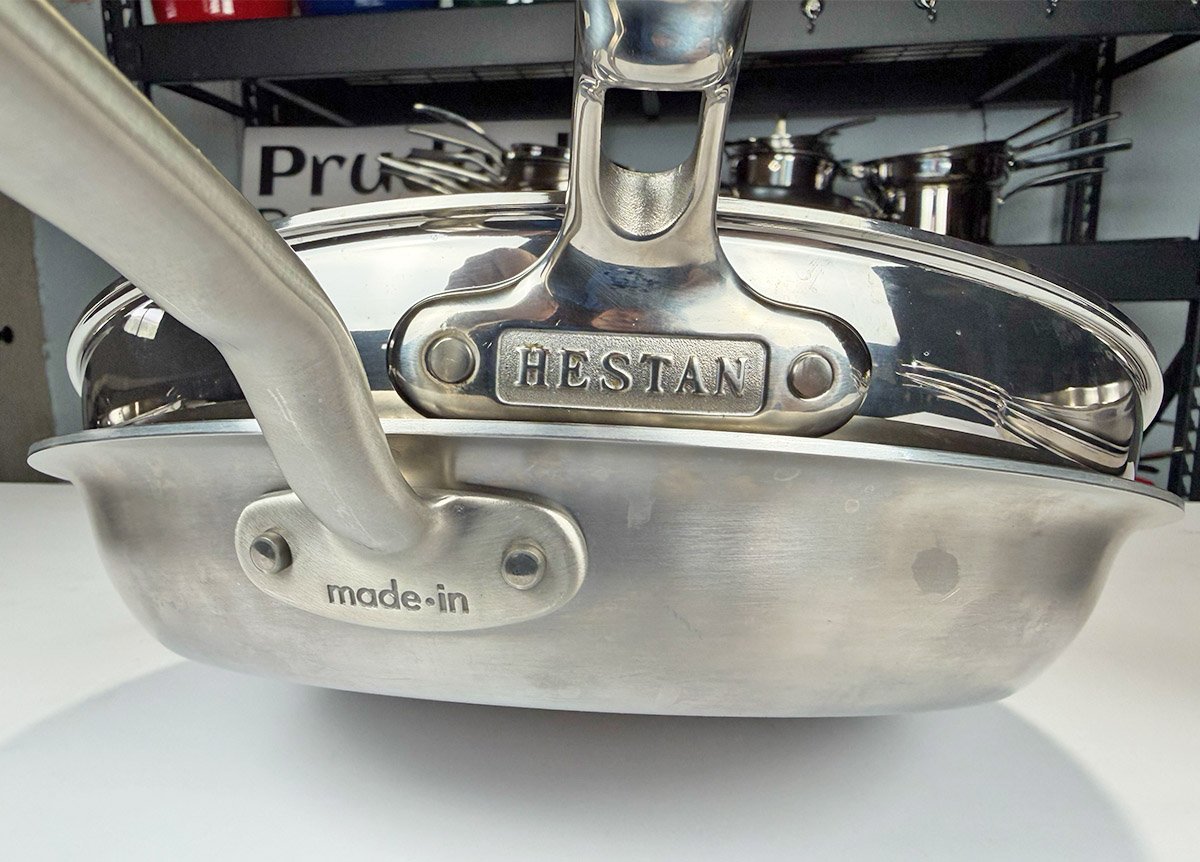
Made In and Hestan are two of the best stainless steel cookware brands on the market.
Both are made in Italy, both are fully clad, and both deliver excellent real-world cooking performance. But they take very different approaches to design, pricing, and construction.
Made In offers a single, well-executed 5-ply frying pan for under $150. Hestan sells four distinct stainless steel collections, with most falling in the $250 to $300 range and its premium options going higher.
I tested all five pans as part of a 31-pan stainless steel frying pan roundup. I measured heat conduction, heat distribution, heat retention, and warp resistance under identical conditions.
In this comparison of Made In vs. Hestan, I break down how each brand performed across my controlled tests and months of everyday cooking.
I also break down the differences across design, performance, and value to help you decide which brand belongs in your kitchen.
Key Takeaways
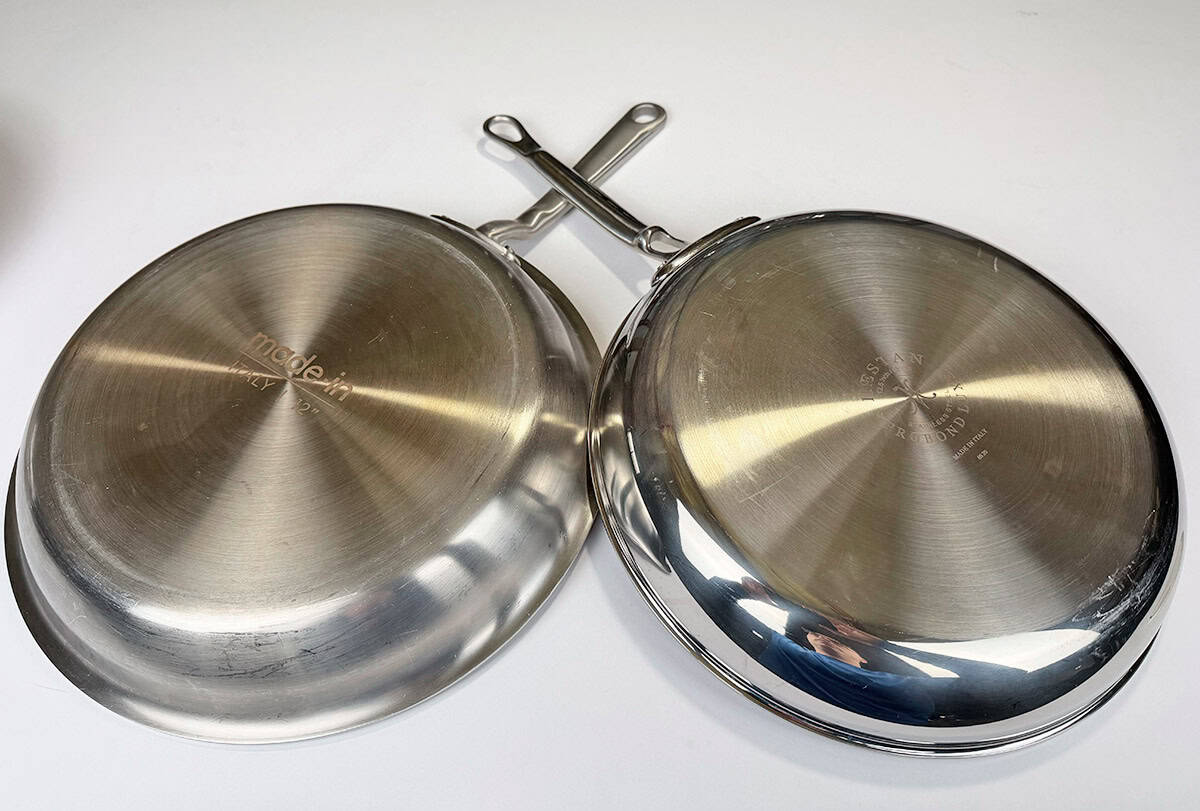
- Made In has the widest flat cooking surface of any pan I tested (10 inches), giving you more usable searing space. None of the Hestan pans match it.
- All four Hestan pans feature flush rivets and three of the four have sealed rims, which are genuine construction upgrades over Made In’s standard rivets and unsealed rims.
- Made In heated significantly faster than every Hestan pan, ranking 2nd out of 31 pans tested. The fastest Hestan (ProBond Luxe) ranked 14th.
- Hestan CopperBond and NanoBond distributed heat more evenly than Made In, with temperature differences of just 19 and 34 degrees between center and edge compared to Made In’s 125 degrees.
- Made In costs less than half the price of most Hestan pans. Whether the Hestan upgrades justify the premium depends on which features matter most to you.
- My recommendation: Made In is the best choice for most home cooks. If you can afford the higher price, Hestan ProBond Luxe is the sweet spot in Hestan’s lineup. And if money is no object, Hestan NanoBond is the best stainless steel frying pan I’ve tested (along with Demeyere Proline).
If you’re ready to buy or want to learn more, Made In is available on MadeInCookware.com and Amazon, and Hestan is available on HestanCulinary.com and Amazon.
Use the links below to navigate the comparison:
- Comparison Chart
- Design and Construction
- Heat Performance
- Features
- Handles
- Maintenance
- Customer Service
- Bottom Line: Should You Buy Made In or Hestan?
Comparison Chart
| Feature | Made In | Hestan ProBond Forged | Hestan ProBond Luxe | Hestan NanoBond | Hestan CopperBond |
|---|---|---|---|---|---|
| Price Range | Under $150 (view current price) | $250–$300 (view current price) | $250–$300 (view current price) | $400+ (view current price) | $400+ (view current price) |
| Construction | 5-ply | 3-ply | 3-ply | 3-ply | 5-ply |
| Core Material | Aluminum | Aluminum | Aluminum | Aluminum | Copper |
| Cooking Surface | Stainless | Stainless | Stainless | Titanium-reinforced | Stainless |
| Flat Surface (in) | 10.0 | 9.5 | 9.5 | 9.5 | 9.5 |
| Weight (lbs) | 3.2 | 3.5 | 3.4 | 3.5 | 4.1 |
| Thickness (mm) | 2.8 | 3.1 | 3.1 | 3.1 | 2.3 |
| Sealed Rims | No | Yes | Yes | Yes | No |
| Rivets | Standard | Flush | Flush | Flush | Flush |
| Exterior | Brushed | Brushed | Polished | Polished | Polished |
| Handle Length (in) | 8.1 | 8.7 | 8.5 | 8.7 | 8.7 |
| Oven Safe | 800°F | 600°F | 600°F | 1050°F | 600°F |
| 2-Min Center Temp | 529°F | 465°F | 472°F | 389°F | 411°F |
| Heat Conduction Rank | 2nd | 15th | 14th | 27th | 24th |
| Center-to-Edge Diff | 125°F | 113°F | 104°F | 34°F | 19°F |
| Heat Distribution Rank | 26th | 24th | 23rd | 8th | 5th |
| Temp After 5 Min | 123°F | 115°F | 122°F | 134°F | 127°F |
| Heat Retention Rank | 25th | 30th | 27th | 12th | 19th |
| Made In | Italy | Italy | Italy | Italy | Italy |
Design and Construction
The Made In 12-inch stainless steel frying pan is 5-ply with an aluminum core, a brushed exterior, standard rivets, and flared rims for easy pouring.

At 13 inches rim to rim, it’s one of the largest pans I tested, and that extra size translates directly into usable cooking space. The interior has a smooth starburst pattern, and the build quality is excellent for the price. There are no flashy design elements, but everything is executed well.
Hestan’s approach is more varied because you’re choosing between four distinct collections, each with its own design. Across all four, you get flush rivets that sit smooth against the cooking surface (easier to clean than standard rivets) and handles with a subtle anti-rotation groove. Every Hestan pan I tested feels intentional and well-crafted.
ProBond Forged has a brushed exterior with a polished accent ring around the top, sealed rims, and a handle with smooth rounded edges. There’s a small gap between the handle and the rim that can collect grease, but it’s a minor issue.

ProBond Luxe swaps the brushed exterior for polished, giving it a sleeker more luxurious look. The handle sits lower and closer to parallel with the cooking surface, which means less clearance needed between oven racks. It also has a tighter connection where the handle meets the rim, so less grime builds up in that joint.
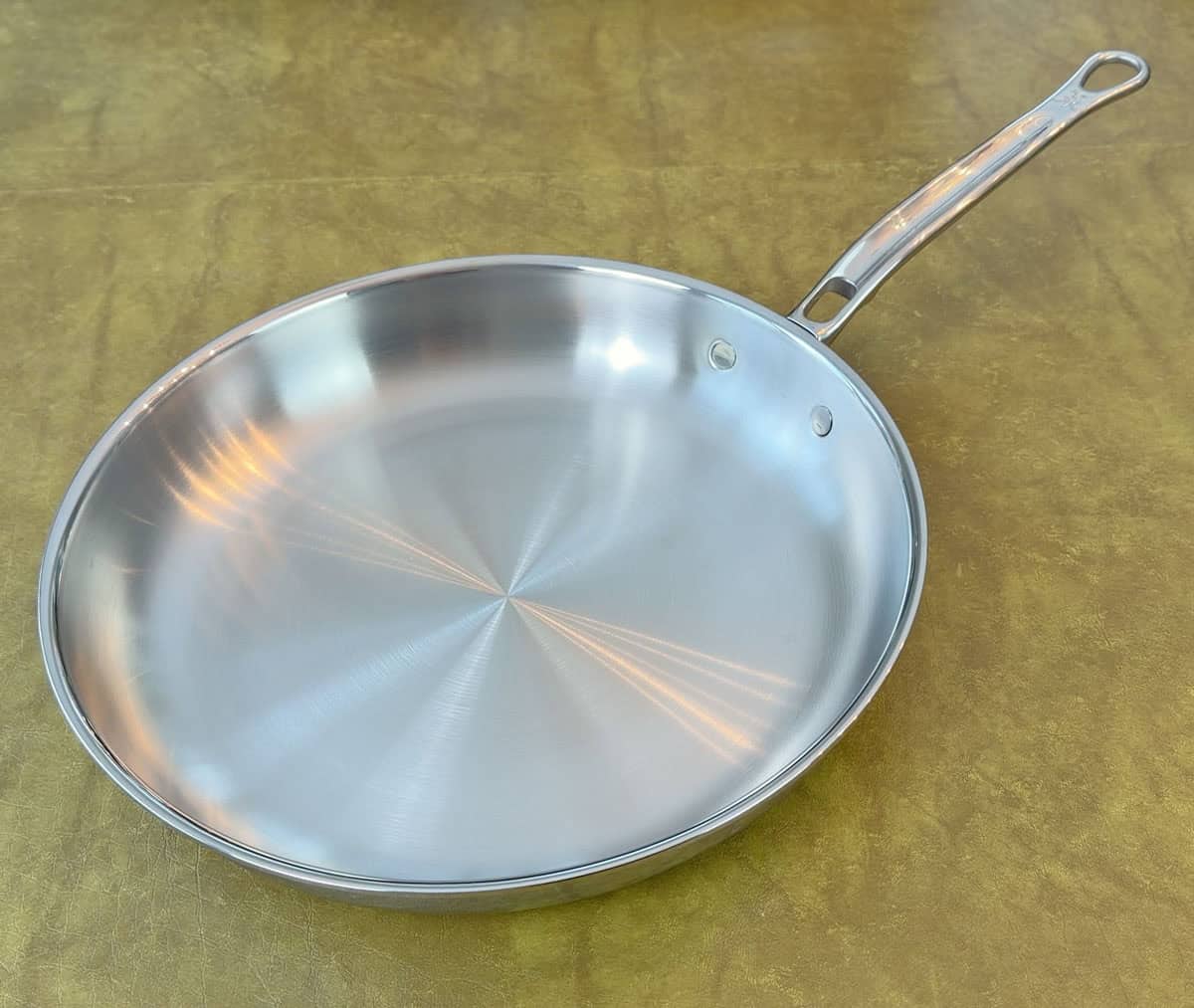
NanoBond is the most unique pan in Hestan’s lineup. Titanium ions are vaporized in a vacuum chamber and bonded to the cooking surface, creating a layer that’s four times harder than standard stainless steel. The surface has a distinct gray-blue color and an almost silky texture that’s noticeably smoother than any other stainless pan I’ve tested.

It’s also significantly more scratch-resistant. In my durability tests, the rough side of a Scotch-Brite sponge scratched a ProBond pan but left zero marks on NanoBond. It’s also oven-safe up to 1050°F; the others can handle up to 600°F (Made In’s limit is 800°F).

CopperBond is the heaviest of the group at 4.1 pounds. Its 5-ply construction has a copper core layer, and the copper is exposed on the sides. This looks beautiful but tarnishes quickly and requires regular polishing. Unlike the other Hestan pans, CopperBond does not have sealed rims.

Where CopperBond stands out is induction compatibility. Copper isn’t magnetic, so most copper-core cookware won’t work on induction cooktops. Hestan solves this by using a magnetic steel base on the bottom of the pan, which makes it one of the few copper-core options that’s induction-friendly.
Heat Performance
I tested all five pans under identical conditions as part of my 31-pan comparison. To measure heat conduction, I placed each pan on the same burner at the same heat setting and recorded the surface temperature at the center after one and two minutes.
To measure heat distribution, I also recorded the temperature at the outer edge to see how evenly heat spread across the cooking surface.
And to measure heat retention, I heated each pan to exactly 400 degrees, removed it from the heat, and checked the surface temperature after five minutes. Here’s how Made In and the four Hestan pans compared.
Heat Conduction. Made In was one of the fastest pans to heat up in the entire 31-pan test, reaching 529 degrees at the center after two minutes (2nd overall).
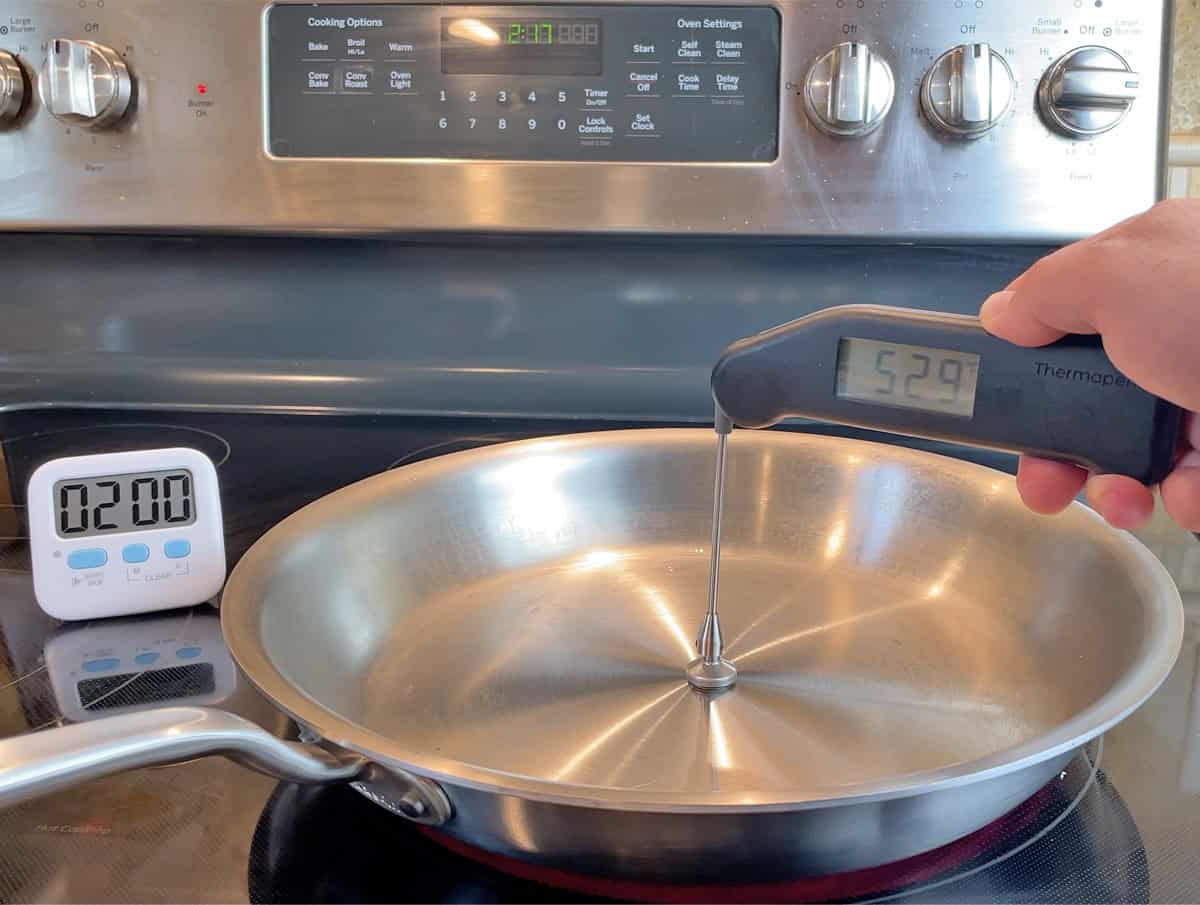
By comparison, the Hestan (ProBond Luxe) reached 472 degrees, ranking 14th. Hestan ProBond Forged hit 465 degrees, and NanoBond was the slowest of the five at 389 degrees, ranking 27th out of 31. For everyday cooking, Made In gets you to searing temperature noticeably faster.
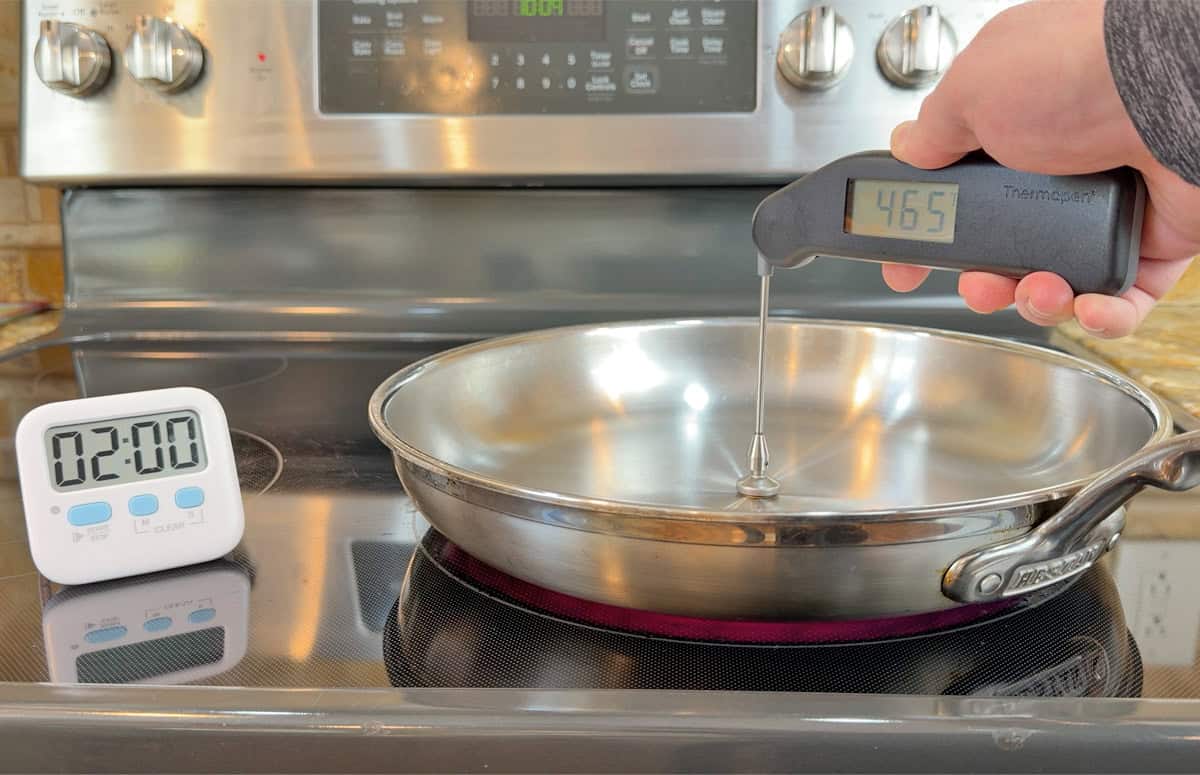
Heat Distribution. This is where the Hestan pans pull ahead, particularly CopperBond and NanoBond. Made In had a 125-degree difference between center and edge, ranking 26th out of 31 pans. CopperBond had just a 19-degree difference (5th overall), and NanoBond had a 34-degree difference (8th overall). ProBond Forged and Luxe fell in between at 113 and 104 degrees, respectively.
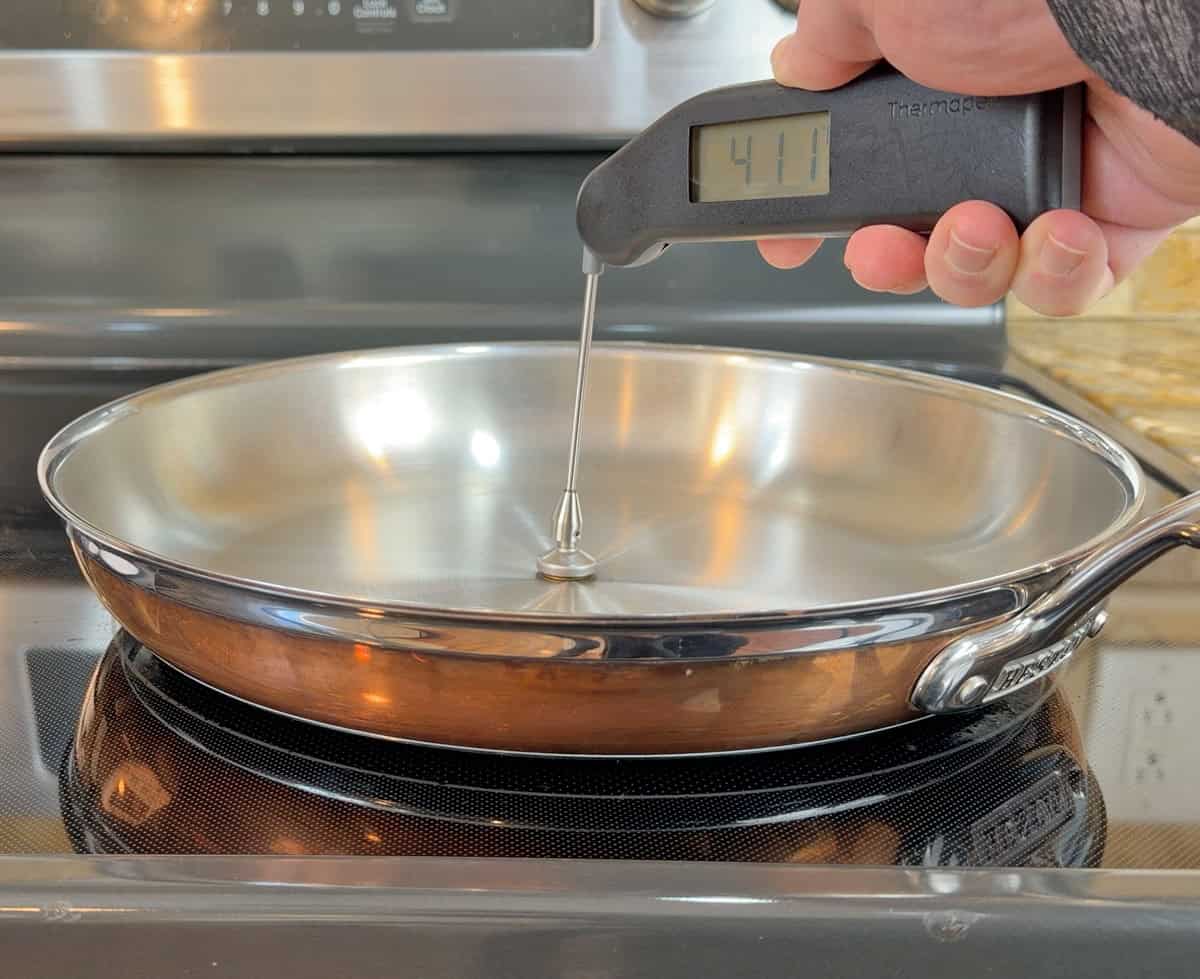
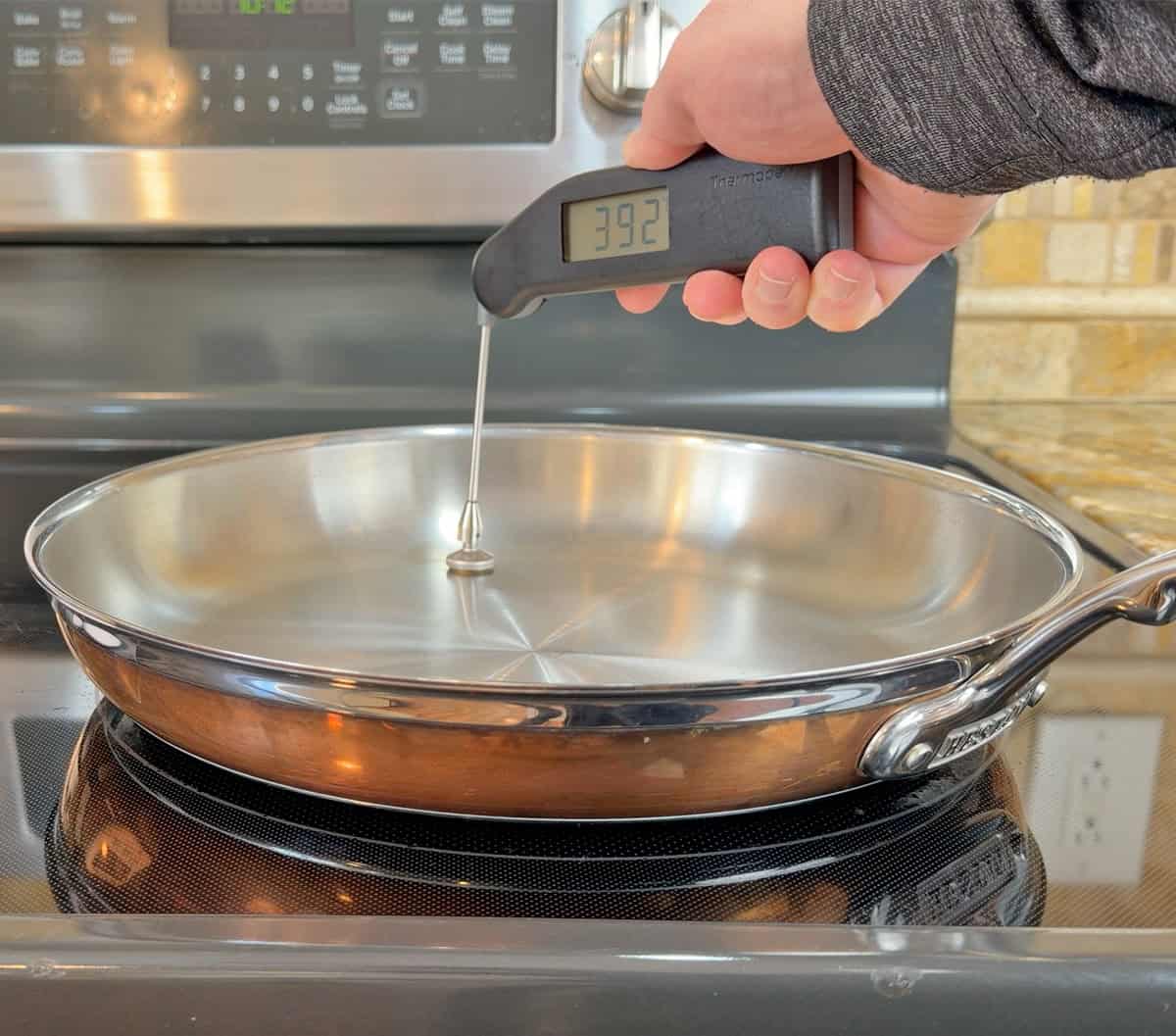
In practical terms, Made In heats fast in the center but takes longer to equalize across the full surface. The Hestan CopperBond and NanoBond pans deliver a much more uniform temperature from edge to edge, which matters when you’re searing multiple pieces of food across the entire pan.

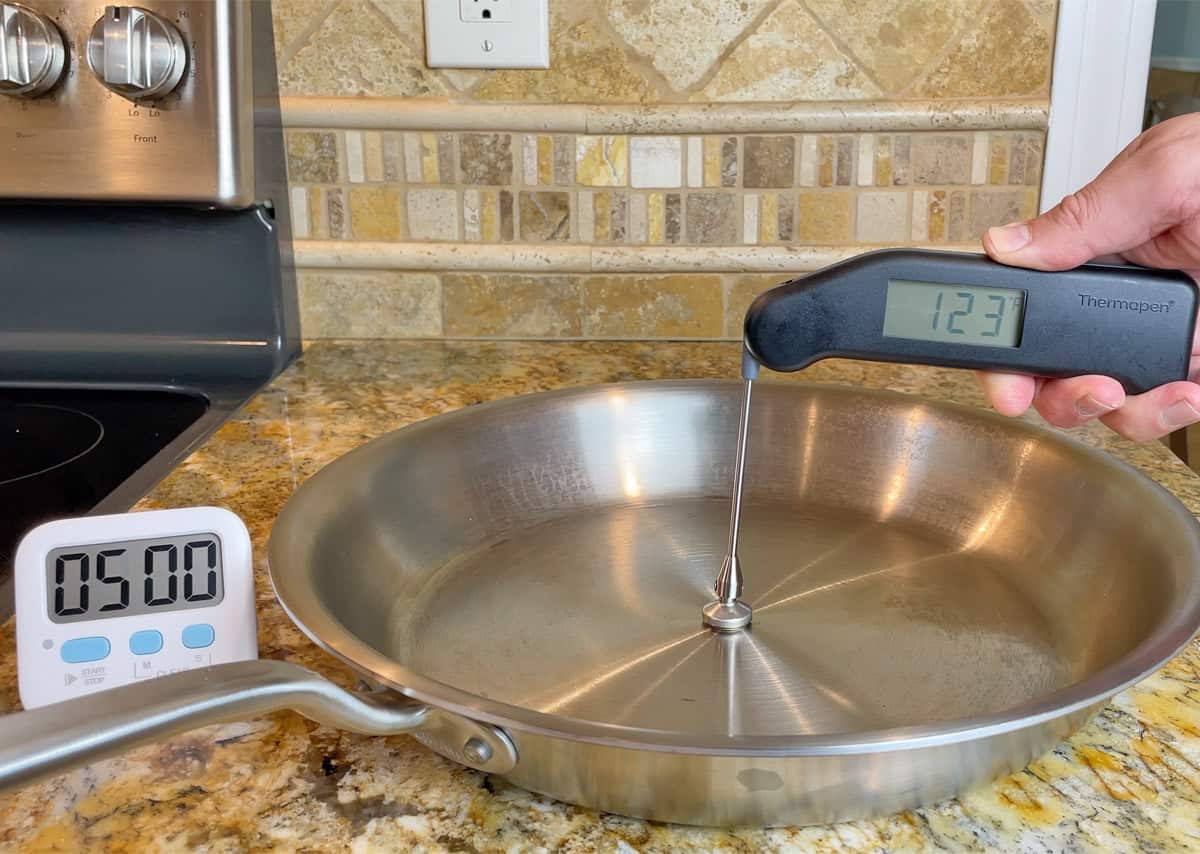
Heat Retention. After heating each pan to 400 degrees and letting them cool for 5 minutes, Made In held 123 degrees (25th), ProBond Forged dropped to 115 degrees (30th), ProBond Luxe held 122 degrees (27th), and CopperBond held 127 degrees (19th). NanoBond performed best among the group at 134 degrees, ranking 12th overall. If heat retention is your top priority, something like the Demeyere Atlantis Proline or Fissler Original-Profi would be a much better choice.
Features
Made In’s biggest practical advantage is its flat cooking surface. At 10 inches, it’s the widest of any pan in the full 31-pan test, giving you more usable space for searing, sauteing, and fitting multiple portions without overcrowding. Every Hestan pan measures 9.5 inches. That’s still generous, but half an inch less in every direction adds up.

All four Hestan pans have a standard stainless steel cooking surface except NanoBond, which has the titanium-reinforced surface I described earlier. Beyond being harder and more scratch-resistant, the NanoBond surface is also slightly less sticky with eggs. It won’t replace a nonstick pan, but it gives you a bit more leeway than bare stainless steel. In my testing, eggs slid more easily on NanoBond than on any other uncoated stainless pan.

Three of the four Hestan pans (ProBond Forged, ProBond Luxe, and NanoBond) have sealed rims. Sealed rims cap the exposed aluminum core around the edge of the pan, preventing it from receding over time.

This isn’t a theoretical concern. When aluminum recedes, the steel layers can become razor sharp or even separate. All-Clad actually faced a class action lawsuit over this exact issue, with consumers reporting cuts and bleeding from edges that deteriorated after repeated dishwasher use.

Sealed rims eliminate that risk entirely, which is part of why Hestan’s sealed-rim pans are truly dishwasher safe. Made In and Hestan CopperBond do not have sealed rims so you need to hand wash them to keep the cookware in good condition long term.
Handles
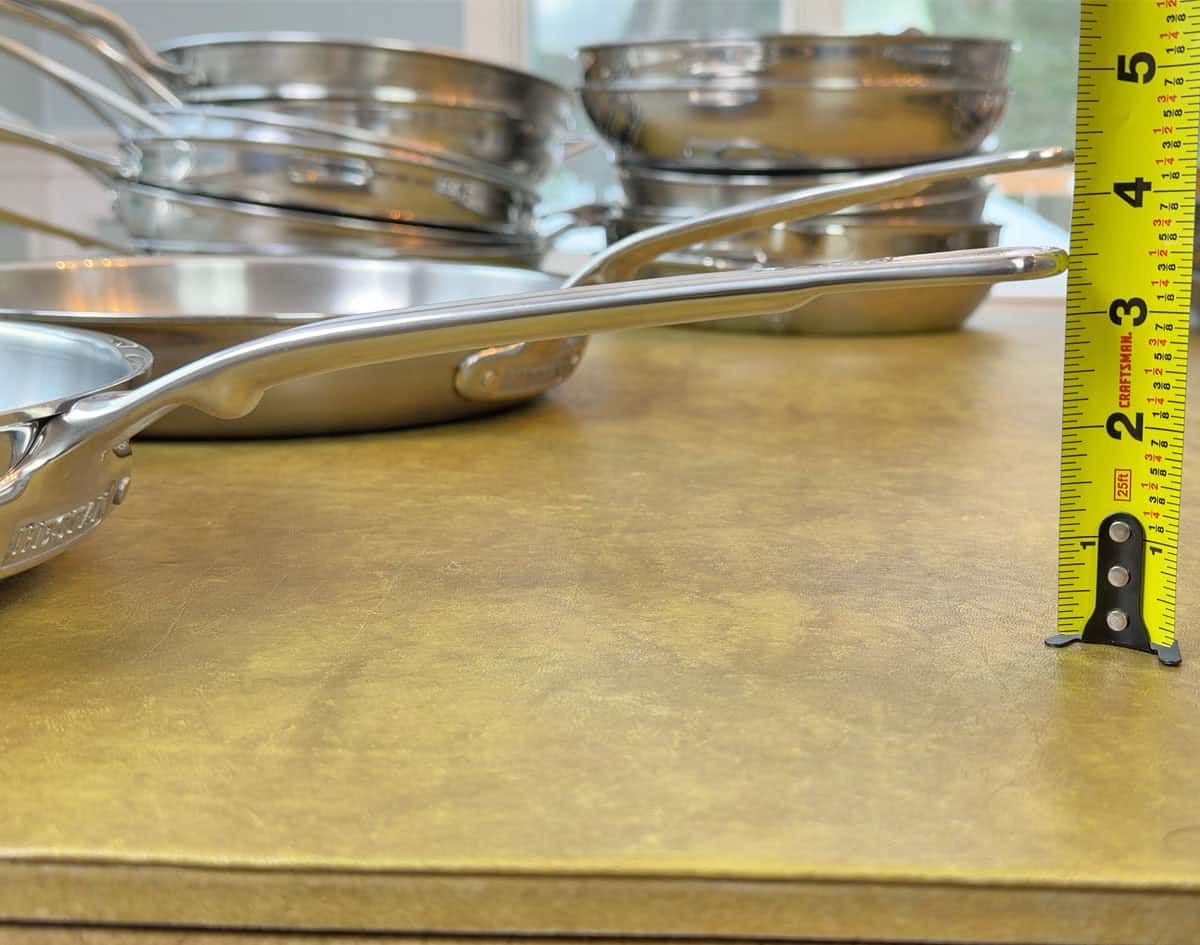
Made In’s handle has a flat-topped profile that gets slightly wider toward the end. It’s comfortable, secure, and doesn’t rotate when you tilt the pan. At 8.1 inches, it’s shorter than the Hestan handles (8.5 to 8.7 inches).

All four Hestan pans share the same handle design: smooth rounded edges with a subtle groove that prevents the pan from rotating. It’s one of the best-designed handles I tested, striking a nice balance between comfort and safety.

That said, the end of the handle tapers thin, and the hanging loop is large enough that your fingers can slip through it. When you grab the very end, there’s not as much to hold onto as you’d expect. It’s a minor annoyance, but given the price of these pans, I need to call it out.

One more thing: Hestan handles are angled higher off the cooking surface than Made In’s. That higher pitch gives you more leverage for flipping and tossing food, but it also means you need more clearance between oven racks. ProBond Luxe addresses this with a lower-profile handle, which is one reason I find its design slightly more polished overall.
Maintenance
Made In is low-maintenance. The brushed exterior hides fingerprints and minor wear, and for the most part, a quick rinse and scrub after cooking is all it needs. The one cleaning annoyance is a small gap at the base of the handle that’s tough to reach and can collect discoloration over time.

Hestan requires more upkeep. The polished exteriors on ProBond Luxe, NanoBond, and CopperBond show fingerprints and water spots more readily. NanoBond can develop rainbow-colored heat tint after just a few uses (a splash of white vinegar removes it, but you’ll be doing this regularly).

CopperBond is the most demanding of the group. The exposed copper tarnishes quickly and needs regular polishing to keep its luster. If you want low-effort cookware you can toss in the dishwasher without a second thought, Made In is the easier choice.

Customer Service
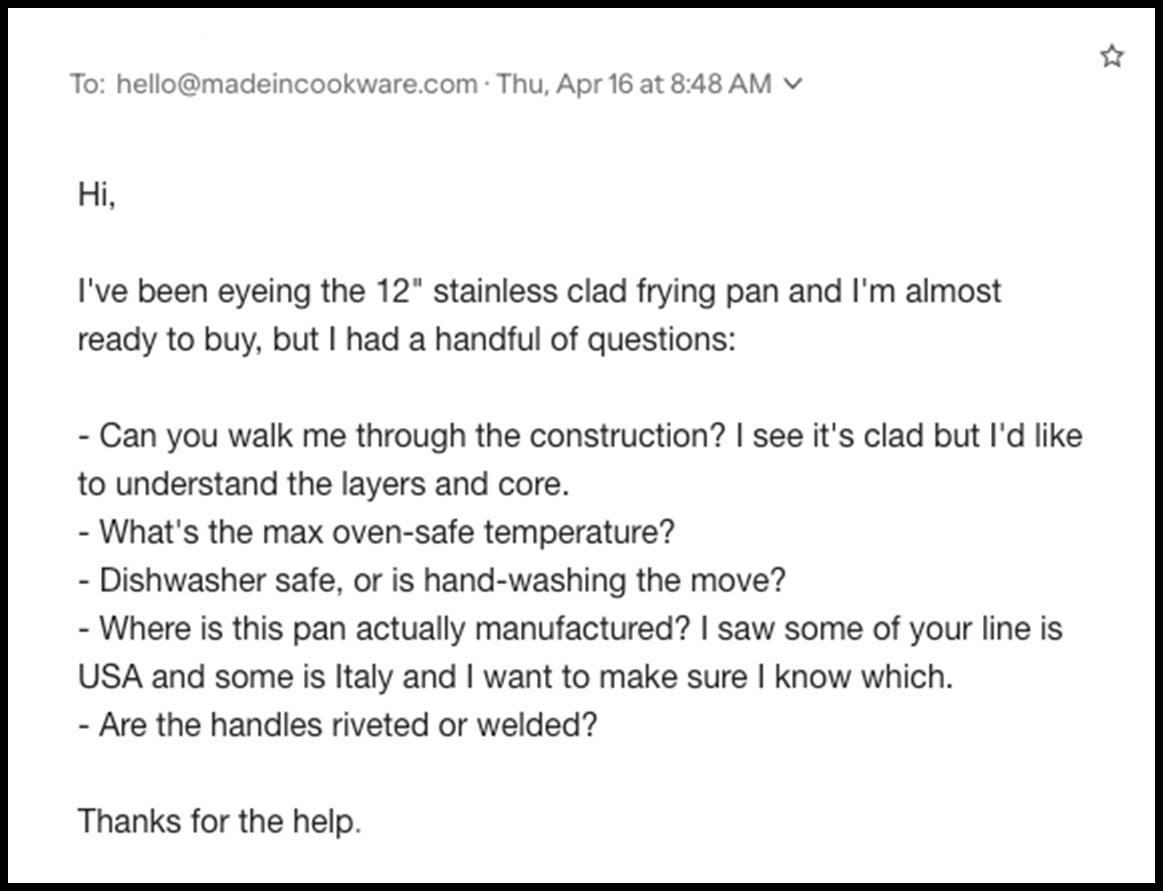
To get a sense of how each brand treats its customers, I set up three email aliases and contacted both companies anonymously. The first email tested basic product knowledge – construction details, oven-safe temps, manufacturing origin.
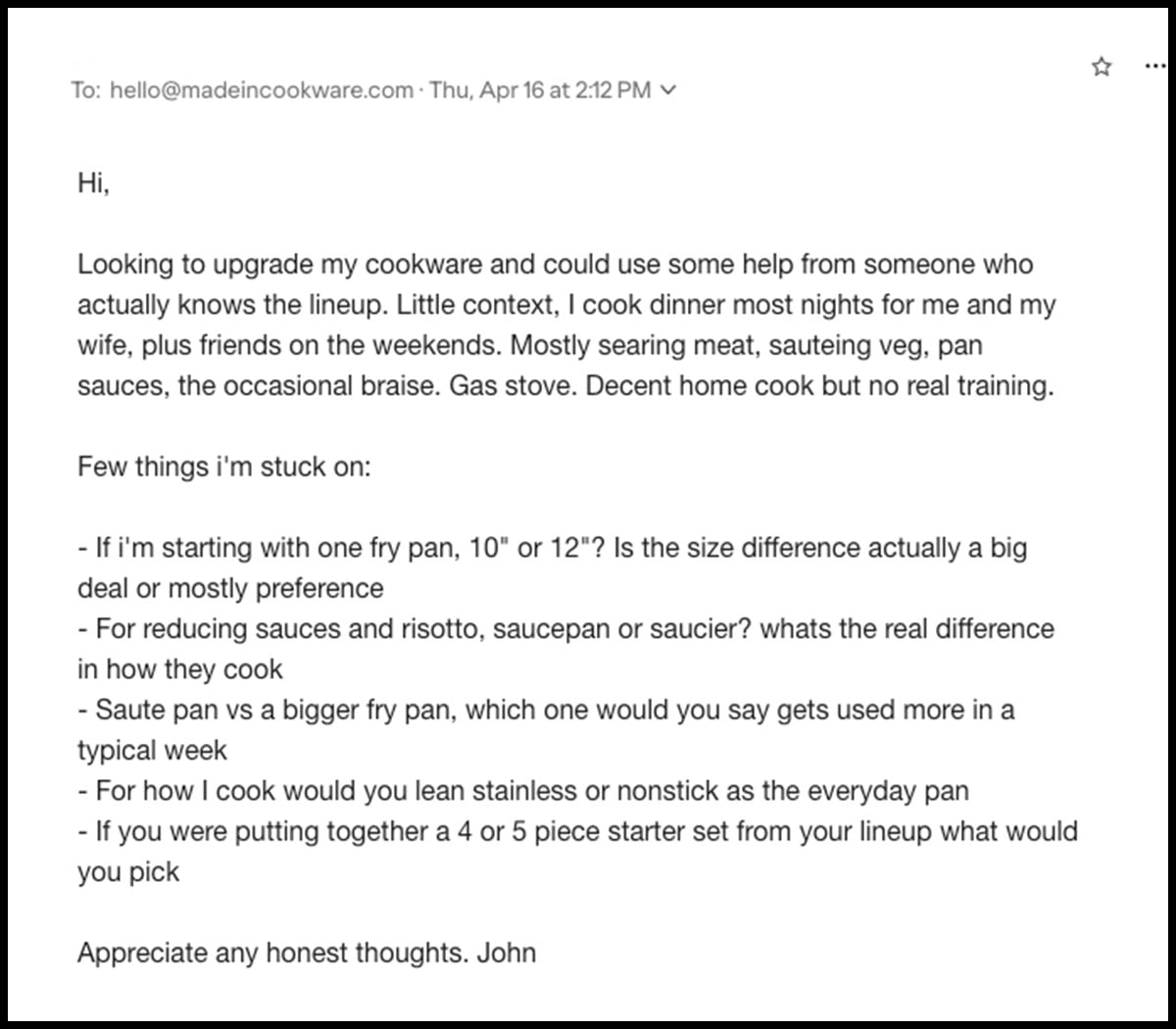
The second asked for real cooking advice, the kind of stuff that requires someone to actually have opinions.
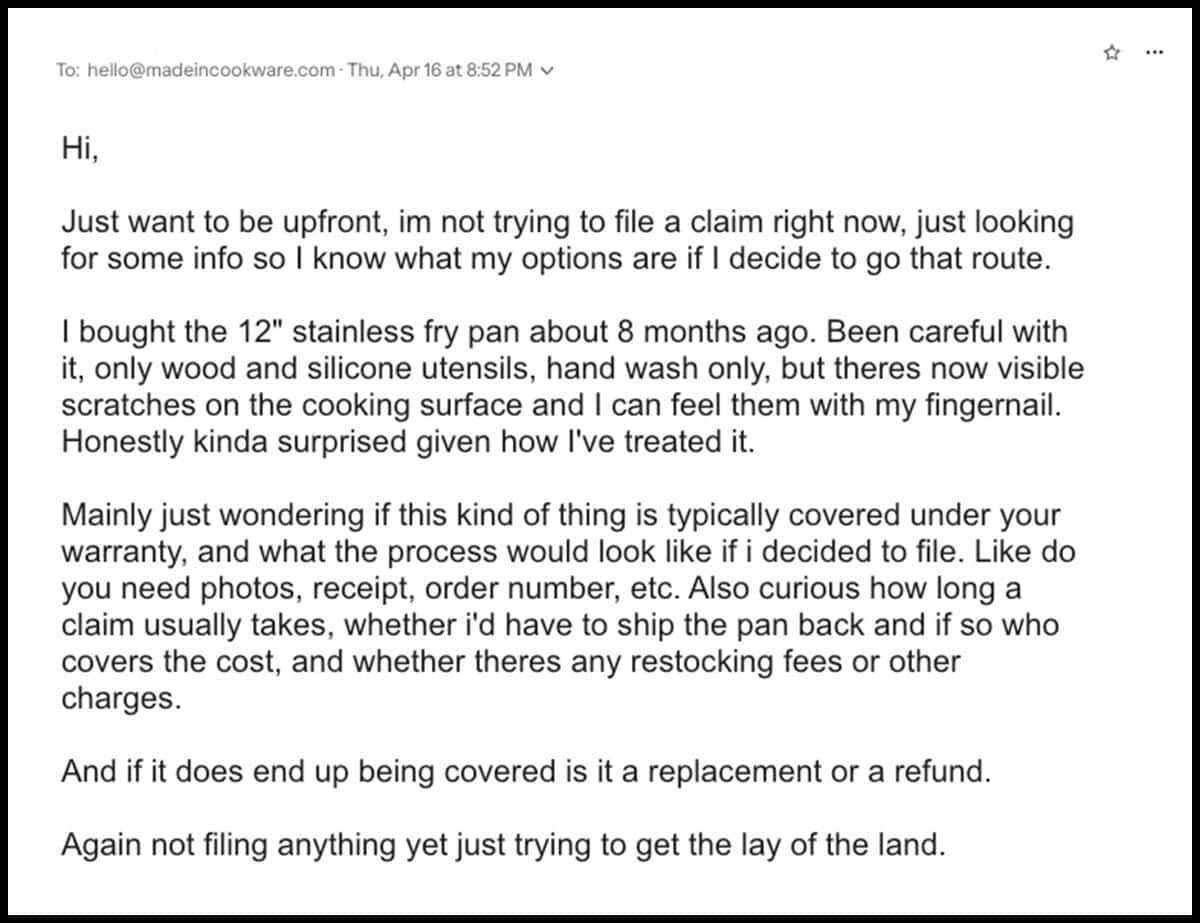
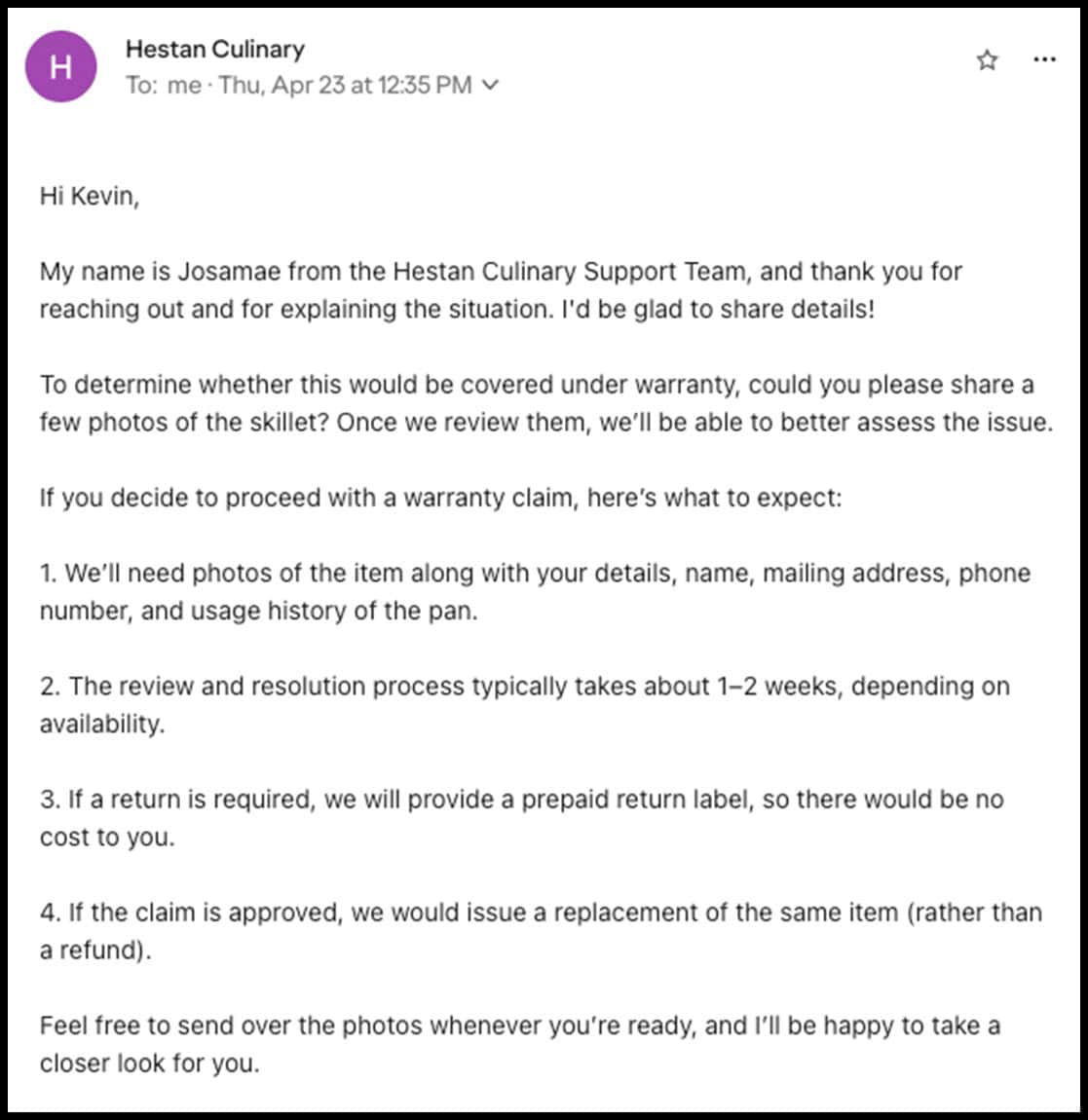
The third presented a warranty scenario and asked how the process works.
I ran this same test across nine cookware brands total, but here’s how Made In and Hestan stacked up.
One thing worth mentioning upfront: Hestan offers a dedicated “Cookware Concierge” service staffed by Michael Kane, a former top-performing sales associate at the Williams Sonoma in Beverly Hills. It’s a unique offering in the cookware space – you can schedule appointments for personalized advice by phone, video, or email. Made In doesn’t have anything like that. They use a standard customer service team.
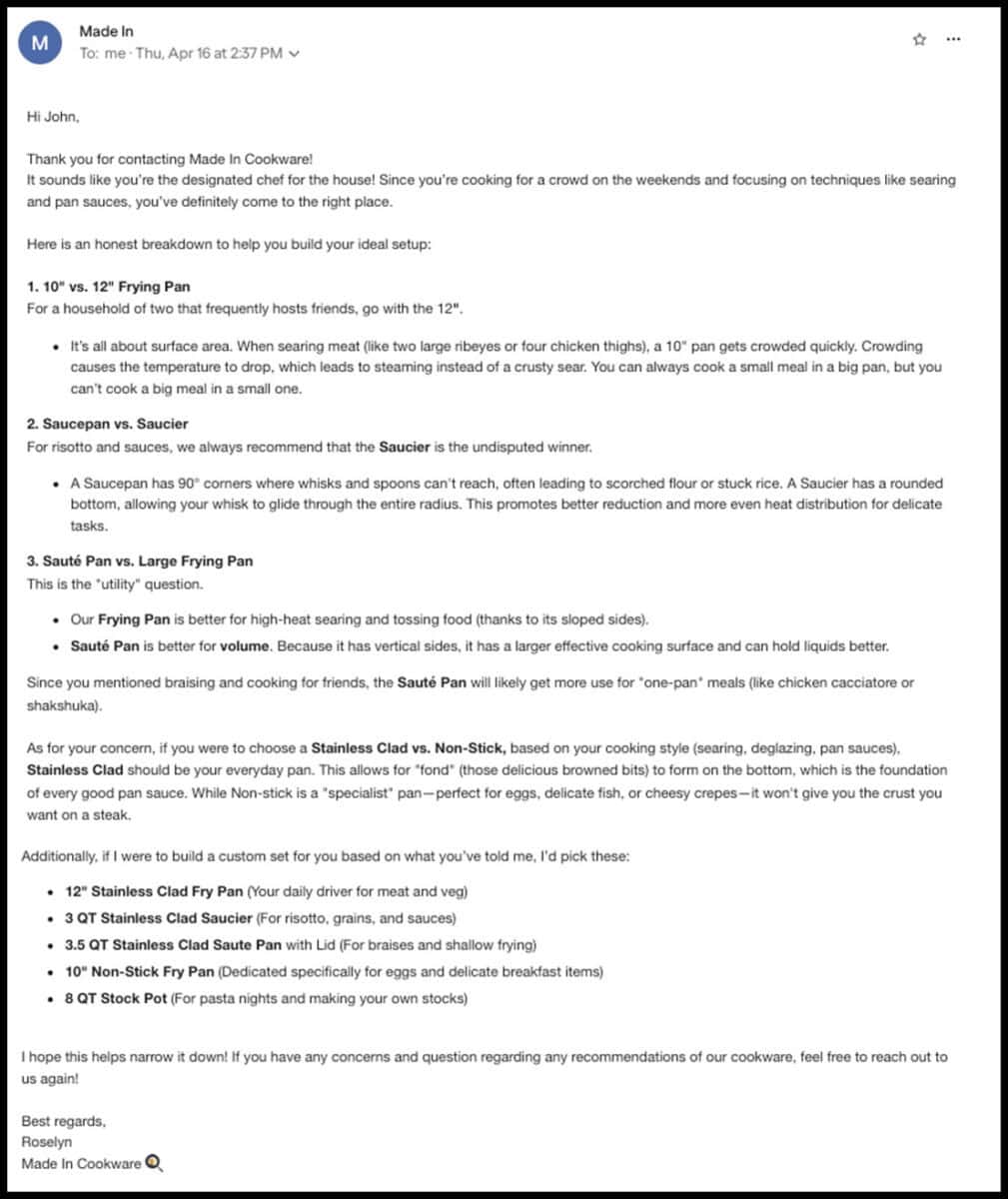
Made In answered all three emails within about an hour, and every response was detailed, accurate, and clearly written by someone who read the full email. In their opinion response, the rep broke down why the 12 inch pan is better for searing, explained the functional difference between a saucepan and saucier, and assembled a 5-piece starter set tailored to the cooking style described in the email.
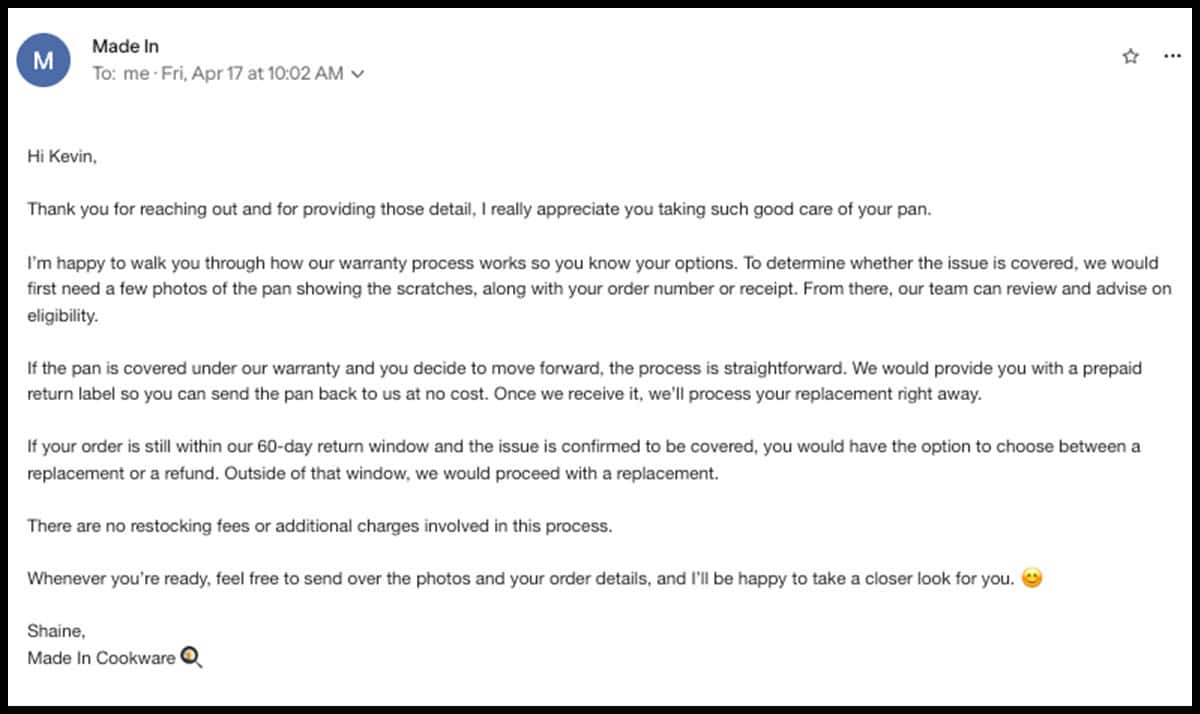
Their warranty response covered the full process from start to finish, including the prepaid return label, no fees, and the specific cutoff between when you’d get a replacement vs. a refund.
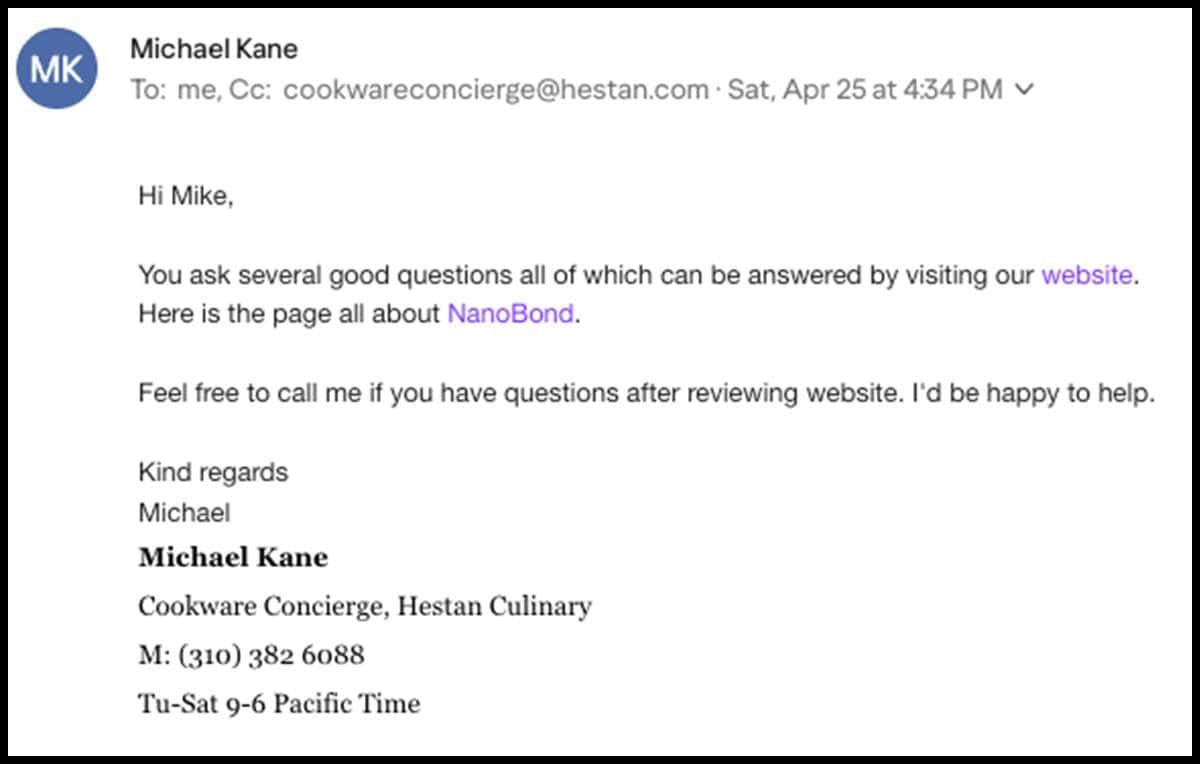
Hestan’s results were all over the map. The factual email went to the concierge address and took nearly three days. When the response finally came, it didn’t answer a single question. It just linked to the website and suggested a phone call.
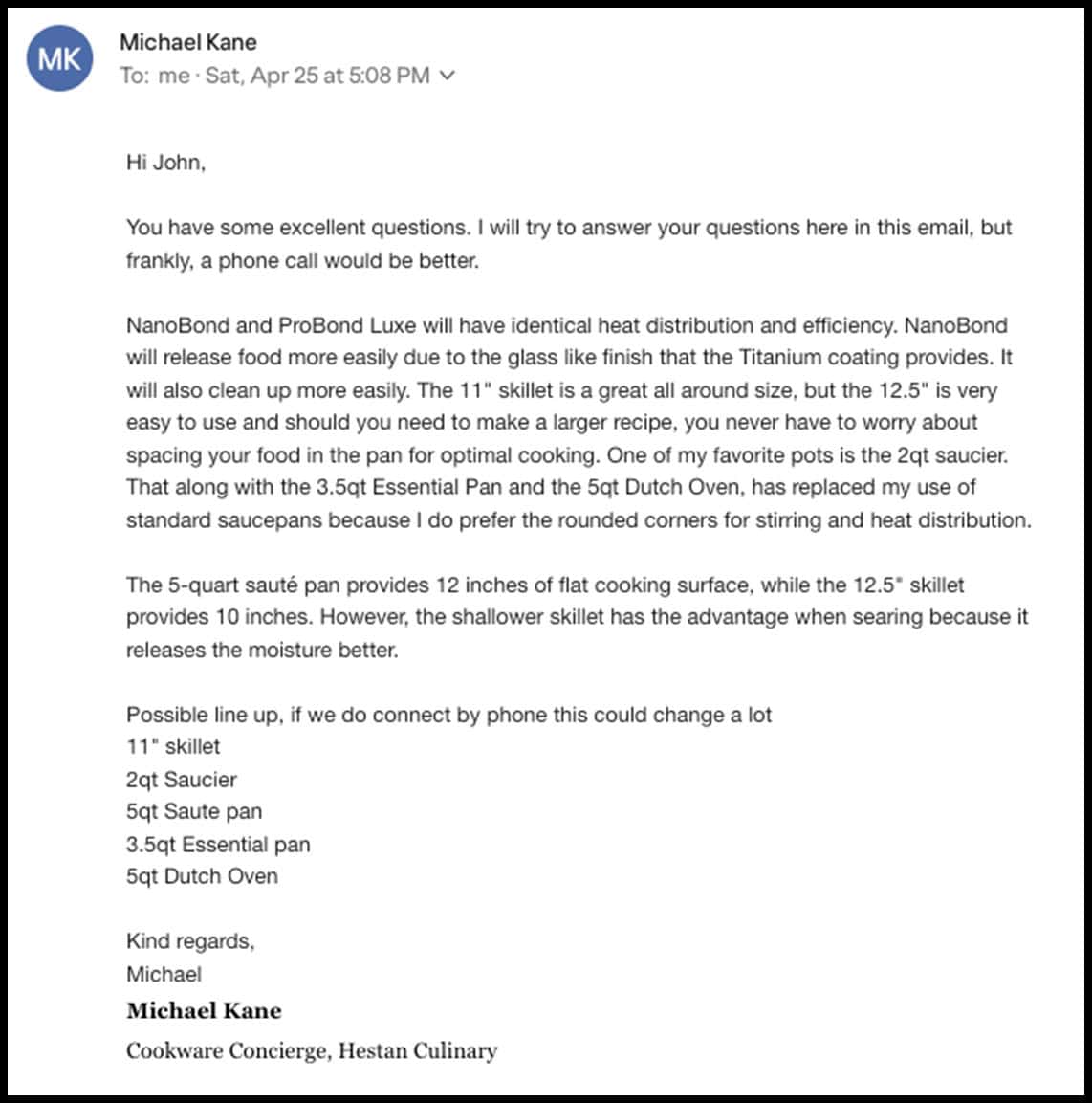
The opinion email also took about two days, but the content was much stronger. Michael mentioned he’s moved away from standard saucepans entirely in favor of sauciers, gave actual surface area comparisons between the sauté pan and skillet, and put together a thoughtful 5-piece lineup. You could tell he knows the products.
The warranty email was handled by a different team member (not the concierge) and came back in under 4 hours with a clear breakdown: photos and usage history needed, 1-2 week timeline, prepaid return label at no cost, replacement not refund.
Factual (Pre-Purchase)
| Made In | Hestan | |
|---|---|---|
| Response Time | 1 hr 9 min | 71 hr 30 min |
| Helpfulness | Very Helpful | Not Helpful |
| Accuracy | Fully Accurate | N/A |
| Overall | Excellent | Poor |
Opinion/Expertise
| Made In | Hestan | |
|---|---|---|
| Response Time | 25 min | 44 hr 18 min |
| Helpfulness | Very Helpful | Very Helpful |
| Accuracy | Fully Accurate | Fully Accurate |
| Overall | Excellent | Excellent |
Warranty (Post-Purchase)
| Made In | Hestan | |
|---|---|---|
| Response Time | 1 hr 9 min | 3 hr 42 min |
| Helpfulness | Very Helpful | Very Helpful |
| Accuracy | Fully Accurate | Fully Accurate |
| Overall | Excellent | Excellent |
Bottom Line: Should You Buy Made In or Hestan?
Both Made In and Hestan make excellent stainless steel cookware. These are not budget pans with trade-offs you have to talk yourself into. Every pan in this comparison is well-built, performs at a high level, and should last for years. The question is which set of strengths matters more to you.
Made In is the more practical choice for most home cooks. It heats up fast, has the widest cooking surface I tested, and performs consistently well in everyday cooking. It doesn’t have sealed rims or flush rivets, and heat distribution across the full surface isn’t its strongest area, but at this price point it outperforms many pans that cost significantly more. If you want one great stainless steel frying pan and don’t want to overthink it, Made In is a safe, long-term buy.
Hestan ProBond Forged and ProBond Luxe are worth the step up if fit, finish, and construction details matter to you. Flush rivets, sealed rims, and the handle design are genuinely better than what you get on most pans under $200. I like both, but Luxe edges ahead for me with its polished exterior, lower-profile handle, and tighter handle-to-rim connection. Performance is solid across the board, though not dramatically better than Made In in the metrics that matter most for everyday cooking.

Hestan NanoBond is one of the best stainless steel frying pans I’ve tested. The titanium-reinforced surface is harder, more scratch-resistant, and slightly less sticky than anything else in the category. Heat distribution is excellent, and the build quality is top-tier. That said, it’s not the most practical pan for every home cook. It heats slowly, it’s very expensive. If you want the absolute best and don’t mind the premium price, this is it.
Hestan CopperBond delivered the most even heat distribution of the five pans and it’s compatible with induction, which is rare for copper cookware. But it’s the heaviest pan in this group at 4.1 pounds, the copper tarnishes quickly, it lacks sealed rims, and it costs the same as NanoBond. For the same money, I think NanoBond gives you more with its harder, more durable cooking surface. Unless you specifically want the look of exposed copper, NanoBond is the stronger pick.
For most people, Made In is the right call. Excellent performance, fair price, no compromises where it counts. If you have the budget and want more refined construction, Hestan ProBond Luxe is the sweet spot in Hestan’s lineup. And if money isn’t a factor and you want the best of the best, NanoBond stands alone.
If you’re ready to buy, Made In is available on MadeInCookware.com and Amazon, and Hestan is available on HestanCulinary.com and Amazon.
Related Topics
- Made In Cookware Review After 3+ Years (With Test Results)
- Is Hestan Cookware Worth the Splurge? In-Depth Review
- All-Clad vs. Made In: The Ultimate Cookware Comparison
- Made In Carbon Steel Cookware (In-Depth Review)
- Made In vs. Demeyere: Which Stainless Steel Pans Are Better?
- Hestan vs. All-Clad: Which Cookware Is Better?
- Hestan vs. Demeyere Cookware: 9 Differences
- Hestan NanoBond vs. ProBond vs. CopperBond
- Are Made In Sheet Pans Worth Buying? (Review & Test Results)
- Are Made In Non-Stick Pans Worth Buying? An In-Depth Review
- Made In 8-Inch Chef’s Knife Review (With Pictures)
- Best Stovetop Griddle? I Tested Made In, Hestan, and Nordic Ware
- Made In vs. Caraway Cookware: 11 Key Differences
- Calphalon vs. Made In: Which Cookware and Knives Are Better?
- Made In vs. Le Creuset: Which Dutch Ovens Are Better?
- Made In vs. Misen: How Do Their Kitchen Knives and Cookware Compare?
- Made In vs. Wusthof: Which Kitchen Knives Are Better?
