


Are you shopping for a Dutch oven but need help deciding between Made In and Le Creuset?
Both brands make their enameled cast iron cookware in France, but which is better? What are the main differences?
In this comparison of Made In vs. Le Creuset, you’ll learn how their Dutch ovens differ in construction, design, performance, price, and more.
Use these links to navigate the comparison:
- Made In vs. Le Creuset: Comparison Chart
- Weight and Thickness
- Heat Retention
- Exterior Colors
- Interior Color
- Lids
- Lid Knobs
- Handles
- Shapes
- Sizes
- Where It Is Made
- Other Products
- Price
- Common Complaints
- Customer Service
- Bottom Line: Should You Buy a Made In or Le Creuset Dutch Oven?
Made In vs. Le Creuset: Comparison Chart
The following chart provides a quick comparison of Made In vs. Le Creuset enameled cast iron Dutch ovens.
| Made In | Le Creuset | |
|---|---|---|
| Construction | Enameled cast iron | Enameled cast iron |
| Exterior colors | 5 colors | 20+ colors |
| Interior colors | Sand or black | Sand |
| Handle Opening | .75 in | 1.25 in |
| Lid | Dimpled | Domed |
| Lid Knob | Stainless or antique brass | Stainless, gold-plated, copper, iridescent, or black phenolic knobs |
| Shapes | Round and oval | Round, oval, specialty |
| Round Sizes (quarts) | 5.5 | 2, 3.5, 4.5, 5.5, 7.25, 9, 13.25 |
| Oval Sizes (quarts) | 7.5 | 1, 2.75, 3.5, 5, 6.75, 8, 9.5, 15.5 |
| Weight | 13.4 pounds (5.5-quart) | 11.5 pounds (5.5-quart) |
| Where It’s Made | Northeast, France | Fresnoy-le-Grand, France |
| First Launched | 2022 | 1925 |
| Price | $$$ (MadeInCookware.com, Amazon) | $$$$$ (LeCreuset.com, Amazon) |
| Top Reason to Buy | Thicker construction; better heat retention; lower price | Variety of colors, sizes, and shapes; proven track record; lightweight |
| Top Reason to NOT Buy | Limited options | High Price |
Weight and Thickness
Although Made In and Le Creuset Dutch ovens are both made of cast iron and coated with multiple layers of enamel, their construction differs.
As you can see in the picture below, Made In’s Dutch oven has thicker walls. Because of that, the Made In 5.5-quart Dutch oven is nearly 2.5 pounds heavier than Le Creuset.

The Made In 5.5-quart Dutch oven weighs in at 13.4 lb. Le Creuset’s Dutch oven of the same size weighs 11.5 lb.


The added weight in the Made In Dutch oven makes it more difficult to move around, especially when it’s full of food or liquid. However, it also increases the cookware’s heat retention.
Heat Retention
Heat retention is an important factor to consider when buying any cookware, but it’s crucial in Dutch ovens.
Since Dutch ovens are often used for low and slow cooking, such as braising and stewing, you want one that holds heat well, so you can keep the burners low.
Heat retention is also important for consistency. As you add ingredients, you want the cookware to stay hot, so the food cooks evenly.
Thin pots heat up fast, but the temperature fluctuates as you add ingredients, increasing the risk of food burning or cooking unevenly.
So how do Made In and Le Creuset stack up in terms of heat retention?
To find out, I conducted a simple experiment. First, I poured 32 ounces of water into each Dutch oven. Then I set them both on the stove and turned the burners on high. After the water came to a boil, I took both Dutch ovens off the heat and set them aside.
After ten minutes, the water in the Made In Dutch oven was 133.7°F.

The water in the Le Creuset Dutch oven was 129.4°F.

After another 10 minutes (20 minutes total), the water in the Made In Dutch oven was 108.1°F.

The water in the Le Creuset Dutch oven was 103°F.

Both Dutch ovens retain heat well, but since the Made In Dutch oven has thicker walls, it absorbs and retains heat slightly better than Le Creuset.
I conducted this test with other top-rated Dutch ovens to see how Made In and Le Creuset compare to the wider market. Below are the results:
| Dutch Oven | Water Temperature (10 minutes) | Water Temperature (20 minutes) |
|---|---|---|
| Staub | 136.2°F | 111.3°F |
| Tramontina | 134.1°F | 108.8°F |
| Made In | 133.7°F | 108.1°F |
| Cuisinart | 128.4°F | 107.2°F |
| Lodge | 130.8°F | 105.6°F |
| Le Creuset | 129.4°F | 103.5°F |
| Great Jones | 128.6°F | 102.3°F |
Exterior Colors
With over 20 exterior colors and a mix of solid shades, ombre (two-tone) hues, and patterns, Le Creuset is the clear winner in color variety.

Le Creuset Dutch oven colors vary by shape and size, but the mid-range sizes (3.5-quart to 7.25-quart) feature the most choices.
Made In features four solid exterior colors: ash grey, antique white, harbour blue, and Made In red. It also offers one ombre color: blood orange.

The green Made In Dutch oven featured in this comparison is not currently available.
Interior Color
Made In and Le Creuset Dutch ovens feature a light, sand-colored interior.

Because the interior is light, it’s easier to keep an eye on browning and fond development — the caramelized brown bits that stick to the pan after searing meat or vegetables. But the light interior is more challenging to keep clean.
If you prefer a dark interior, Made In offers one option: the ash grey Dutch. Its black interior hides stains well but makes it more difficult to monitor browning.
Made In and Le Creuset both offer enameled cast iron skillets with black interior cooking surfaces. The black enamel on these pieces has a coarser texture (compared to the light enamel), perfect for grilling, searing, and developing a caramelized crust on food.
Lids
Another difference between Made In and Le Creuset is the lids.

All Le Creuset Dutch oven lids are domed and feature a smooth interior.

Made In’s Dutch oven lid interior is different. The exterior is smooth, but the interior features a series of small dimples.

The dimples stick out, creating a self-basting system — moisture collects on the dimples and drops evenly onto the food below.
This self-basting system distributes moisture more evenly over the food, but it won’t make a major difference in taste or tenderness.
All else equal, I’ll take the Dutch oven with the dimples. But should it be the main reason you buy one brand over the other? No.
Lid Knobs
Made In and Le Creuset Dutch ovens both come with interchangeable lid knobs, allowing you to change the look of your cookware.
Made In features two knob styles. Both are circular and flat on top. The Dutch oven comes with a stainless steel knob, but you can upgrade to an “antique-style” stainless steel knob with a brass finish.

Le Creuset offers multiple lid knob options, including:
- Stainless steel
- Light gold
- Signature gold
- Copper
- Black phenolic
- Iridescent
Most knobs are circular with a thick stem, but Le Creuset also features specialty-shaped knobs shaped like hearts and flowers.
The black phenolic knob is textured and offers a better grip than the metal options. All knobs have Le Creuset etched into the top.

Comparing the shape of Made In and Le Creuset knobs, the stem of Made In’s lid knobs is longer and thinner, making it easier to grip because of the extra room.
From the lid to the underside of the lid knob is 1.1 inches on Made In; with Le Creuset, the distance is 0.8 inches.


Handles
Made In has wide, flat handles. At 0.75 inches, the handle opening is narrow, with just enough space for your fingers. The Made In logo is in raised print across each handle.


Le Creuset has thinner loop-style handles. At 1.25 inches, the handles have a wider opening than Made In, making them easier to grip if you are wearing an oven mitt or heat-resistant gloves.

Shapes
Le Creuset offers round, oval, and specialty-shaped Dutch ovens. For example, they offer pumpkin-shaped Dutch ovens in the fall and heart-shaped cookware around Valentine’s Day.
They also have shallow Dutch ovens with shorter walls and wider bases. These are ideal for searing and browning because you have fit more meat on the cooking surface without overcrowding.
When Made In launched its Dutch ovens in 2022, round was the only shape offered. However, in March 2023, they released their first oval Dutch oven (7.5 quarts). Made In constantly adds new products to its lineup, so expect more shapes and sizes to become available in the coming months.
While you can cook most meals with a round Dutch oven on a stovetop or in the oven, the oval designs come in handy when cooking foods like long cuts of brisket, beef roasts, and whole carrots.
Read this comparison of round vs. oval Dutch ovens to learn more and get advice on how to choose.
Sizes
One of Le Creuset’s advantages over Made In is the number of sizes they offer.
Le Creuset offers round and oval Dutch ovens ranging from 1.5 quarts to 13+ quarts.
With Made In, you only have two options: 5.5 quarts (round) and 7.5 quarts (oval). However, these are the two most common sizes.
Where It Is Made
Made In and Le Creuset make their enameled cast iron cookware in France. Both brands work with skilled craftspeople with decades of experience in crafting cookware. But Le Creuset manufactures its own, whereas Made In outsources the task.
Made In’s business model relies on partnering with the most skilled makers of each type of cookware it offers. As a result, they work with partners around the globe in locales like Italy and France (where Made In makes its Dutch ovens).
Le Creuset is made in Fresnoy-le-Grand, France — the birthplace of the brand. Since 1925, Le Creuset has kept its manufacturing in-house and in the same foundry.
Other Products
Made In offers a variety of cookware types. It has a more diverse product offering than Le Creuset.
Le Creuset is known for its enameled cast iron cookware. It’s the brand’s specialty.
With Made In, you get a choice of the following cookware:
- Stainless steel clad
- Carbon steel
- Copper
- Non-stick
- Enameled cast iron

Made In also makes knives; knife accessories; porcelain, ceramic, or aluminum bakeware, and tabletop items like plates and flatware.
Check out the full lineup on MadeInCookware.com or read my Made In review to learn more.
Le Creuset offers a variety of enameled cast iron cookware options, from skillets and grill pans to saucepans and Dutch ovens.
However, the brand also makes:
- Stainless steel clad cookware
- Hard-anodized aluminum non-stick pans
- Stoneware for baking
- Kitchen knives and tools
- Tabletop items
- Tea kettles and other specialty cookware
Check out the full lineup on LeCreuset.com and Amazon or read my Le Creuset review to learn more.
Price
One of the most notable differences between Made In and Le Creuset Dutch ovens is their price.
Made In is significantly less expensive than Le Creuset. It’s about half the price for the same size (5.5-quart).
Made In can sell its cookware for less because its direct-to-consumer model doesn’t require a markup from third-party sellers like department stores.
So, if you are looking for a high-quality, mid-range-sized enameled cast iron Dutch oven, go with Made In to save some money.
Le Creuset’s pricing for its Dutch ovens varies by size. For perspective, the smaller options are more affordable, running about $300 or less. The larger pieces can exceed $500.
Compare today’s prices by clicking the links below:
- Made In Dutch ovens on MadeInCookware.com and Amazon
- Le Creuset Dutch ovens on LeCreuset.com and Amazon
Common Complaints
Both brands produce well-made cookware with few complaints about workmanship or performance.
However, neither brand is perfect. Here are the most common complaints about Made In and Le Creuset Dutch ovens.
Made In’s complaints include:
- The Dutch oven is too heavy.
- It only comes in one size.
- Flaws in the enamel coating
- The enamel is so thick it’s difficult to read the words on the bottom of the Dutch oven.
- The handle openings are small and difficult to grip while wearing oven mitts.
Le Creuset’s main complaint is that it is expensive, but people also complain that the enameled cast iron cookware is heavy, the exterior stains easily, and it takes a while to heat up (but that is true for any cast iron cookware).
I’ve also noticed an accumulation of tiny scratches on the interior enamel. Although these surface scratches don’t impact performance, the pot doesn’t look as flawless and pretty as it did right out of the box.

Customer Service
Beyond construction and performance, I wanted to see what happens when you actually need to talk to someone at each company. I set up three separate email addresses under fake names and contacted both brands without revealing who I was.
Each brand got a pre-purchase question about product specs, an email asking for cooking advice, and a post-purchase email describing a warranty issue. I tested eight cookware brands in total, but here’s where Made In and Le Creuset landed.
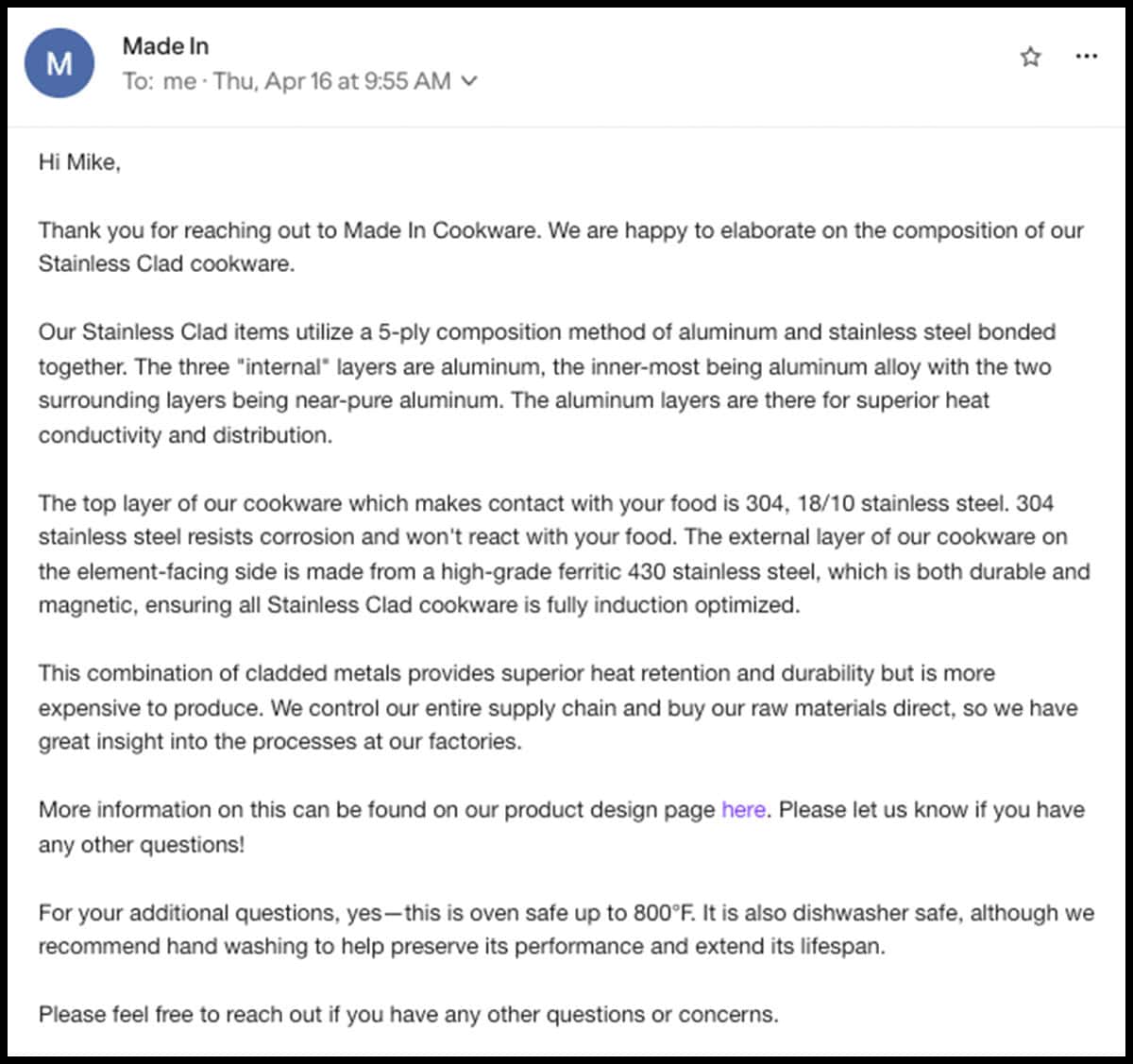
Made In responded to every email within about an hour, each time from a different person on their team. The product specs email was thorough and included specifics most brands skip over, like the exact stainless steel grades for each layer.
The cooking advice email was where they really separated themselves. Instead of generic suggestions, the rep broke down the reasoning behind each recommendation, things like why overcrowding a pan leads to steaming instead of searing, and built a custom starter set around the cooking habits I had described.

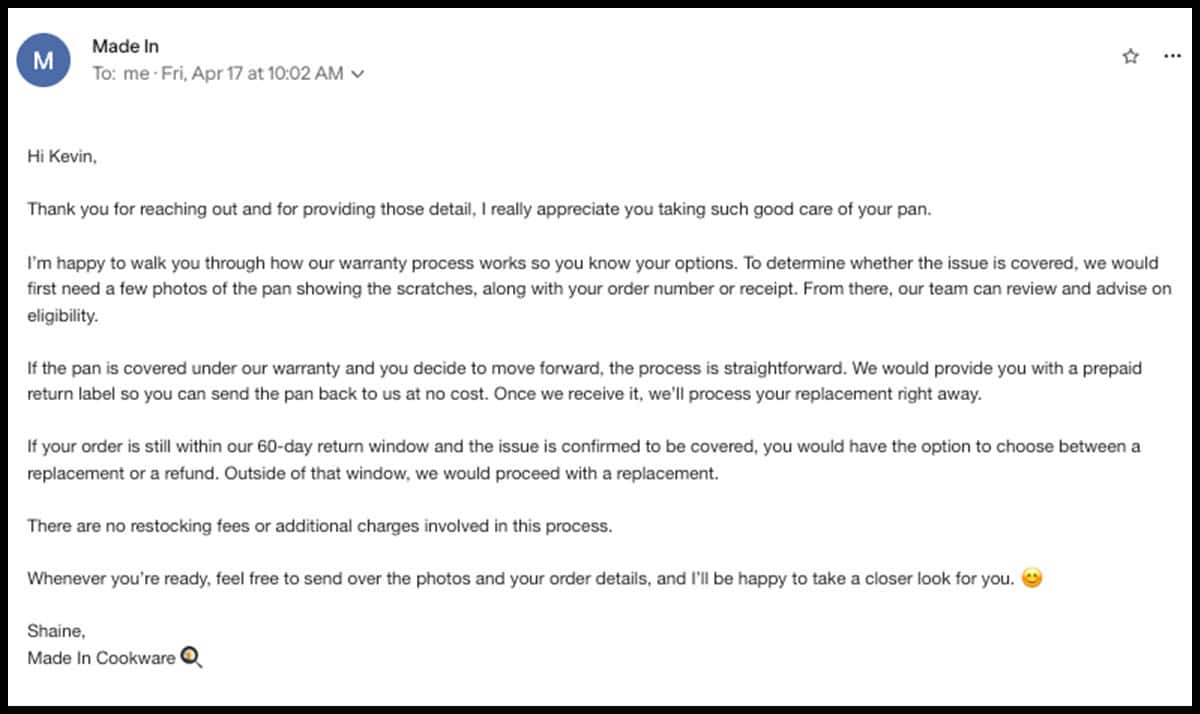
The warranty email was just as solid. They walked through the process step by step, confirmed there are no fees or shipping costs on the customer’s end, and clearly explained the difference between when you’d qualify for a refund vs. a replacement.
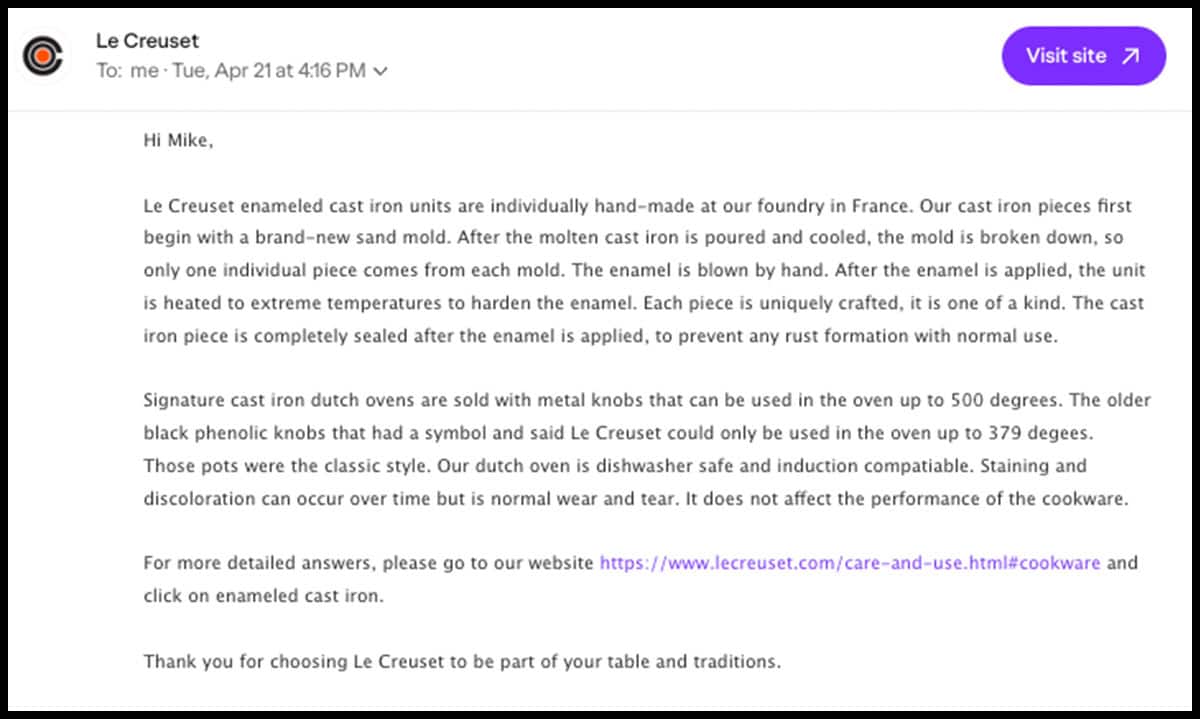
Le Creuset responded to all three emails, but none came back quickly. The two non-warranty emails took over five days each. The pre-purchase response covered the manufacturing process in detail but didn’t actually answer the specific question about whether the interior and exterior enamel are the same formulation, and dodged whether staining affects the warranty.
My email:
Hello,
I’m about to buy the 5.5 quart Signature Dutch oven and had some questions before I do:
Can you tell me about the enamel itself — is the interior enamel the same formulation as the exterior, and is there anything I should know about how it’s applied?
What’s the maximum oven-safe temperature with the standard knob? I’ve heard the phenolic knob has a lower limit than the stainless knob — is that still the case, and if so what are both numbers?
Is it dishwasher safe? I’m asking about what’s technically allowed, not just recommended.
Is this piece manufactured in France?
Is it induction compatible?
Any guidance on what to expect with the light-colored interior over time — does staining or discoloration affect the warranty?
Thanks so much.
Le Creuset’s response:
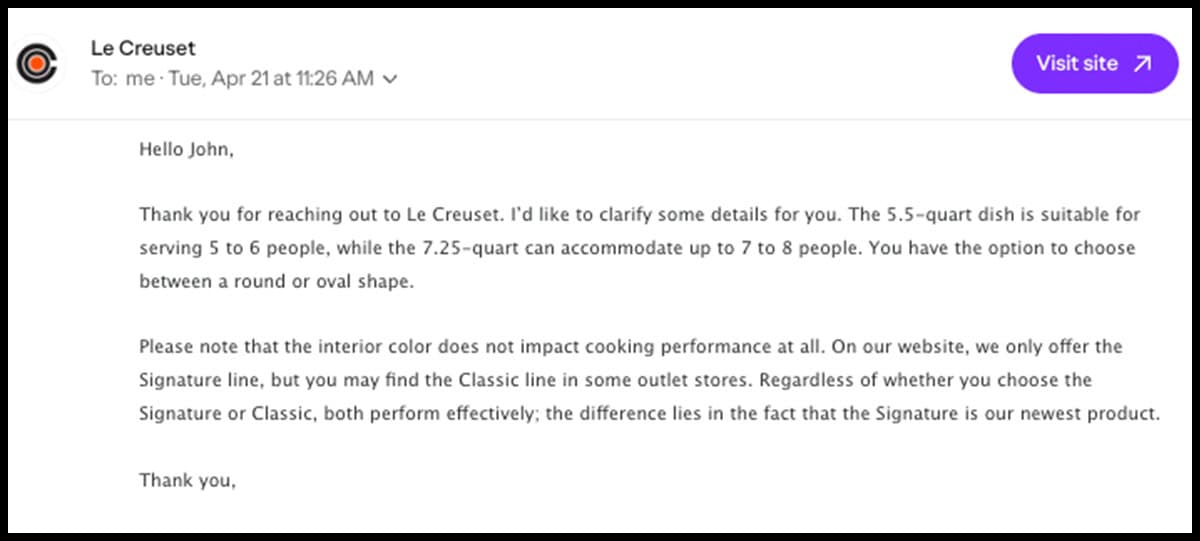
The cooking advice email was worse. It didn’t address round vs. oval in any meaningful way, didn’t explain the real difference between Signature and Classic (the handles are larger on Signature), and ignored the question about whether a dutch oven or braiser would be a better single piece. For a brand at this price point, five-day response times and incomplete answers are a tough look.
My email:
Hi,
Planning to buy my first Le Creuset dutch oven and could use some help. Background, I cook most nights for two, plus weekend dinners with friends (usually 4 to 6 people). I make a lot of braises, stews, soups, occasional no knead bread, and i’d want this to handle all of it.
Couple things i cant decide:5.5 qt vs 7.25 qt for my situation, is 5.5 really enough for 4 to 6 people or am I going to regret not sizing up. And is the 7.25 noticeably harder to deal with day to day
Round vs oval, is there a real functional difference or is it mostly looks. I’ve heard oval can be awkward on round burners
Does the interior color actually affect anything, like being able to see the fond or monitor browning
If i was only going to own one Le Creuset piece for the next few years would you still recommend the Signature dutch oven or point me at the braiser or something else
Signature vs Classic, is there a real cooking difference or is it mostly the handles
Thanks for any honest guidance.
Le Creuset’s response:
The warranty email took almost four days. The information was technically accurate but the tone was guarded.
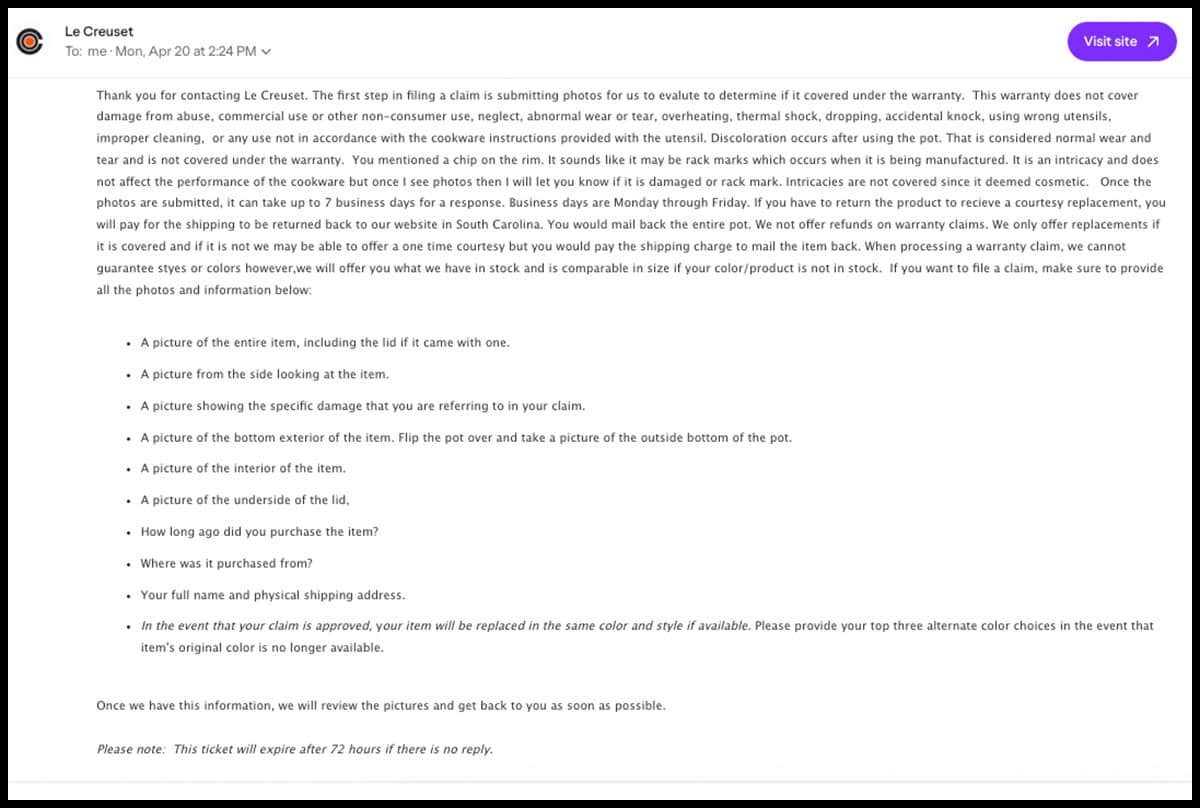
The rep listed every warranty exclusion upfront before seeing the issue, suggested that the enamel chip I described might be a manufacturing “rack mark” that wouldn’t be covered, clarified that the customer pays return shipping (which matters when you’re mailing back a 12-pound pot), and noted they can’t guarantee a color match on replacements. It answered some of my questions, but it didn’t exactly inspire confidence.
Factual (Pre-Purchase)
| Made In | Le Creuset | |
|---|---|---|
| Response Time | 1 hr 9 min | 127 hr 17 min |
| Helpfulness | Very Helpful | Somewhat Helpful |
| Accuracy | Fully Accurate | Fully Accurate |
| Overall | Excellent | Acceptable |
Opinion/Expertise
| Made In | Le Creuset | |
|---|---|---|
| Response Time | 25 min | 129 hr 6 min |
| Helpfulness | Very Helpful | Somewhat Helpful |
| Accuracy | Fully Accurate | Not Accurate |
| Overall | Excellent | Poor |
Warranty (Post-Purchase)
| Made In | Le Creuset | |
|---|---|---|
| Response Time | 1 hr 9 min | 89 hr 20 min |
| Helpfulness | Very Helpful | Somewhat Helpful |
| Accuracy | Fully Accurate | Fully Accurate |
| Overall | Excellent | Acceptable |
I ran this same test with six other brands. Made In was the only one that earned “Excellent” across all three emails. Le Creuset was one of the slowest to respond, with all three emails taking between four and five days. You can find the full results in my Made In cookware review.
Bottom Line: Should You Buy a Made In or Le Creuset Dutch Oven?
Now that you know the facts about Made In and Le Creuset Dutch ovens, which brand is best for you?
Before I share my recommendation, let’s quickly recap the main differences.
- Made In Dutch ovens are heavier, but the thicker construction holds heat longer.
- Le Creuset has the most colors, sizes, and shapes of Dutch ovens.
- All Le Creuset Dutch ovens have a light-colored interior; Made In offers one with a dark interior.
- Made In Dutch oven lids have raised dimples on the interior that self-baste food, resulting in a more even moisture distribution.
- While both have interchangeable knobs, Le Creuset offers six options to Made In’s two.
- Made In’s lid knobs are easier to grip because the stems are longer and thinner.
- Le Creuset handles have wider loops, making it easier to pick up with an oven mitt or bulky oven gloves.
- Both brands make Dutch ovens in France, but Le Creuset’s are made in-house, while Made In contracts out for manufacturing.
- Le Creuset Dutch ovens are significantly more expensive.
Bottom line — Made In Dutch ovens have thicker construction, retain heat better, and come with self-basting lids. For half the price, it’s hard to beat the value of Made In.
However, there’s a certain prestige that comes with Le Creuset. It’s the gold standard of enameled cast iron cookware — they’ve been perfecting the craft since 1925. Plus, few brands offer as many colors and sizes as Le Creuset.
Ultimately, you’ll be happy with either brand. But if your primary goal is to get the best-performing Dutch oven at the best value, go with Made In.
If you have a particular color or size in mind and are okay paying a premium for the peace of mind that comes with a century-old brand, Le Creuset is a worthy investment.
Read more reviews and compare current prices at the links below:
- Made In Dutch ovens on MadeInCookware.com and Amazon
- Le Creuset Dutch ovens on LeCreuset.com and Amazon
Related Topics
- 6 High-Quality Alternatives to Le Creuset Dutch Ovens
- Staub vs. Le Creuset Dutch Ovens: How Do They Compare?
- Best Dutch Oven? I Tested Le Creuset, Lodge, Staub, Caraway, & Made In
- Staub Dutch Oven Review: Pros, Cons, and Test Results
- Le Creuset vs. Tramontina: Which Dutch Ovens Are Better?
- Made In vs. Demeyere: Which Stainless Steel Pans Are Better?
- Made In Cookware Review After 3+ Years (With Test Results)
- Made In vs. Heritage Steel: 9 Key Differences Explained
- Are Made In Non-Stick Pans Worth Buying? An In-Depth Review
- Made In vs. Hestan: Which Stainless Steel Cookware Is Better?
- All-Clad vs. Made In: The Ultimate Cookware Comparison
- Where Is Made In Cookware Made? (Solved!)
- HexClad vs. Made In: The Ultimate Cookware Comparison
- Made In vs. Caraway Cookware: 11 Key Differences
- Lodge vs. Le Creuset Dutch Ovens: What’s the Difference?
- HexClad vs. Le Creuset: 7 Differences & How to Choose
- Lodge Dutch Oven In-Depth Review (With Pictures)
- Le Creuset vs. Cuisinart Dutch Ovens: What’s the Difference?
- Staub vs. Lodge: Which Dutch Ovens Are Better?
- Ceramic vs. Enameled Cookware: What’s the Difference?
- Oval vs. Round Dutch Ovens: Which Shape Is Better?
- Great Jones vs. Le Creuset: Which Dutch Oven Is Better?
- All-Clad vs. Le Creuset: Which Stainless Steel Cookware Is Better?
- Is Le Creuset Worth the High Price? An In-Depth Review

