

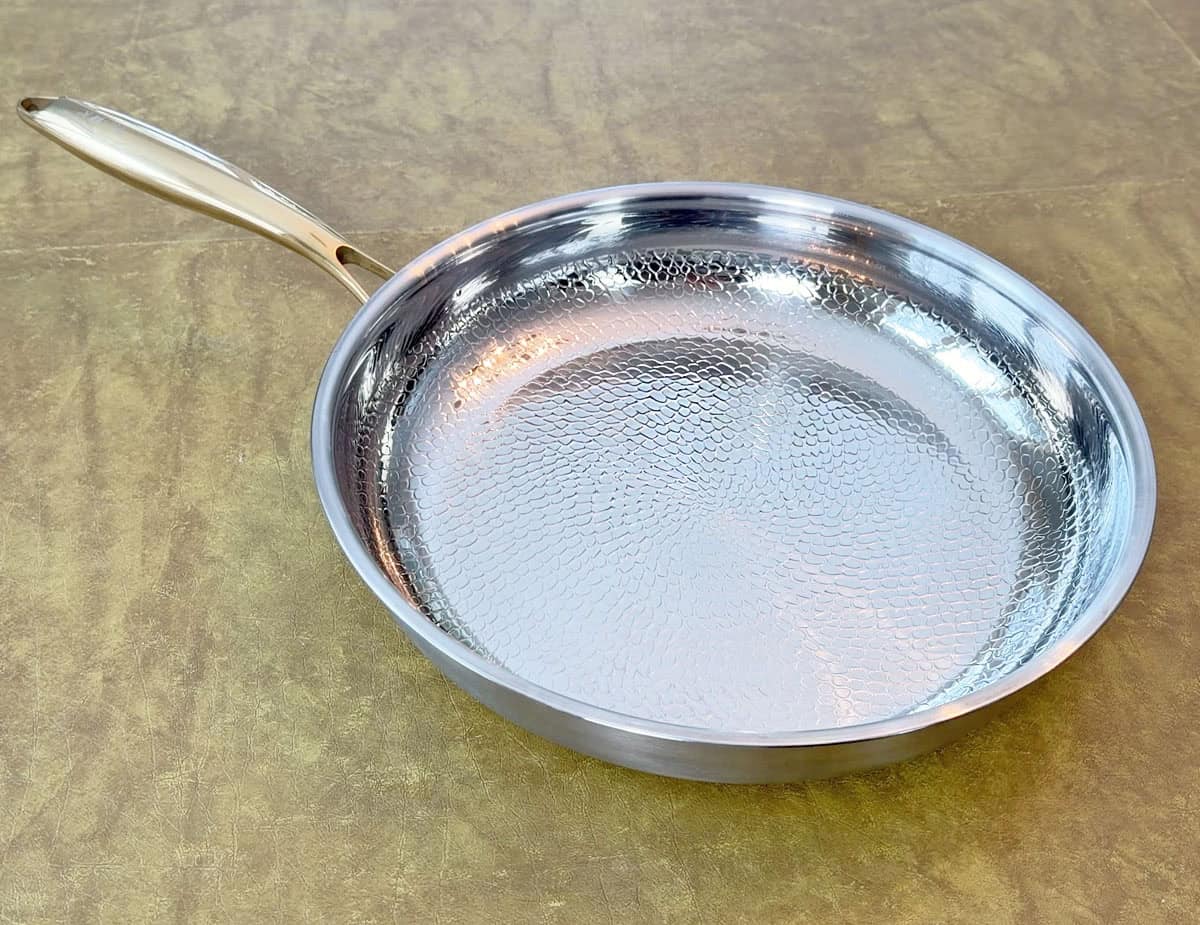
Taima claims its pan has a pure Grade 1 titanium cooking surface that’s naturally nonstick, impossible to corrode, and built to last a lifetime. They also say the textured surface, called SlipScale, improves food release with minimal oil by up to three times.
To see if those claims hold up, I cooked with the Taima Titanium Classic Pan for several months and tested it alongside four other titanium pans (Hestan NanoBond, Our Place Titanium Always Pan Pro, Viking PureGlide Pro, and Heritage Steel Titanium) and a stainless steel control (Henckels Clad H3).
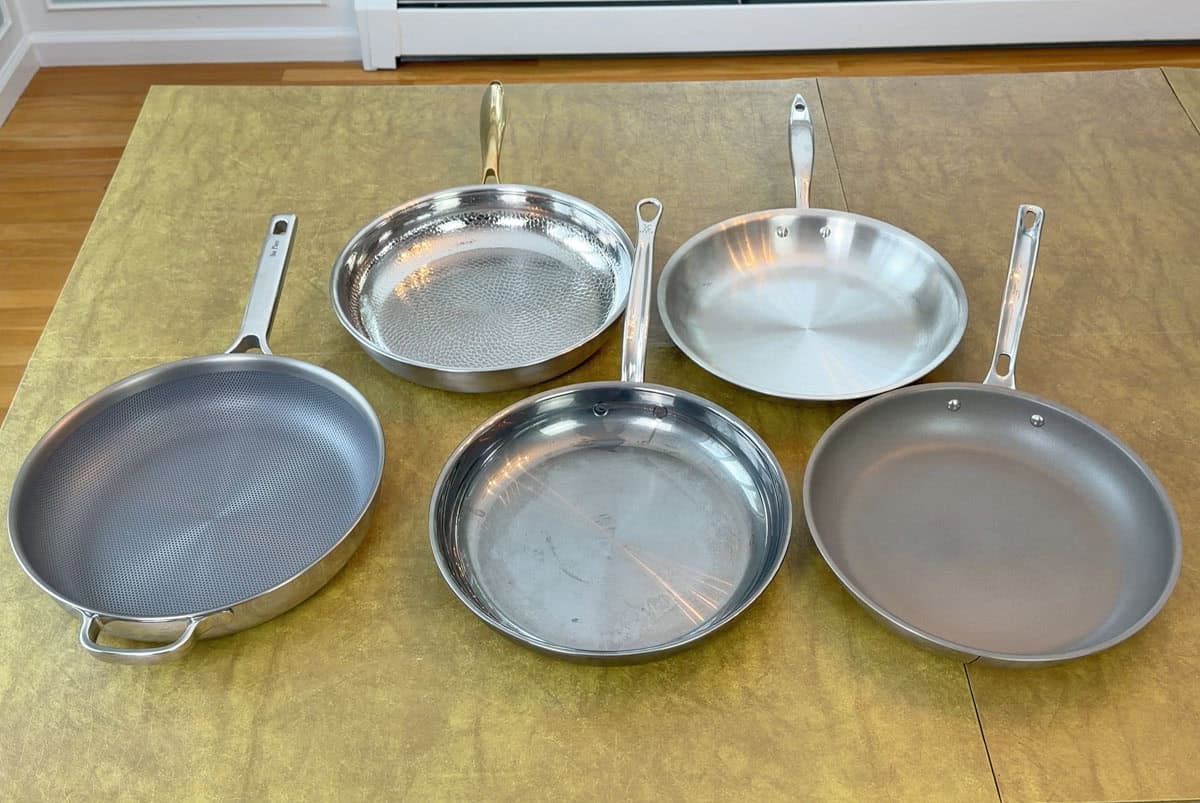
I ran them through the same set of tests. I cooked eggs and pancakes with and without fat, performed five escalating scratch tests, repeated the egg test after scratching the surface, and ran an aggressive salt pitting test to see how well each pan resists corrosion.
I also measured heat conduction, heat distribution, and heat retention using the same protocols I use on every pan I review.
In this review, I’ll show you which claims held up, which ones didn’t, and whether the Taima pan is worth the high price.
Key Takeaways
- Nonstick performance with a small amount of fat was nearly flawless, on par with the best titanium pans I tested.
- Without fat, the egg stuck badly, just like regular stainless steel. The SlipScale surface didn’t prevent it.
- It handled ladle and spatula scratches better than any pan in the group, but a serrated knife and Scotch-Brite sponge left significant marks.
- At 2mm thick, it’s thinner than every other fully clad pan I tested, and the bottom bowed out after just a few uses. It spins on a flat cooktop like a top.
- Heat conduction was among the fastest I’ve measured, but heat distribution was among the worst, with a 140-degree gap between the center and outer edge.
- Heat retention was dead last out of all 30+ pans I tested, dropping to just 101 degrees after 5 minutes off the burner.
- Zero signs of pitting or corrosion after three rounds of an aggressive salt test.
- The handle is rounded and slippery when wet, greasy, or soapy.
If you’re considering the Taima, I’d recommend looking at the Viking PureGlide Pro instead. It outperformed the Taima in almost every test I ran and it costs less. Check out Viking PureGlide Pro on Amazon or learn more about Taima on Amazon.
Use the links below to navigate this review:
- Specs and Construction
- Nonstick Performance
- Heat Performance
- Durability and Scratch Resistance
- Corrosion Resistance
- Claims vs. Reality
- Bottom Line: Is Taima Titanium Cookware Worth Buying?
Specs and Construction
The Taima Titanium Classic pan is a 12.5-inch fully clad frying pan made in China. The construction is 5-ply: a pure titanium cooking surface, a triple-layer aluminum core, and a stainless steel exterior.
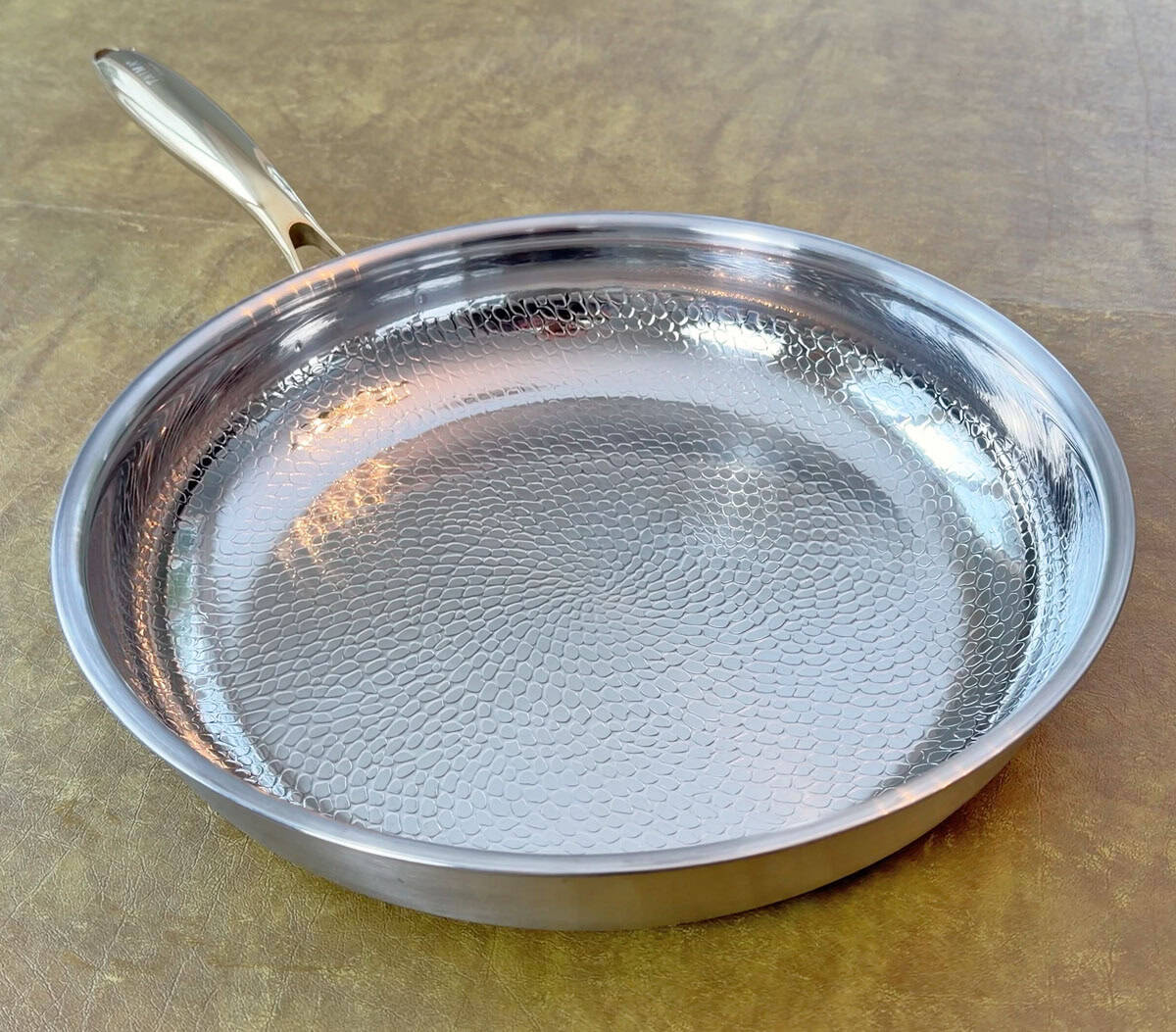
Taima says the cooking surface is Grade 1 titanium, lab-graded at 99.86% purity, which they call medical-grade. The exterior has a brushed finish and the interior is rivetless, which means fewer crevices for food to get trapped around.
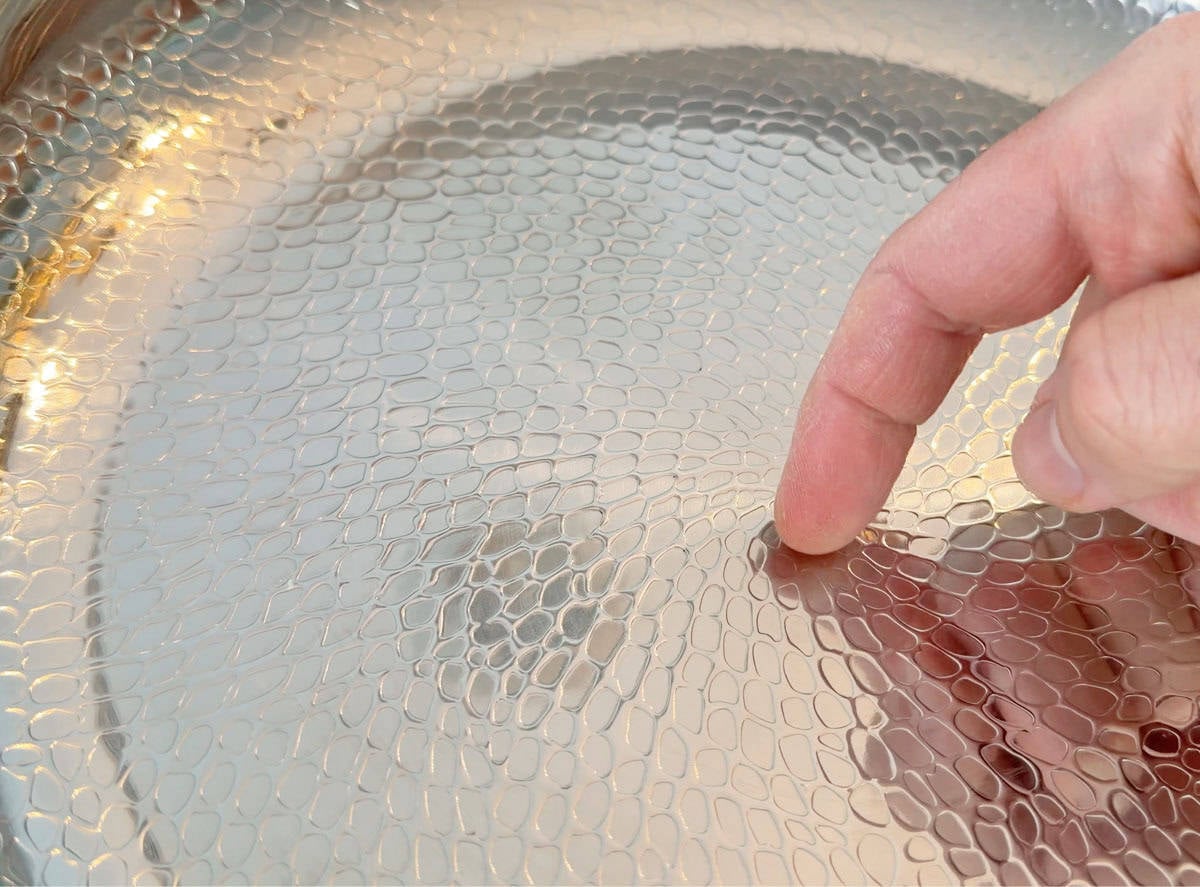
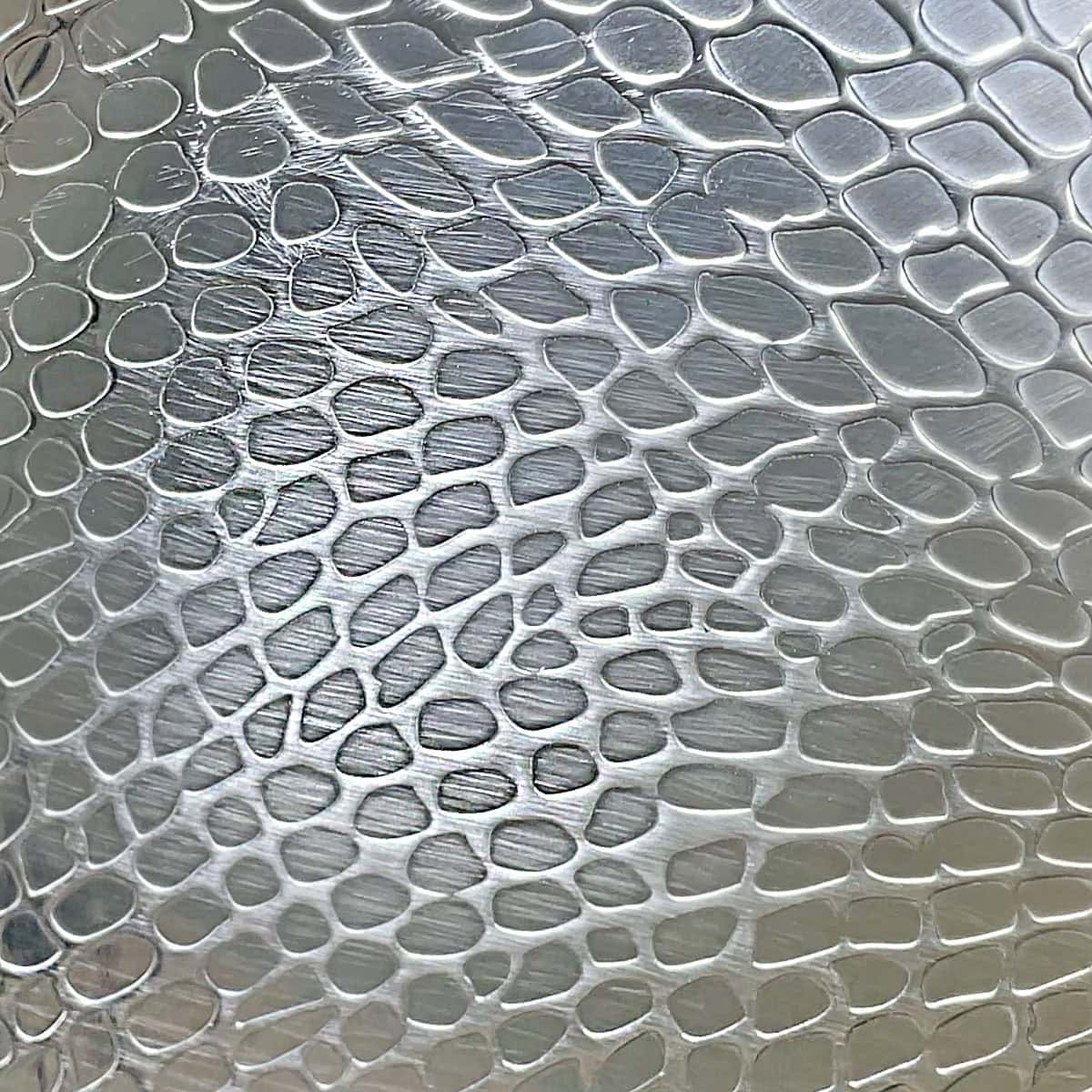
The cooking surface has a scale-like textured pattern that Taima calls SlipScale. It looks similar to what you’ll find on the Our Place Titanium Always Pan Pro. The idea is that the pattern creates small pockets of air and oil between the food and the pan, reducing contact and preventing sticking.
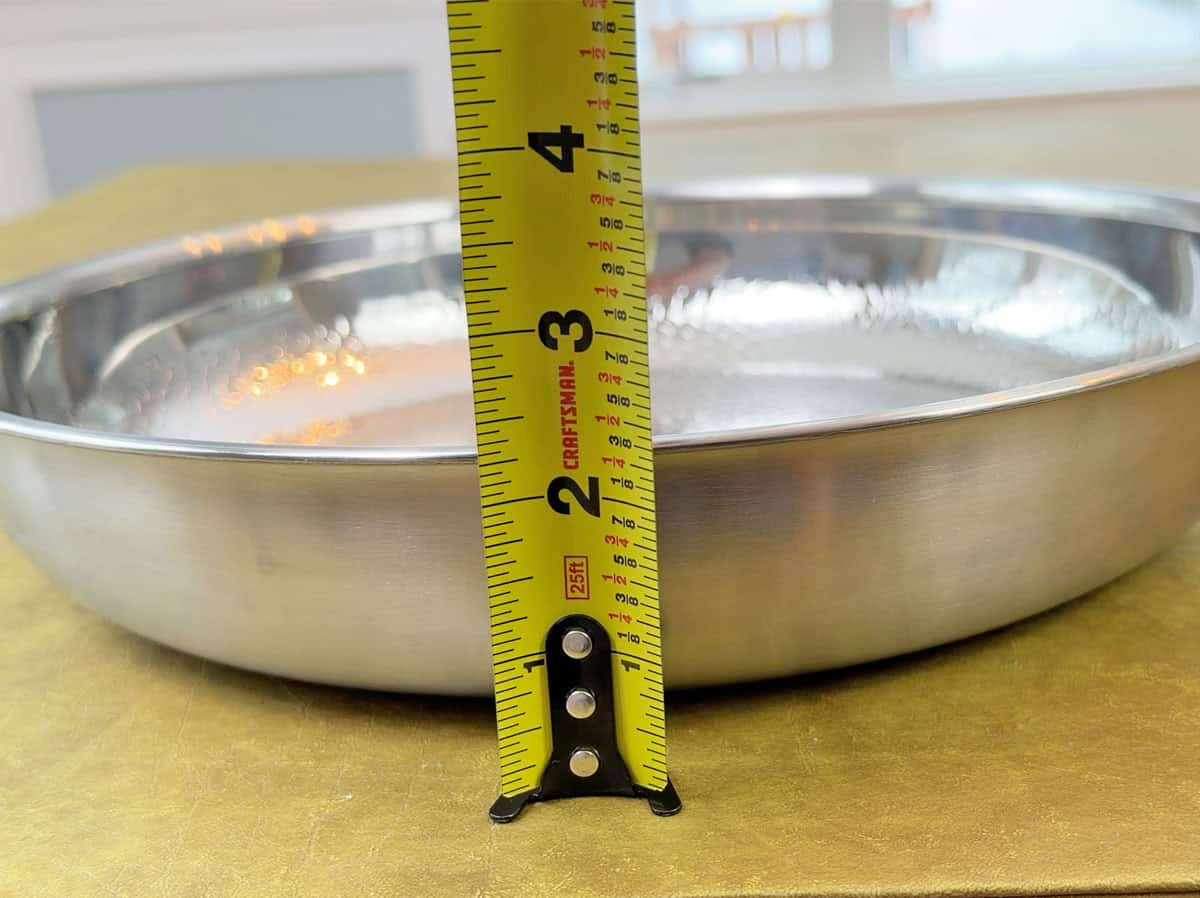
It weighs 2.8 pounds, making it one of the lighter pans I’ve tested. The Heritage Steel Titanium (also 5-ply) weighs 2.9 pounds, and the Our Place Titanium Always Pan Pro comes in at 3.9 pounds. The flat cooking surface measures 9.25 inches across with 2.3-inch walls. The taller walls are a nice feature (most 12-inch pans are around 2 inches). They give you more capacity and help reduce splatter.
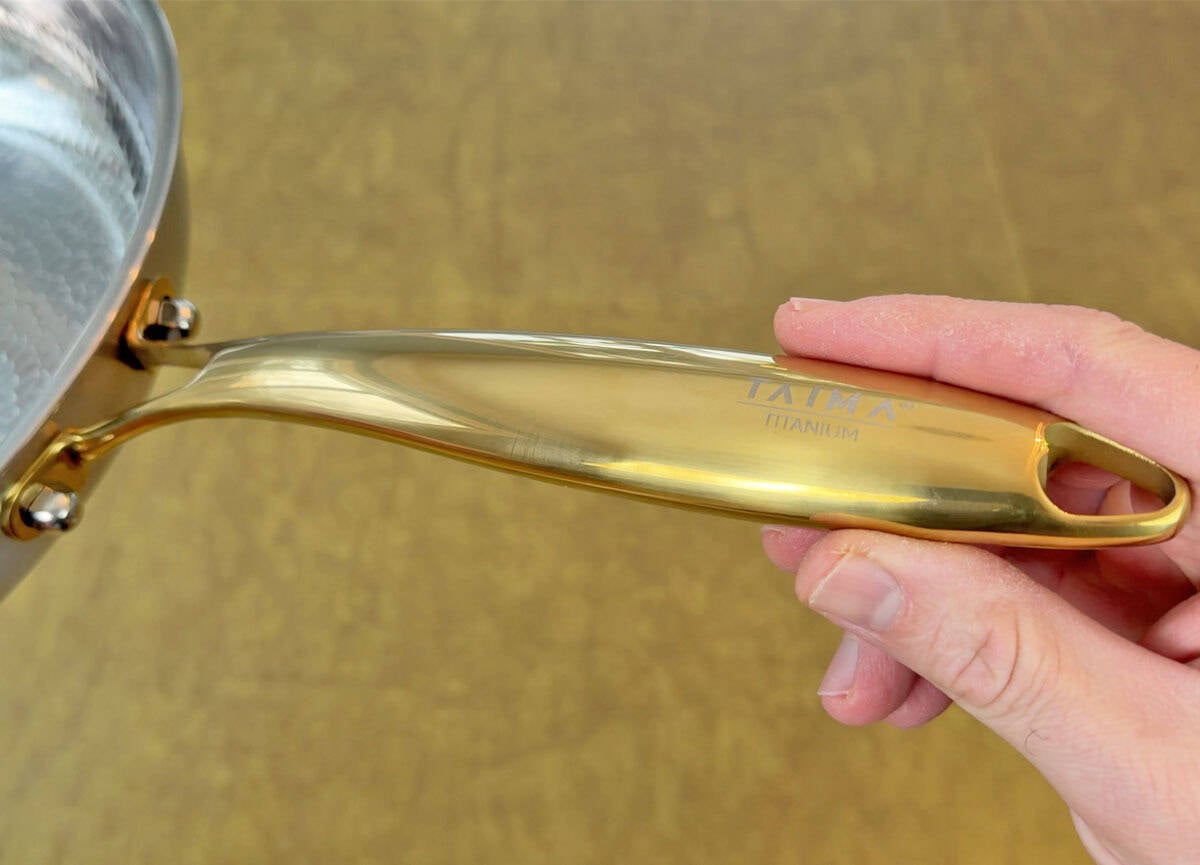
The handle is 8.5 inches long with a gold-tone finish. It looks nice, but because it’s rounded, it gets slippery when your hands are wet, greasy, or soupy. I noticed this issue repeatedly over several months of cooking with the pan.
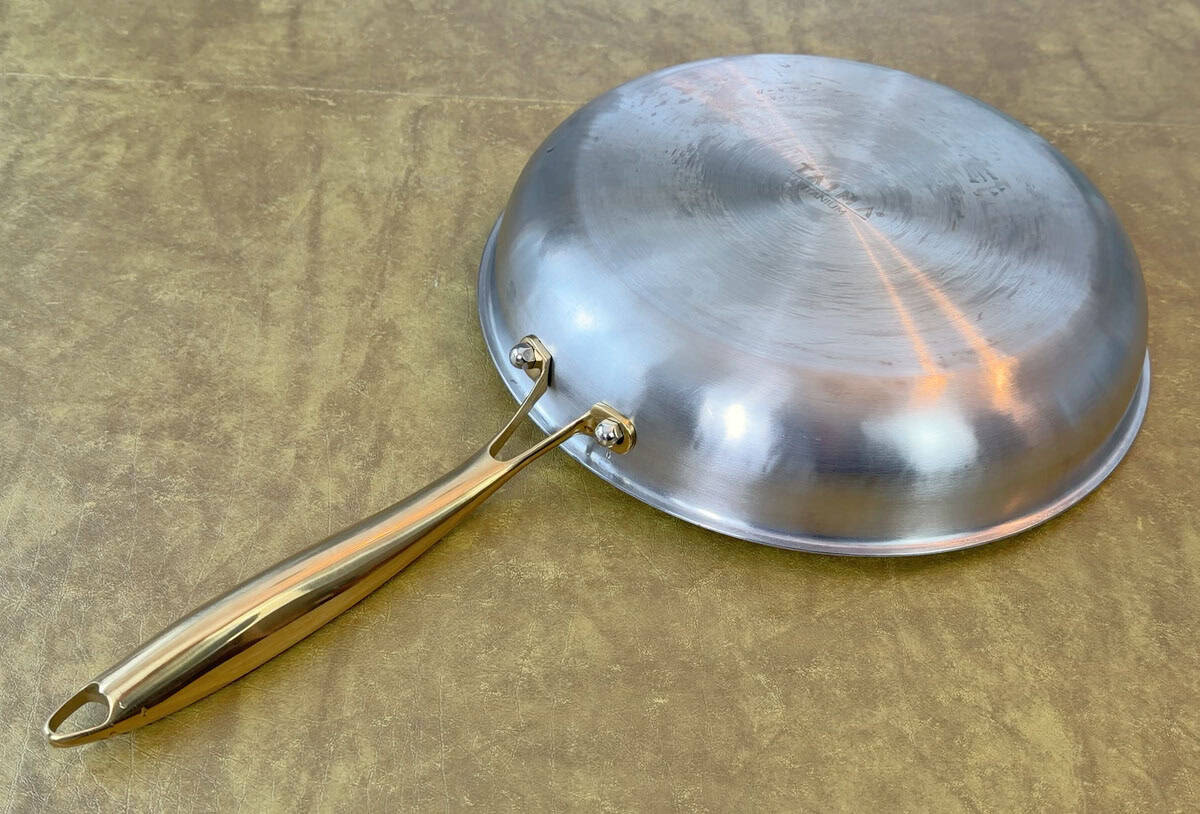
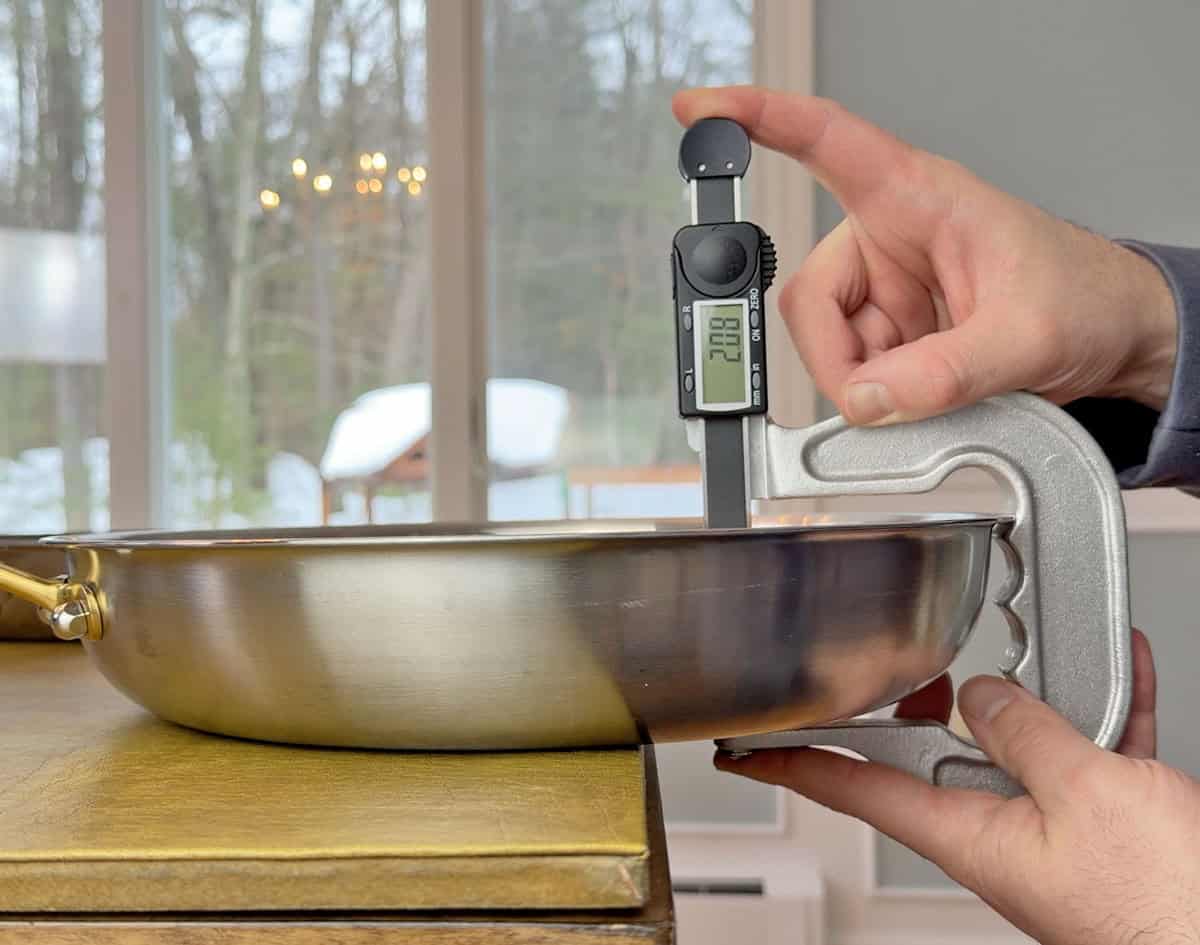
The biggest issue is that it’s only 2mm thick. That’s thinner than every other fully clad pan I tested (I tested over 30 others), where most ranged from 2.4mm to 3.1mm. You can feel the difference when you pick it up.
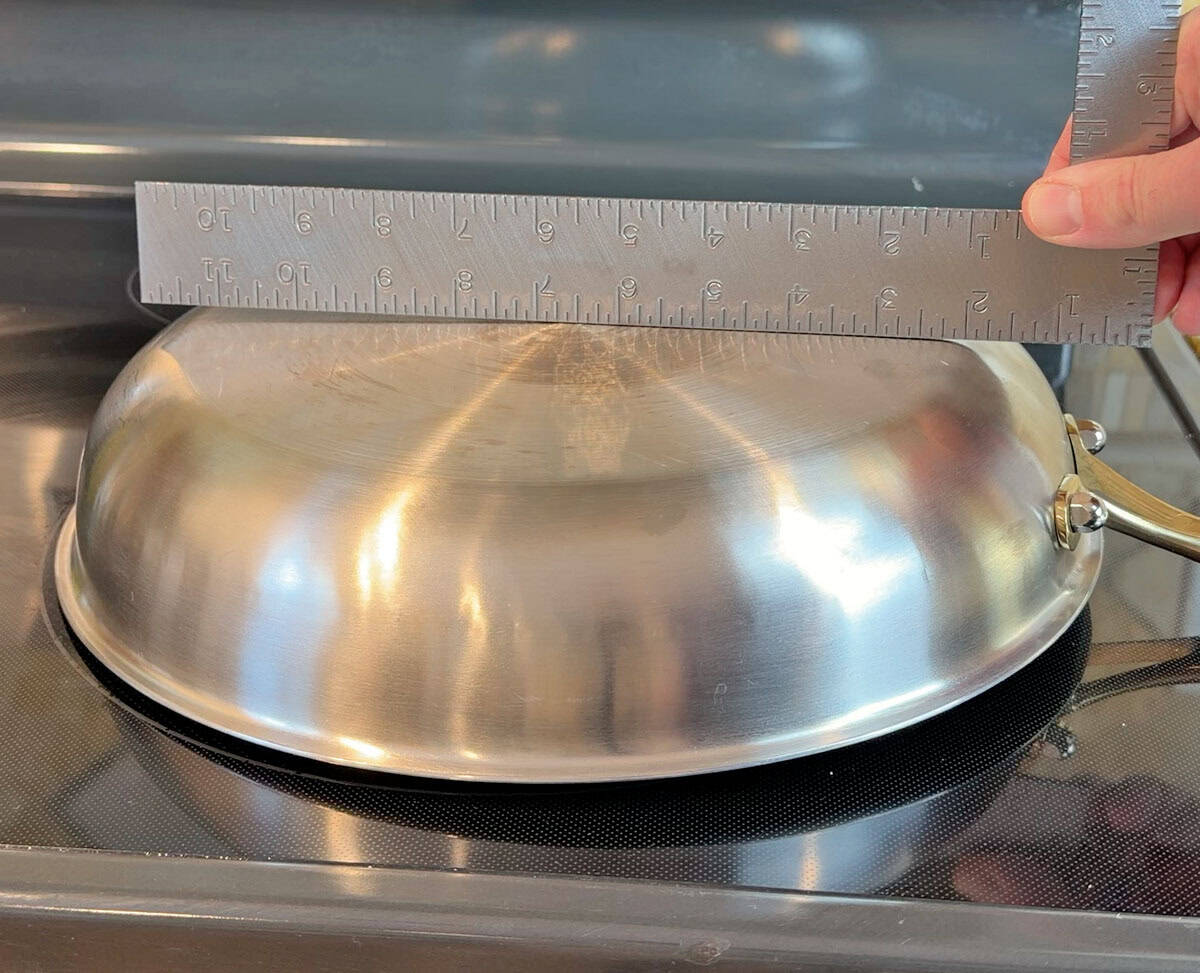
After just a few uses on my cooktop, the bottom bowed out and the pan started spinning on the burner. If you nudge the handle even slightly, it rotates like a top – that’s a serious problem.
| Spec | Taima Titanium |
|---|---|
| Price | $190 on Taima’s website |
| Made In | China |
| Construction | 5-ply (titanium, 3x aluminum, steel) |
| Cooking Surface | Grade 1 titanium with SlipScale pattern |
| Fully Clad | Yes |
| Rivets | Rivetless |
| Diameter (rim to rim) | 12.5 in |
| Flat Cooking Surface | 9.25 in |
| Wall Height | 2.3 in |
| Weight | 2.8 lbs |
| Thickness | 2.0 mm |
| Handle Length | 8.5 in |
| Induction Compatible | Yes |
Nonstick Performance
One of Taima’s biggest selling points is that the SlipScale surface releases food like a nonstick pan, but without any chemical coating. To test that, I preheated each pan on medium-low until the cooking surface reached 325 degrees, then added a half teaspoon of oil and two grams of butter before cooking an egg.
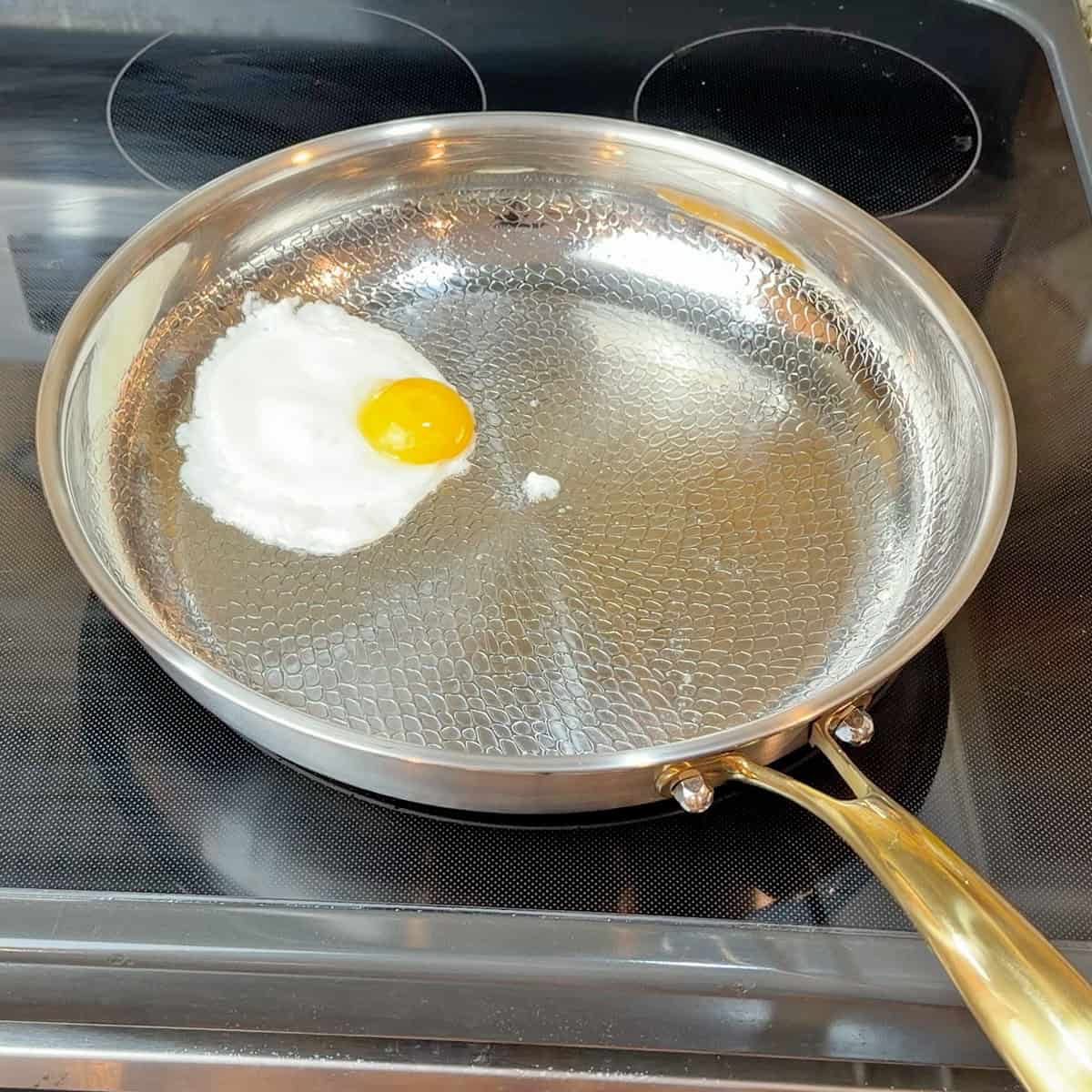
With fat, the Taima performed well. One tiny spot stuck but 99% of the surface released cleanly. The performance was in line with Heritage Steel Titanium and the Our Place Titanium Always Pan Pro. The Viking PureGlide Pro was the best performer in this test. The egg slid around like a hockey puck without needing a spatula at all.
Without fat, the Taima failed. The egg stuck badly, just like the Hestan NanoBond, Heritage Steel, and the plain stainless steel control. The SlipScale surface didn’t help.
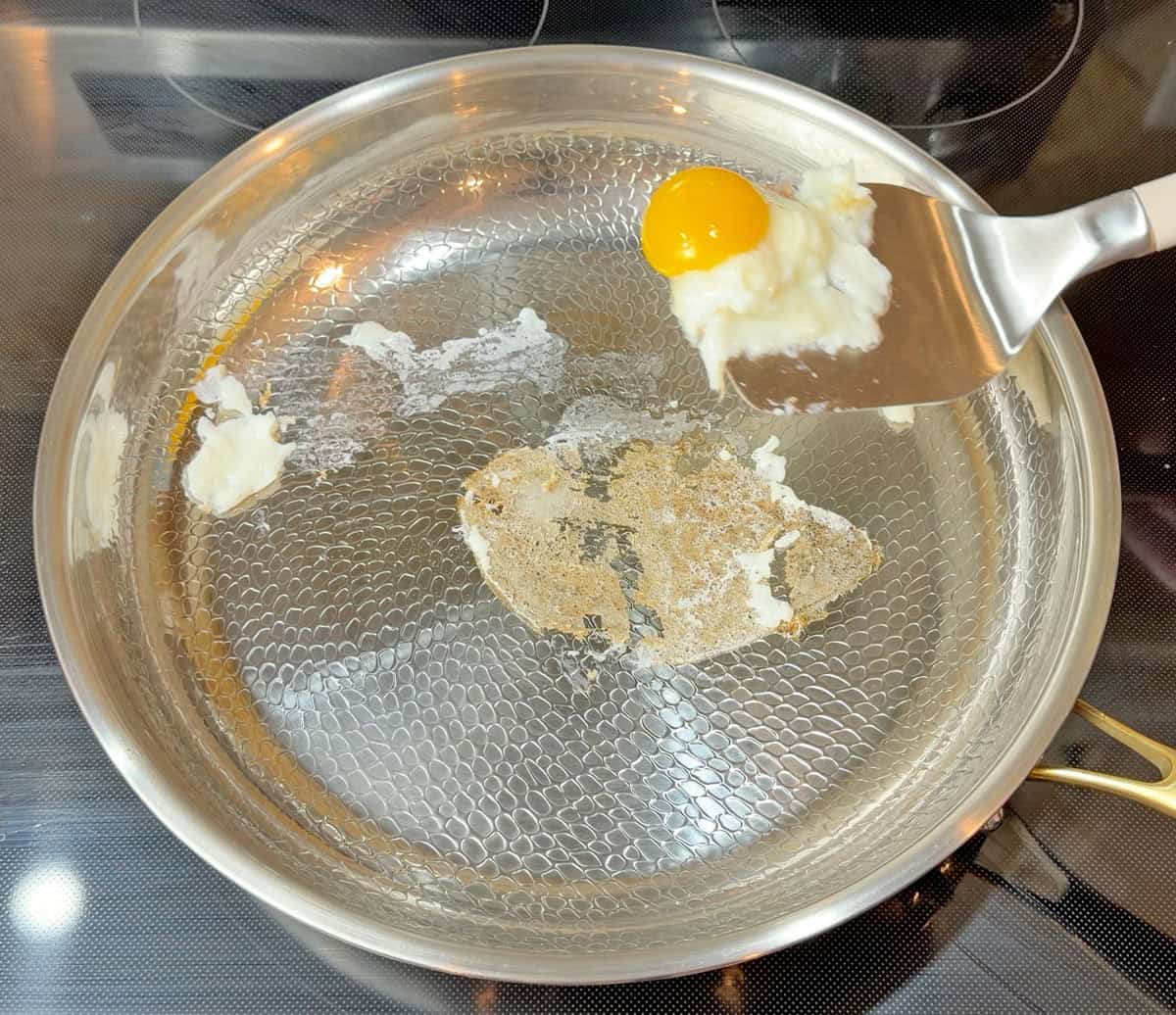
The only two pans that handled a dry egg were the Our Place (which released cleanly, a result I’ve only seen from traditional nonstick pans) and the Viking PureGlide Pro (minor sticking in spots, but still flippable).
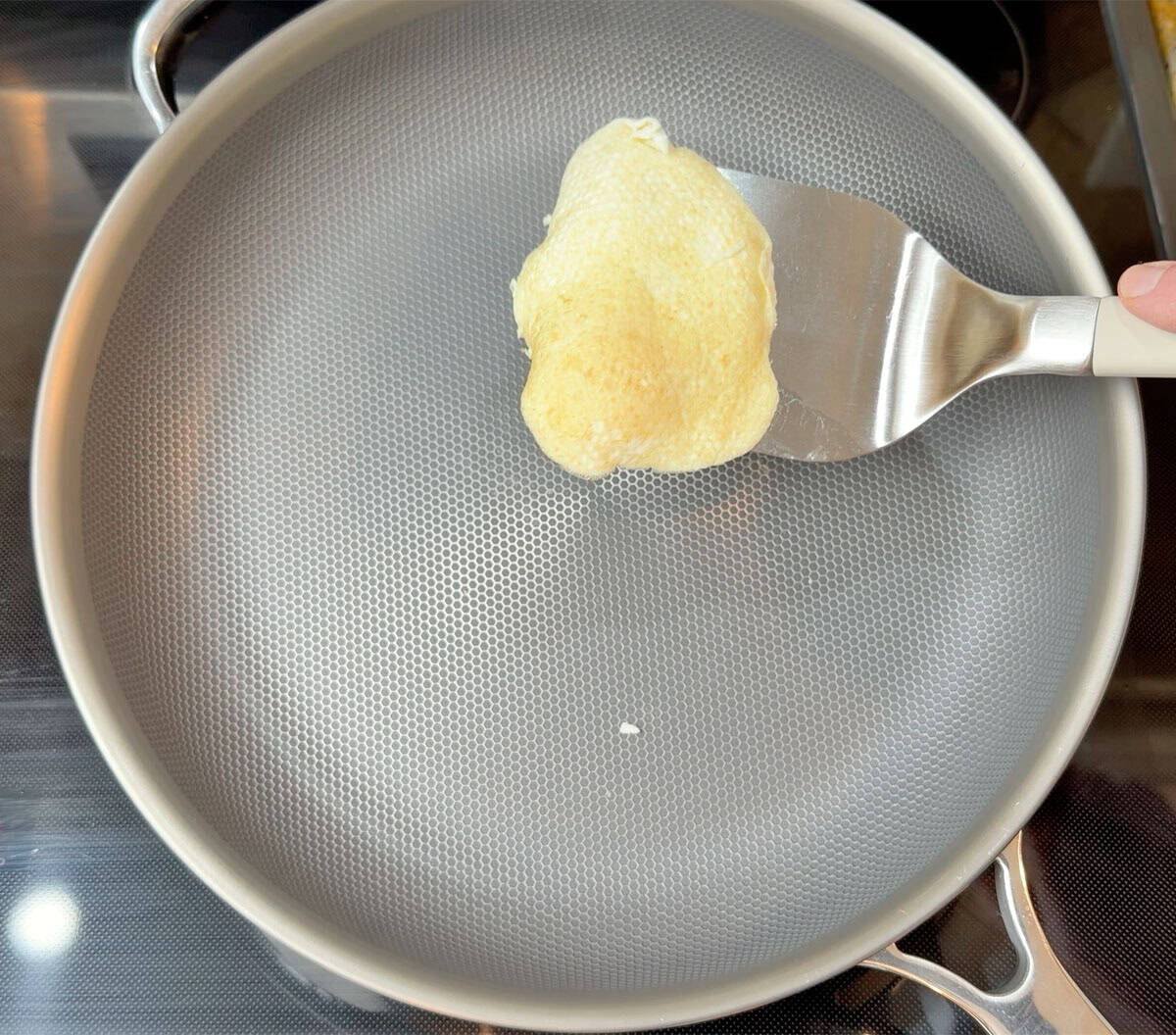
I also cooked pancakes on each pan. For the first round, I spread a thin layer of butter on the surface before adding the batter. Every pan passed without sticking. For the second round, I didn’t use any butter. The Taima performed well with no sticking, along with the Viking and Our Place. The Heritage Steel and stainless steel control stuck the most.
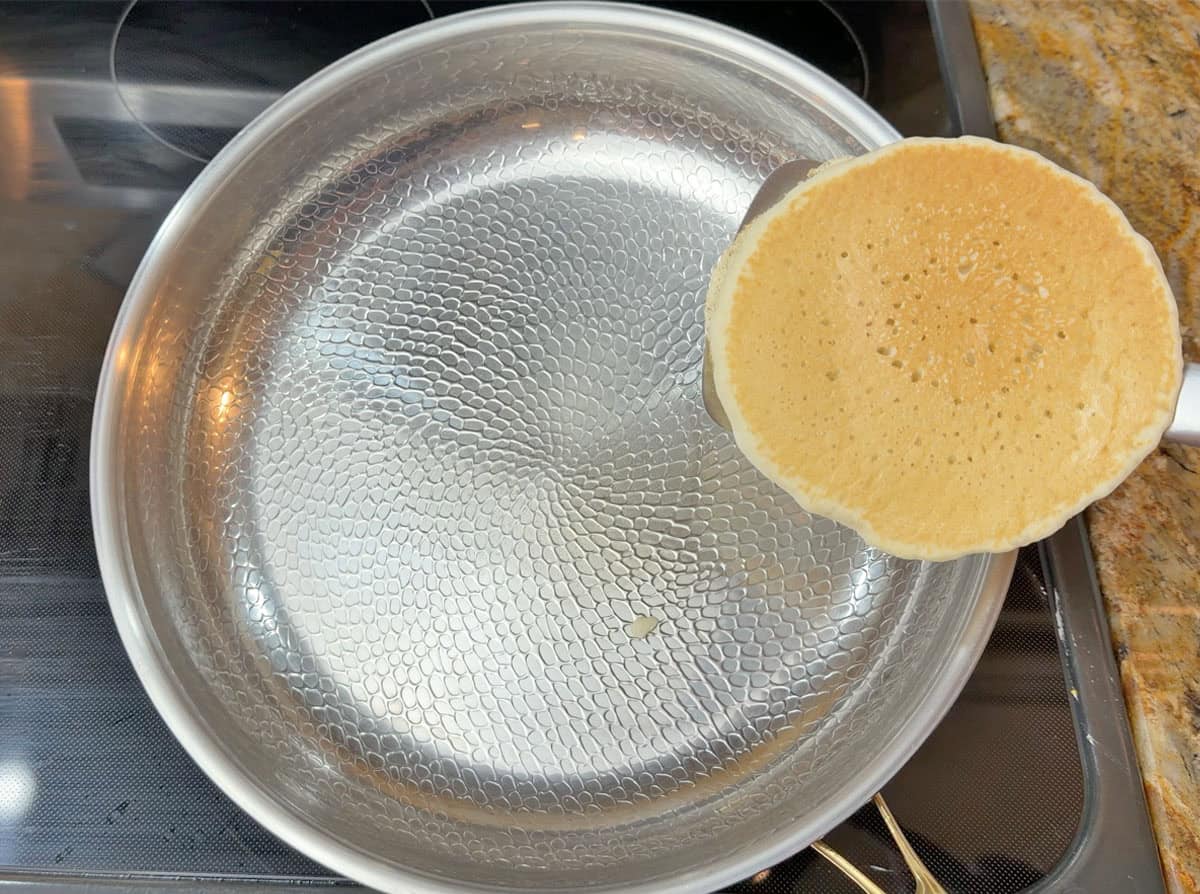
The bottom line on nonstick: the Taima is solid when you use even a small amount of fat. But the nonstick claim falls apart without grease. Taima’s marketing says the SlipScale pattern enhances food release with minimal oil by up to 3x. In my testing, it worked fine with a little fat, but “minimal oil” is doing a lot of heavy lifting in that claim. Without any oil, it performed no better than a regular stainless steel pan.
Heat Performance
Taima’s website claims titanium is the most efficient heat conductor, letting you cook evenly at lower temperatures without losing flavor or nutrients. To put that to the test, I measured heat conduction, distribution, and retention using the same protocols I use across every pan that I test. This is where the thin construction shows up in the data.
Taima conducts heat really fast. After one minute on medium heat, the center of the cooking surface reached 472°F. After two minutes, 522°F. That’s among the fastest I’ve measured across 30+ pans. For comparison, the All-Clad D3 Everyday hit 365°F at the two-minute mark and the Made In reached 529°F.
But fast conduction isn’t always a good thing when it comes with poor distribution.
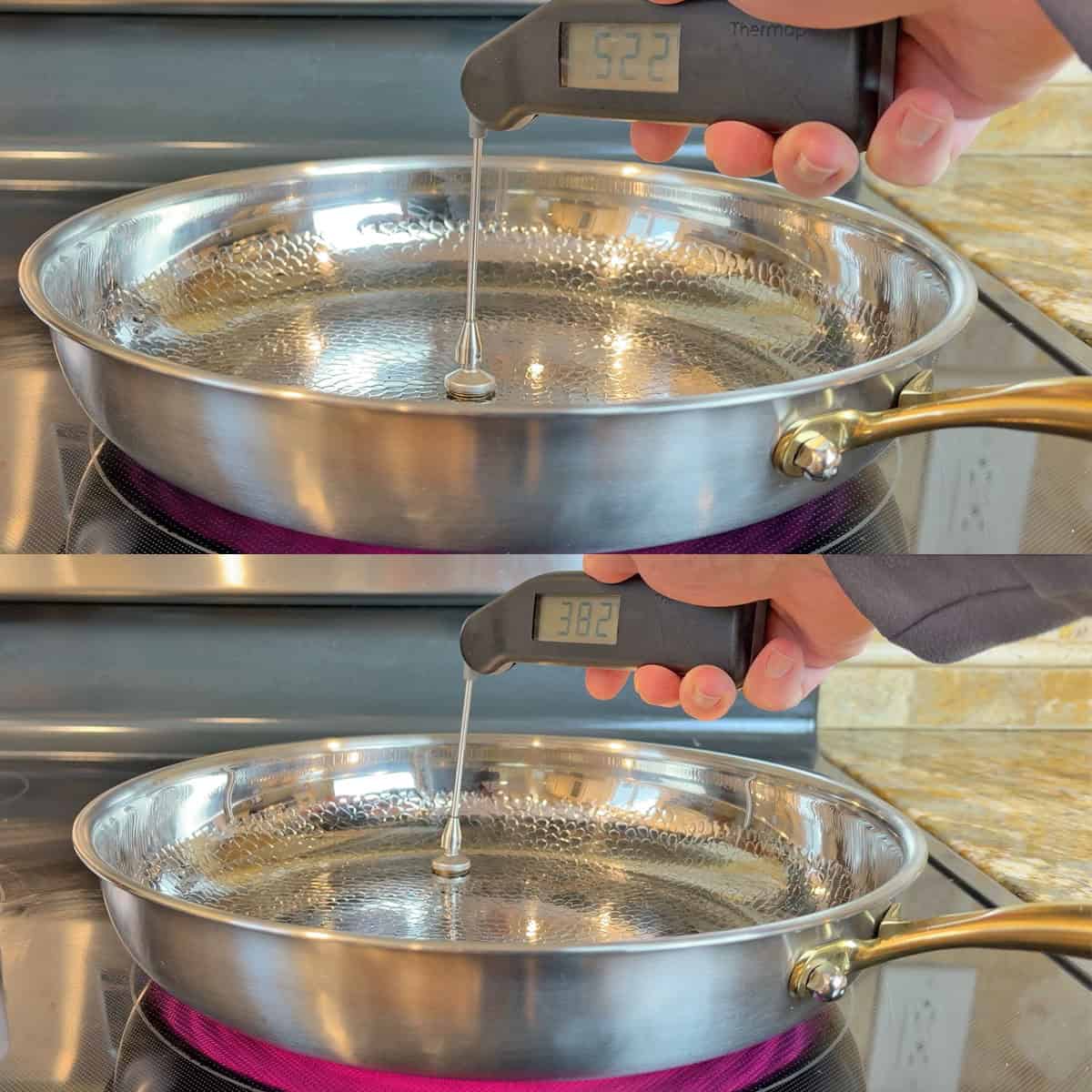
At the two-minute mark, the center measured 522°F while the outer edge was only 382°F. That’s a 140-degree gap, one of the worst in my entire dataset. The All-Clad D5 had a 30-degree gap. The Viking PureGlide Pro had a 35-degree gap. The Heritage Steel Titanium had a 120-degree gap. A pan with a 140-degree difference will produce noticeably uneven cooking, especially with something like a pancake or a piece of fish where consistent browning matters.
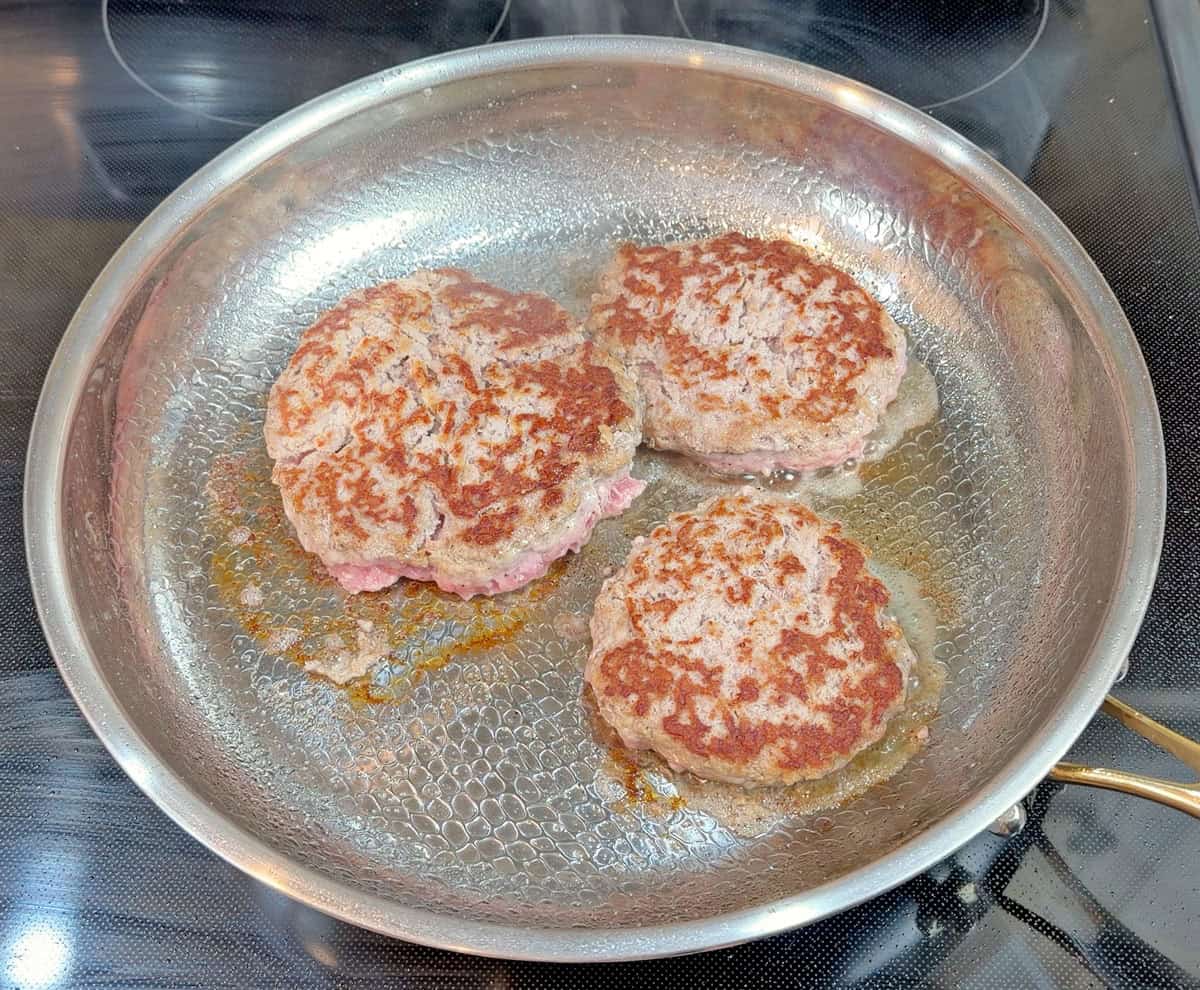
Heat retention was the worst I’ve measured. Five minutes after heating the pan to 400°F and removing it from the burner, the cooking surface dropped to just 101°F. Compare that to the Fissler Original-Profi at 176°F, the Demeyere Atlantis at 166°F, or even the $20 Farberware Classic at 126°F. The Taima loses heat fast when food is added, which is a problem for searing.
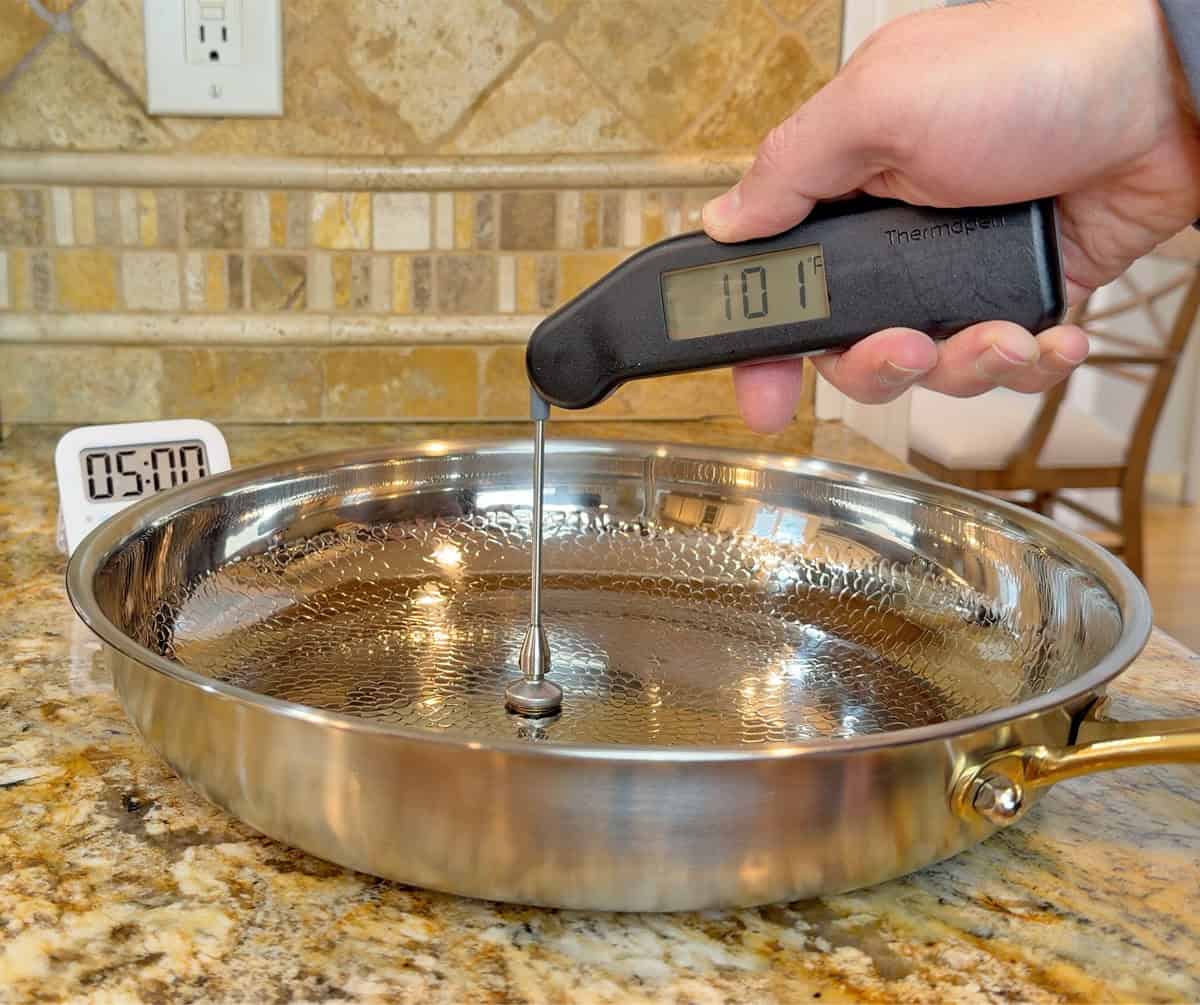
Taima’s website says titanium lets you cook evenly at lower temperatures. My testing showed the opposite. The pan heated up quickly but didn’t spread that heat evenly and didn’t hold onto it. Both issues trace back to the 2mm thickness. A thicker pan absorbs and distributes heat more gradually, resulting in more even cooking and better recovery when cold food hits the surface.
Durability and Scratch Resistance
Taima says their pan is “engineered to outlast you,” that “you couldn’t destroy it if you tried,” and that it’s safe to use with metal utensils. To test those claims, I ran five scratch tests on every pan, escalating in intensity.
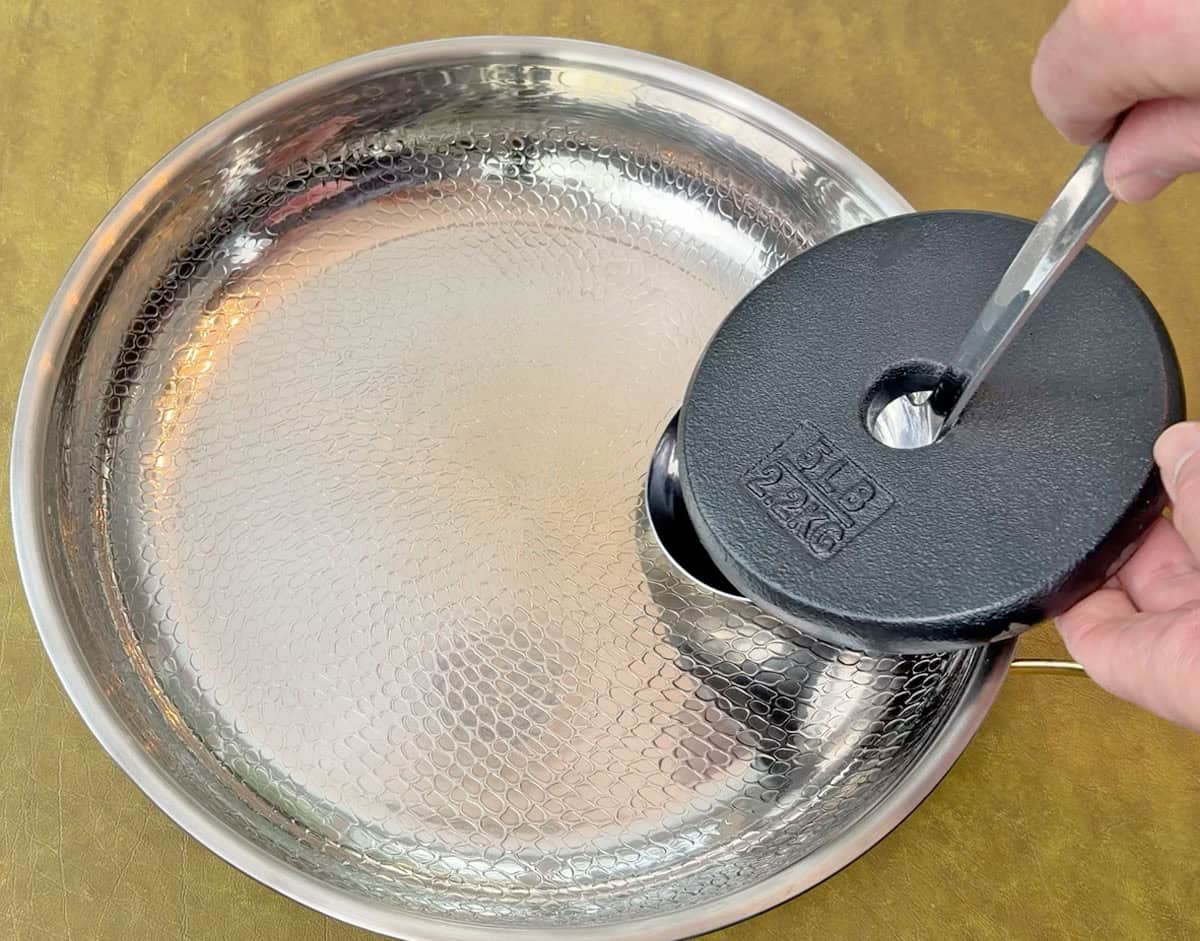
First, I attached a five-pound weight to a metal ladle and scraped it across each pan 50 times, then did the same thing with a metal spatula. The Taima had no noticeable marks at all, the best result in the group. The stainless steel control had scratches you could feel with a fingernail, and the Hestan and Heritage Steel had visible cosmetic marks.
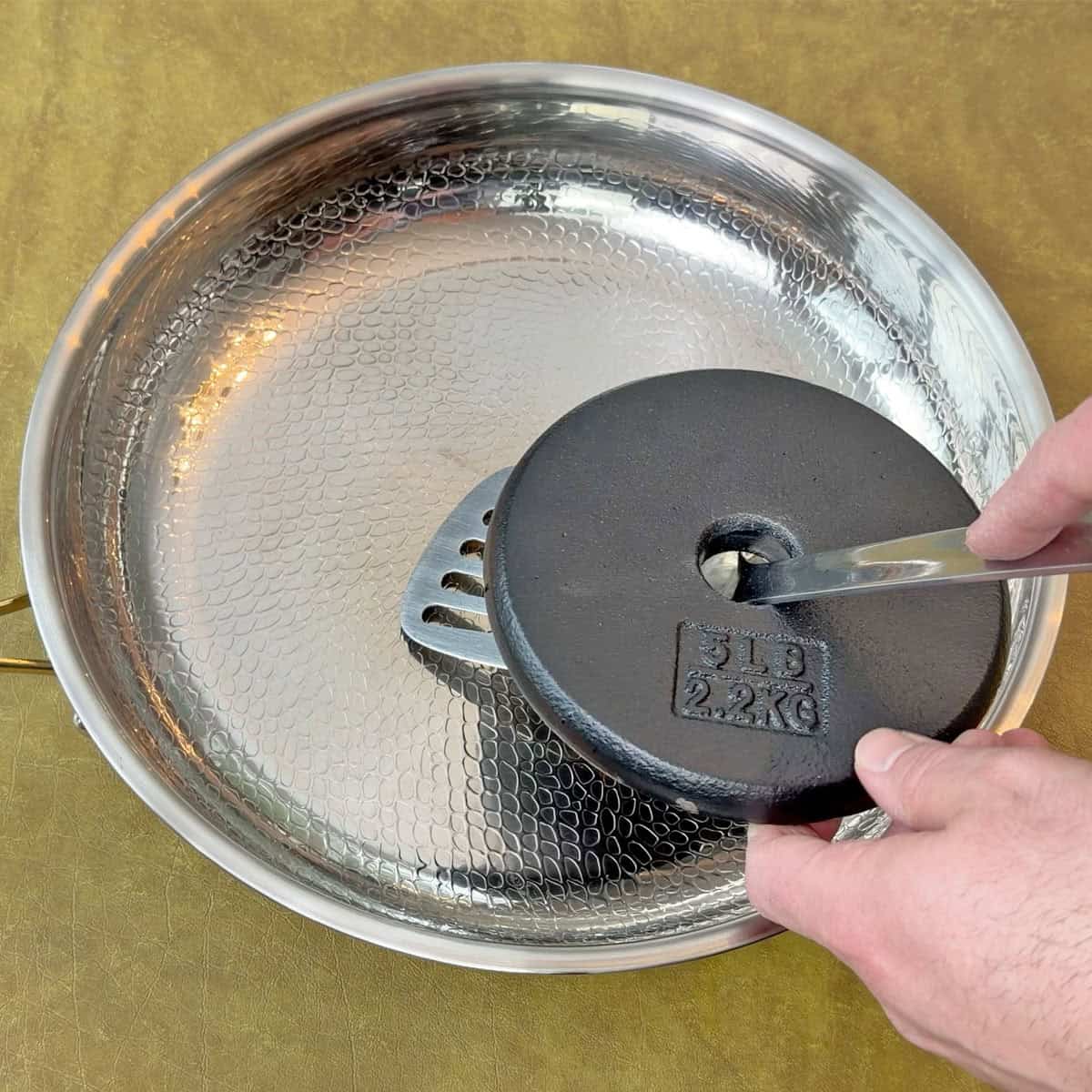
Next, I took a serrated steak knife, attached two magnets weighing 130 grams, and rubbed it across each pan 15 times. This is where Taima showed vulnerability. It sustained significant scratches, similar to the Heritage Steel Titanium. The Viking had zero damage and the Hestan only showed minor rub marks with no actual indentation.
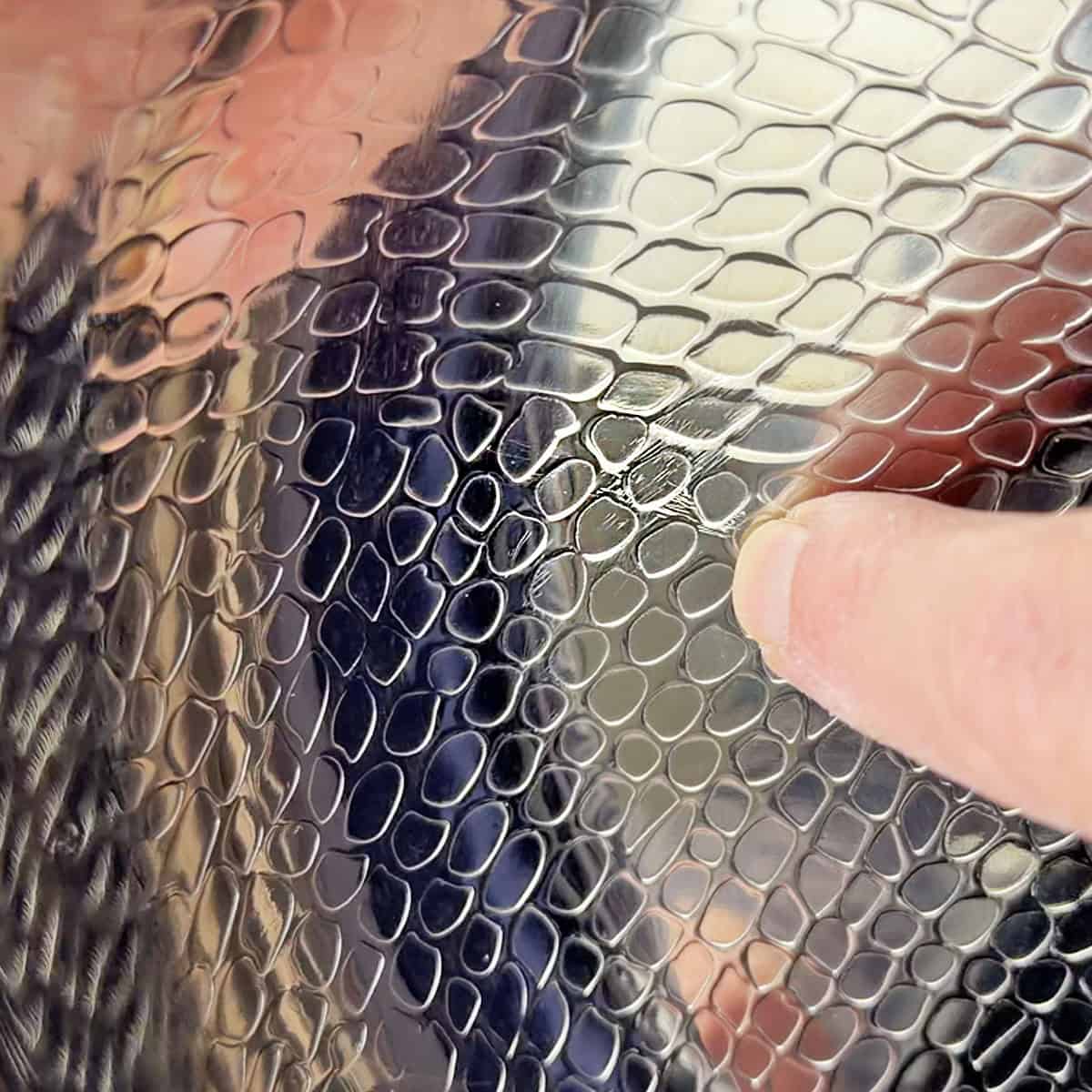
I also placed a heavy-duty Scotch-Brite sponge green side down on each pan with a five-pound weight on top and pushed it back and forth 20 times. The Taima came out with noticeable scratches. The Viking, Hestan, and Our Place all had no damage.
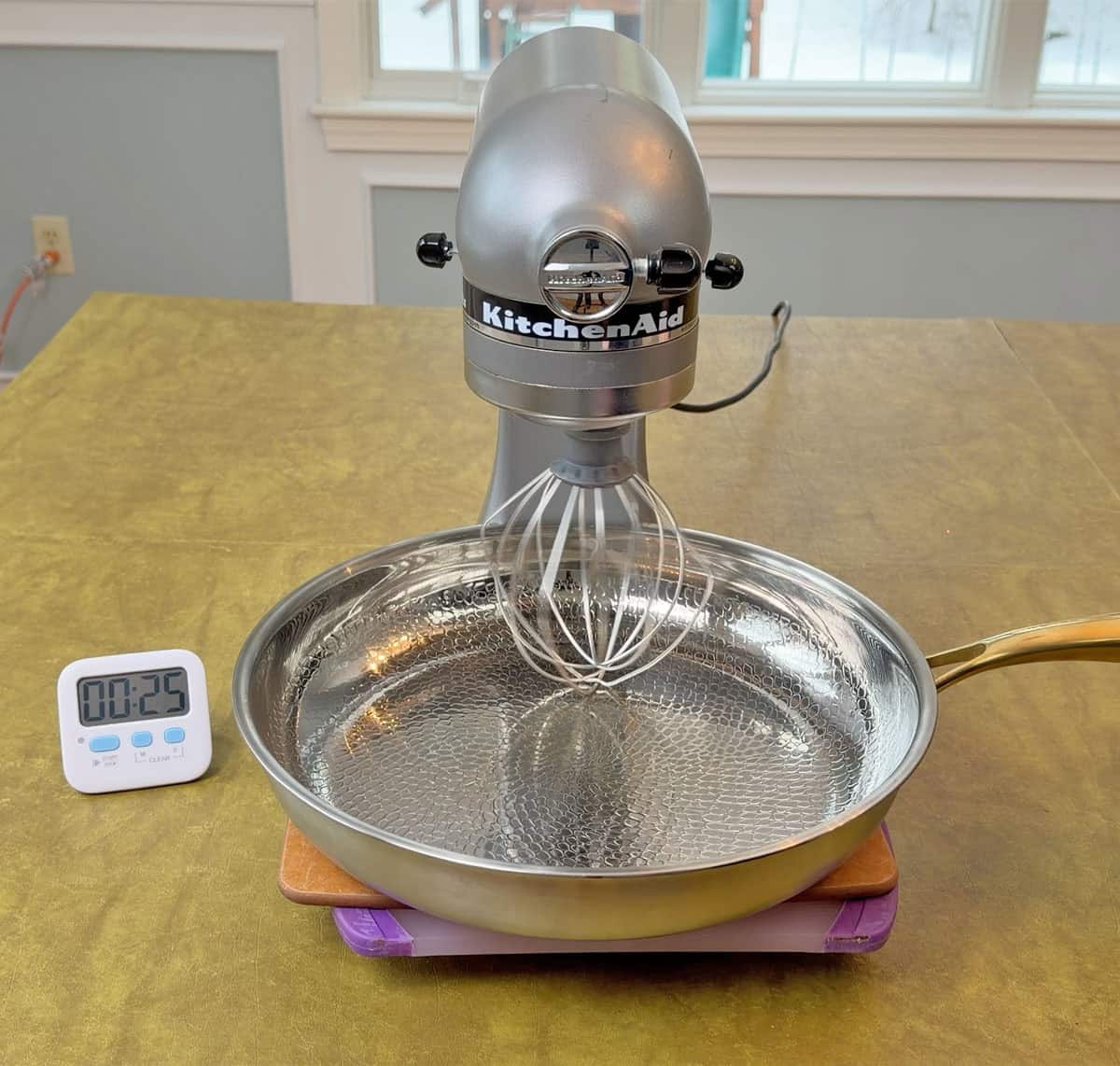
Finally, I set up a stand mixer so a metal whisk was making firm contact with the cooking surface and let it run for 30 seconds. The Taima had circular rub marks but no actual indentation or scratching, comparable to the Hestan and Heritage Steel.
After all five scratch tests, I reran the egg-with-fat test to see if any of the damage affected cooking performance. The Taima still had zero sticking. None of the scratches made a difference.
Corrosion Resistance
Taima claims their titanium surface is completely corrosion-resistant and won’t leach heavy metals when cooking with acidic ingredients like tomatoes, lemon, or vinegar. They say it’s “impossible to corrode.” To test that, I added 20 grams of non-iodized salt and 20 grams of filtered water to each pan, let them sit for an hour, heated them on high until the water evaporated, then let them sit for another hour before cleaning and inspecting. I repeated this three times.
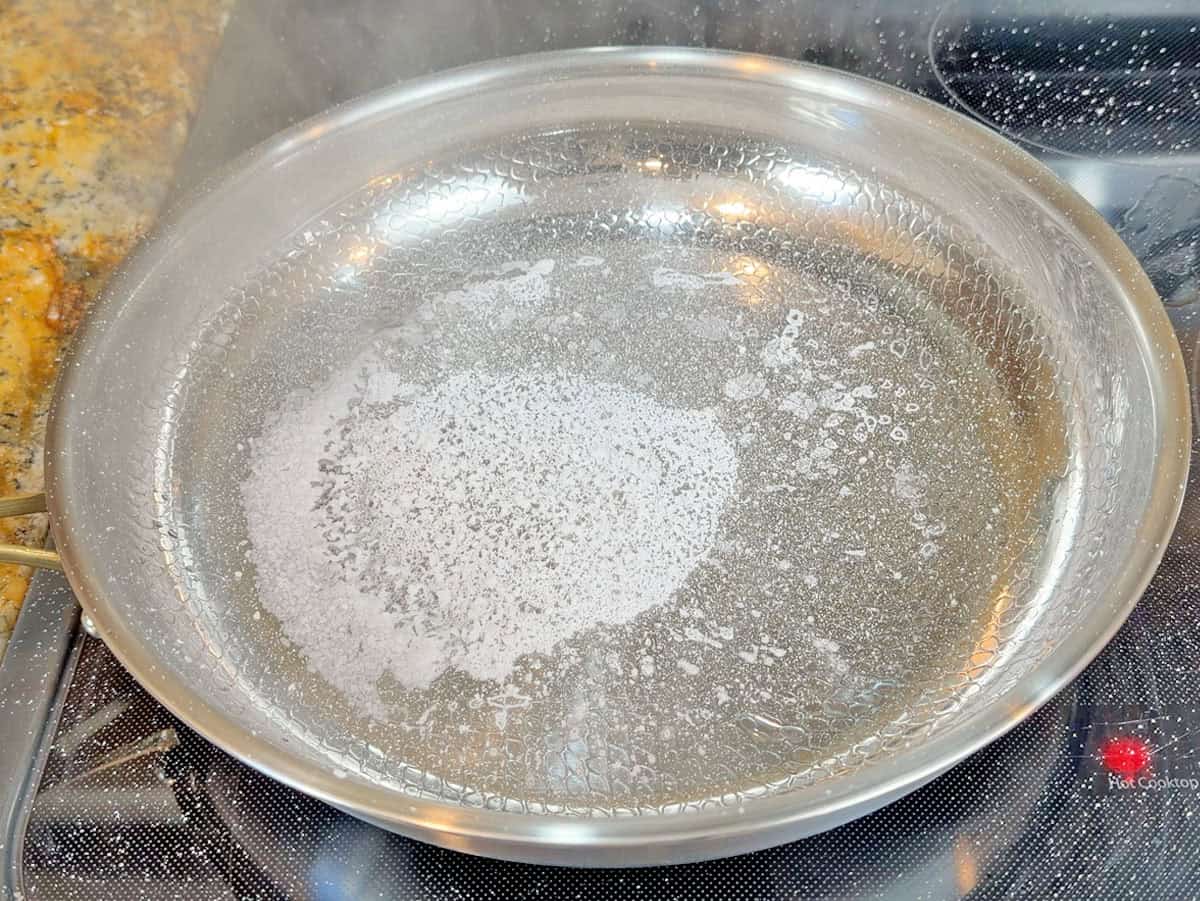
The Taima showed zero signs of pitting or corrosion after all three rounds. Neither did any of the other titanium pans. The stainless steel control developed dark spots after the first round that couldn’t be removed with vinegar or Bar Keepers Friend. By the third round, those spots were starting to eat into the steel with indentations you could feel with a fingernail.
To be fair, this is an extreme test. Under normal use, stainless steel won’t pit if you add salt after the water boils and don’t leave salty food sitting overnight. But the Taima’s titanium surface handled the worst-case scenario without any damage. This is the one area where Taima’s claims fully held up.
Claims vs. Reality
| Claim | Verdict |
|---|---|
| Pure Grade 1 titanium cooking surface | Confirmed. The surface is titanium, not a coating or alloy. |
| SlipScale pattern enhances food release by up to 3x | Partially true. With a small amount of fat, performance was excellent. Without fat, eggs stuck badly, just like stainless steel. |
| Impossible to corrode | Held up. Three rounds of aggressive salt testing produced zero pitting or corrosion. |
| Most efficient heat conductor, cooks evenly at lower temperatures | Not supported. Heat distribution was among the worst I’ve tested, with a 140-degree gap between the center and outer edge. |
| Engineered to outlast you / couldn’t destroy it if you tried | Partially true. It handled everyday utensils well, but a serrated knife and Scotch-Brite sponge caused significant scratches. And the pan warped after a few uses. |
| Metal utensil safe | Partially true. Ladles and spatulas caused no damage. A serrated knife did. |
Bottom Line: Is Taima Titanium Cookware Worth Buying?
The Taima pan gets some things right. Nonstick performance with a small amount of fat was excellent. The corrosion resistance claim fully held up. The rivetless interior is easy to clean, and the taller walls give you more capacity and less splatter than most pans this size.
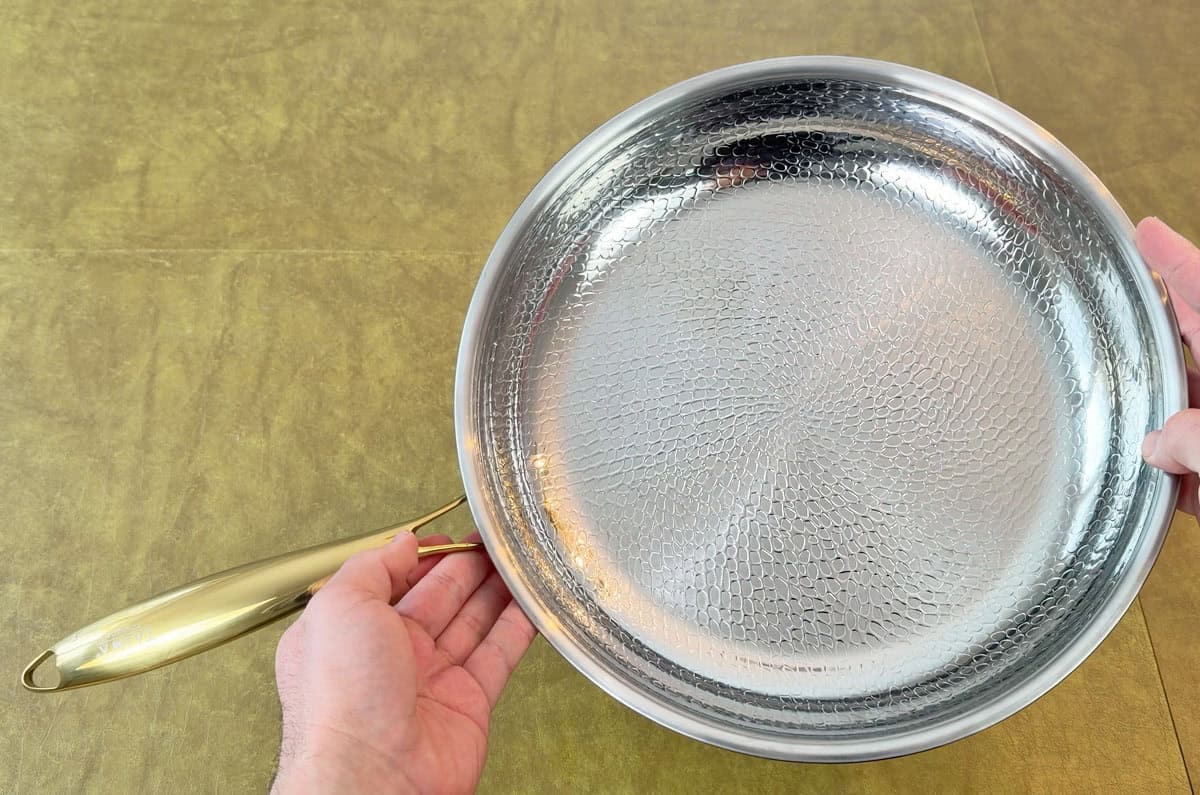
But the problems all come back to one thing: it’s too thin. At 2mm, the Taima is the thinnest fully clad pan I’ve tested, and that shows up in two major ways.
First, the bottom bowed out after just a few uses and now spins on my flat cooktop if you nudge the handle.
Second, it heats extremely fast and loses heat just as fast. That can be fine if you want maximum control, but it’s not forgiving. If you don’t pay close attention, the pan will burn your food. And when you add cold ingredients, the temperature drops immediately with very little recovery. It posted the worst heat retention out of the 30+ pans I tested.
The handle is also worth mentioning. The rounded shape is slippery when your hands are wet, greasy, or soapy.
At such a high price, those tradeoffs are hard to justify. The Viking PureGlide Pro costs less and outperformed the Taima in nearly every test I ran, including nonstick, scratch resistance, and heat distribution. If you want a titanium pan, that’s where I’d put your money.
Check out Viking PureGlide Pro on Amazon.
Related Topics
- My Brutally Honest Review of the Our Place Titanium Always Pan Pro
- HexClad vs. Our Place Always Pan and Titanium Always Pan Pro
- Viking PureGlide Pro Review: Best Titanium Pan?
- Caraway vs. Our Place (Always Pan): Which Cookware Is Better?
- Is Hestan Cookware Worth the Splurge? In-Depth Review
- Heritage Steel Cookware Review: Is It Worth Buying?
- I Tested 31 Stainless Steel Frying Pans: These Are the Best & Worst
- 10 Cookware Brands You Should Never Buy (And Why)
- I Tested 45 Frying Pans: These Are the Best and Worst
- Caraway vs. Our Place (Always Pan): Which Cookware Is Better?
- HexClad Cookware Review: Is It Worth the High Price?
- HexClad vs. Cooksy: 9 Key Differences to Know Before Buying
- 4 Best HexClad Cookware Alternatives
- Henckels Paradigm Review: Pros and Cons to Know Before Buying
- HexClad vs. Stainless Steel Cookware: 7 Key Differences

