

In early 2025, Misen launched the Carbon Nonstick pan on Kickstarter claiming that it’s as easy to use as non-stick while also being as long-lasting as carbon steel. And that bold promise, along with a list of others, led to over $2 million in pre-orders.
To see if this pan lives up to the hype, I tested each claim one by one.
I cooked dozens of eggs in it, scraped it with metal utensils, simmered acidic foods, left it wet overnight to check for rust, cooked at extremely high temperatures, tested it for warping, and compared its weight and maneuverability to the competition.
I also ran it through the same heat conduction and retention tests that I’ve done with over 60 other pans I’ve reviewed.
In this review of the Misen Carbon Nonstick pan, I reveal which claims held up and which ones didn’t. By the end, you’ll know whether this pan is a genius invention or just another well-marketed cookware gimmick.
Editor’s Note: When the Misen Carbon Nonstick pan first launched, it frequently sold out due to high demand. Inventory has since stabilized, and the pan is now regularly in stock. You can buy it today on Misen.com and Amazon.
Editor’s Note (part 2): Since publishing this review, Misen released a deeper version of the Carbon Nonstick pan. One of my main complaints about the original was the shallow sidewalls: 1.3 inches on the 8-inch pan and 1.75 inches on the 10- and 12-inch pans. The deeper version increases those measurements to 1.8, 2, and 2.2 inches, making the pan more practical for sautéing, tossing food, and cooking larger portions.
Key Takeaways
Misen’s Carbon Nonstick Pan is different from other non-stick pans because it doesn’t have a PTFE (i.e. Teflon) or ceramic non-stick coating. Instead, it’s made from carbon steel hardened in a nitrogen-rich oven, creating a naturally slick, ultra-tough surface that resists rust and gets more nonstick with use. It also has an aluminum core layer that makes it lighter and more responsive than traditional carbon steel.
Misen claims it can handle metal utensils, high heat, acidic foods, and even overnight soaking without damage — and my tests put those claims to the test.
Nonstick Properties: In my cooking tests, eggs, pancakes, burgers, and vegetables released easily with only a small amount of oil or butter. It wasn’t as slippery as a brand-new Teflon pan, but it was noticeably more nonstick than stainless steel, cast iron, and preseasoned carbon steel.
Based on my experience using this pan for several months, the nonstick performance seems to come from the hardness and smoothness of the nitrided surface itself, not from any seasoning layer. In fact, I’ve found that buildup from seasoning or carbon can actually make food stick more, so keeping the surface clean is key to maintaining its performance.
Durability: I scraped the surface 50 times with a five-pound weighted ladle, repeated the process with a metal spatula, and ran a stand mixer whisk across it for two minutes. These tests left only light rub marks but no scratches or coating damage. I did the same tests with Teflon, ceramic, and hybrid stainless surfaces (HexClad), and all got permanent scratches.
Rust and Acid Resistance: I soaked the Misen pan, a Lodge carbon steel pan, and a de Buyer carbon steel pan in water overnight. The de Buyer rusted, the Lodge stayed intact, and the Misen showed no rust. After simmering crushed tomatoes for 15 minutes, the de Buyer lost most of its seasoning and the Lodge lightened in color. The Misen looked unchanged. I soaked all three pans overnight again, and the Misen still showed no rust, while the Lodge developed small spots and the de Buyer rusted more severely.
Responsiveness and Even Heating: In my heat conduction test, the Misen reached 535°F in two minutes at the center, making it the fastest-heating carbon steel pan I’ve tested and second overall. The edge was 70°F cooler than the center, ranking third for heat distribution. In my cooling test, it lost heat quickly, confirming its aluminum core makes it highly responsive.
Weight: The 12-inch Misen weighed 3.0 pounds, lighter than most carbon steel pans (4–6 pounds) and cast iron skillets (5–8 pounds). It’s closer in weight to many stainless steel or aluminum pans, making it easier to lift and maneuver.
Downsides: The rounded handle is comfortable, but without a top groove it’s easier for the pan to rotate, especially when you’re wearing an oven mitt or washing it with soapy hands. The shallow 1.75-inch walls limit capacity (most pans have 2 inch walls). However, in Spring 2026 Misen release a deeper version with higher sidewalls. Heat retention is also a tradeoff. The Misen cools quickly, which helps with responsiveness but makes it harder to maintain high heat when searing multiple burgers or shallow frying.
Is the Misen Carbon Nonstick Pan Worth Buying?
The Misen Carbon Nonstick pan delivers on its promise of durability, easy maintenance, and better food release. It’s not as slick as brand-new Teflon, but it’s much more durable than traditional coated nonstick and it doesn’t require active seasoning like carbon steel and cast iron. It’s the ideal pan for anyone who wants to move away from disposable nonstick pans but doesn’t want the hassle of seasoning or the risk of rust that comes with carbon steel and cast iron.
Check the current price and read more reviews at Misen.com and Amazon.
Keep reading to see my full test results and how this pan performed in each category.
Use the links below to navigate this review:
- Claim 1: Nonstick
- Claim 2: Durable
- Claim 3: Doesn’t Need Seasoning
- Claim 4: Responsive
- Claim 5: Lightweight
- Downsides
- Bottom Line: Is the Misen Carbon Nonstick Pan Worth Buying?
Claim 1: Nonstick
The biggest claim Misen makes is that the Carbon Nonstick Pan is nonstick right out of the box, and that it stays that way. So that’s the first thing I tested.
Unlike cookware that’s advertised as non-stick, this pan doesn’t have a Teflon (PTFE) or ceramic coating. Instead, it’s built from three layers: an aluminum core sandwiched between two layers of nitrided carbon steel.
Nitriding is a process where carbon steel is baked in a nitrogen-rich oven, hardening the surface and making it more corrosion resistant. This hardened surface also improves food release compared to raw carbon steel, even without seasoning.
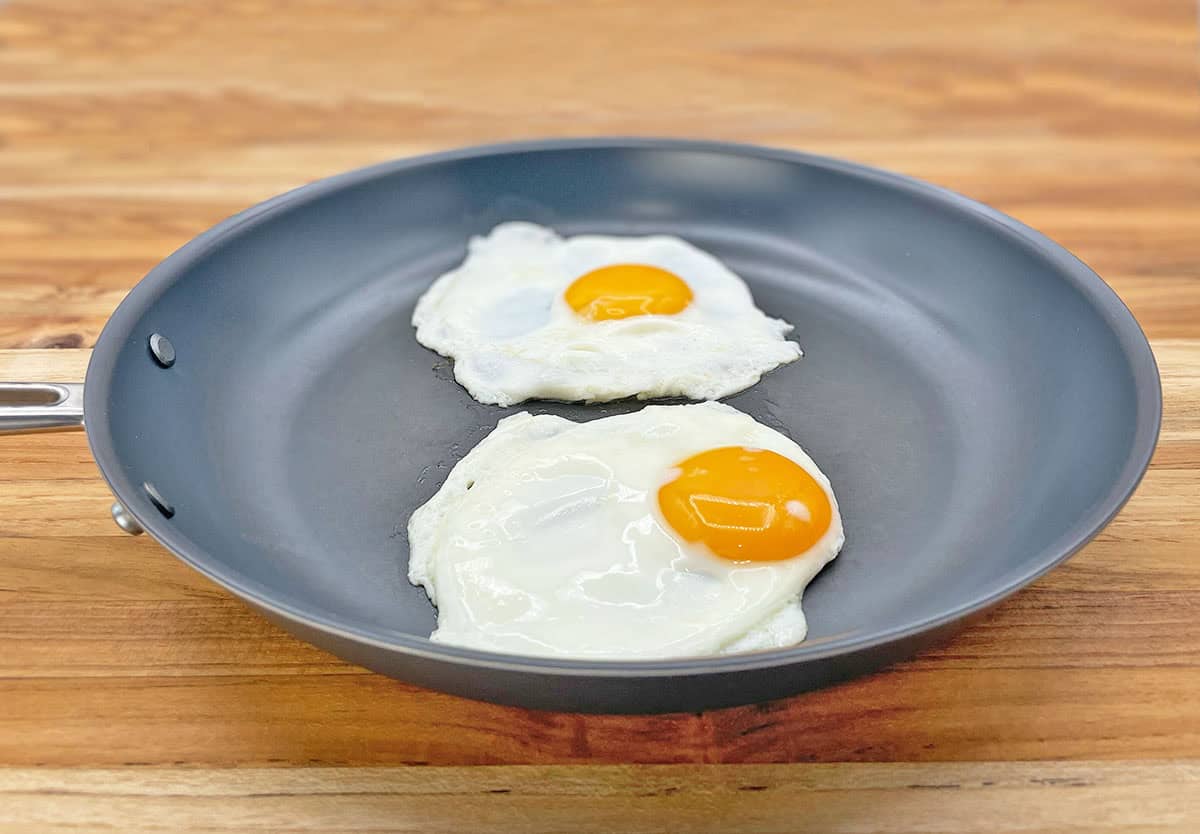
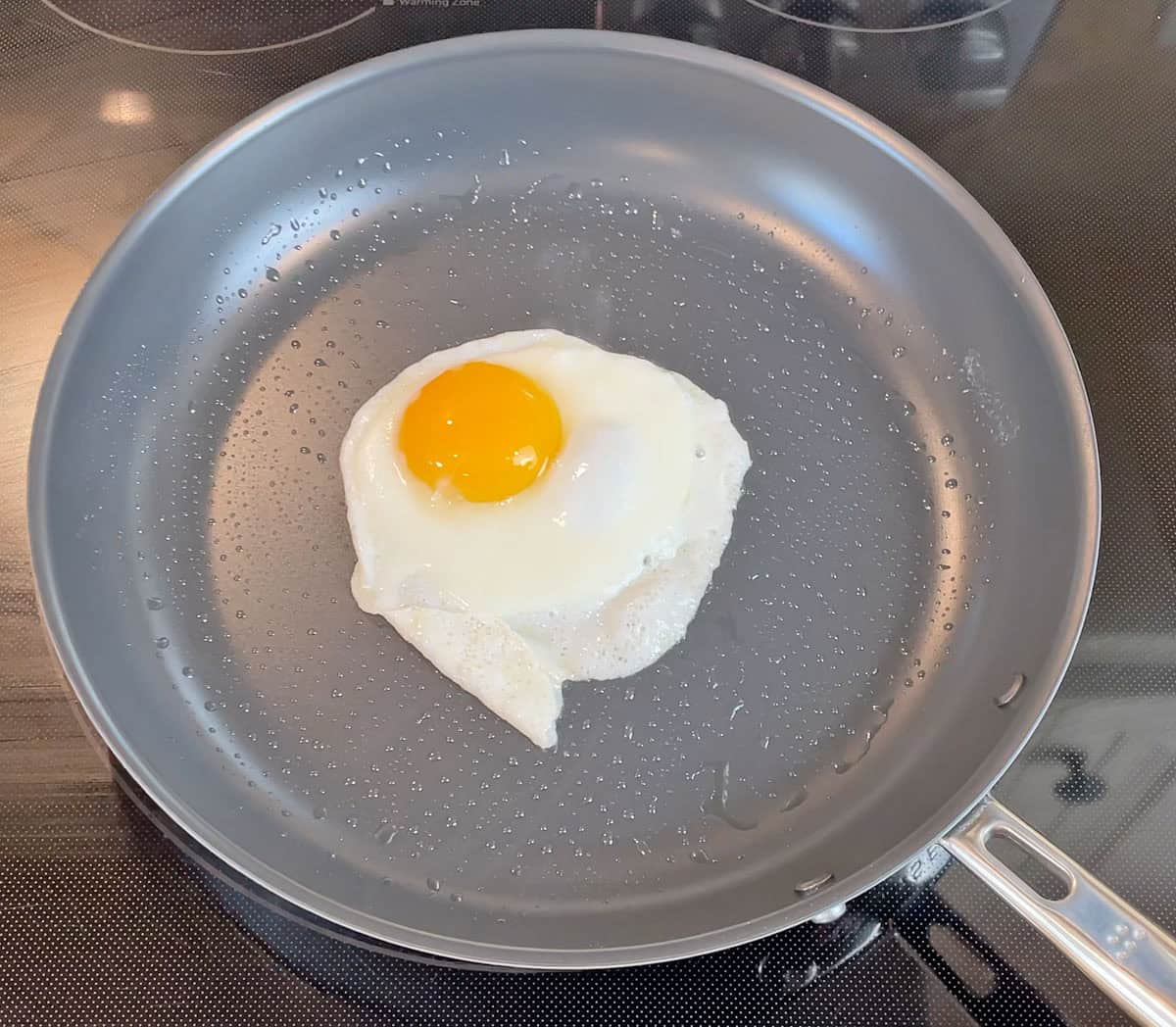
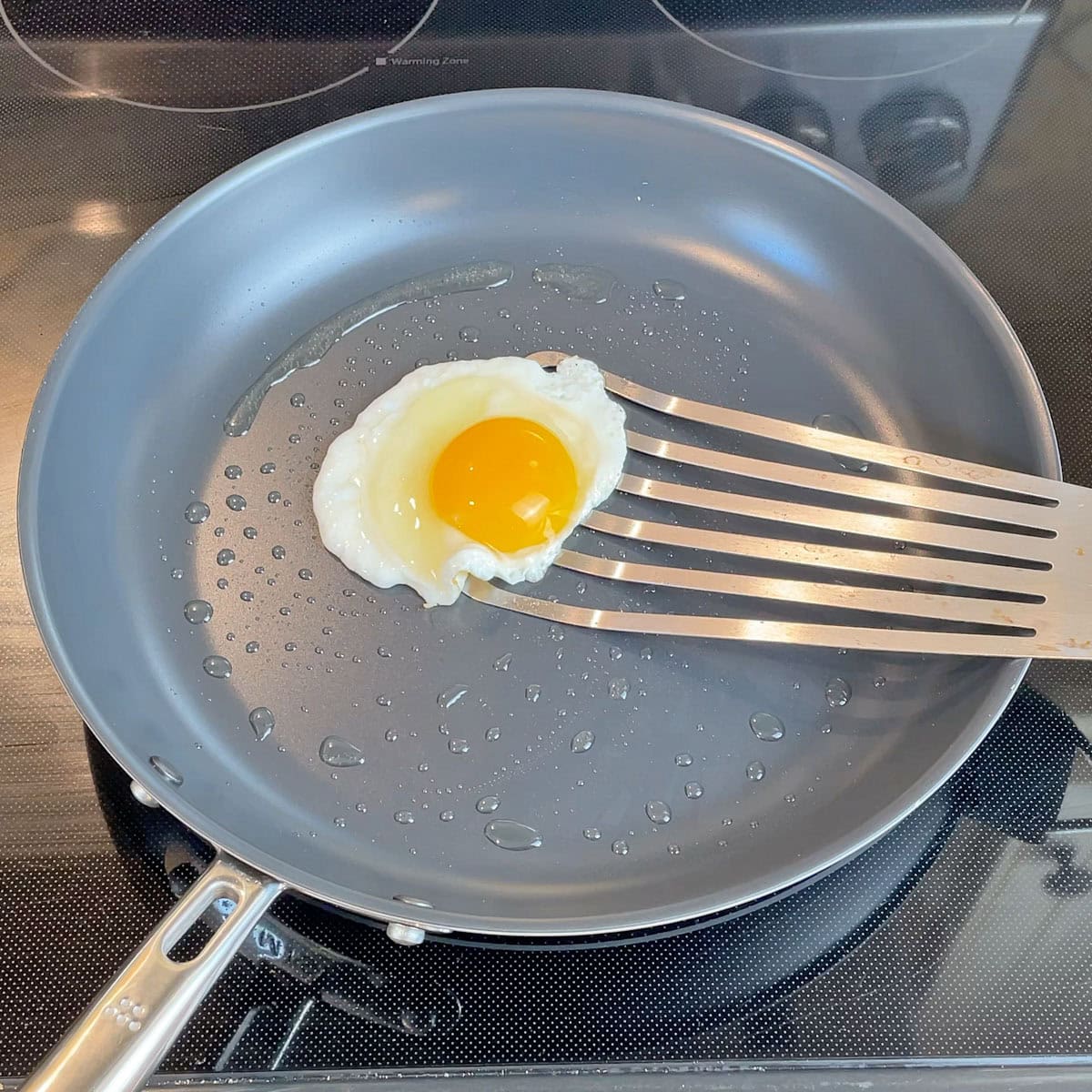
To test the nonstick claim, I started with eggs. Immediately after unboxing and washing the pan, I fried an egg with a small amount of butter (4 grams to be exact). It slid right out without sticking, even though I didn’t monitor the preheat closely. I just preheated it for a couple of minutes on medium heat. I repeated the test using only a teaspoon of oil. The egg clung slightly to my spatula but didn’t stick to the pan.
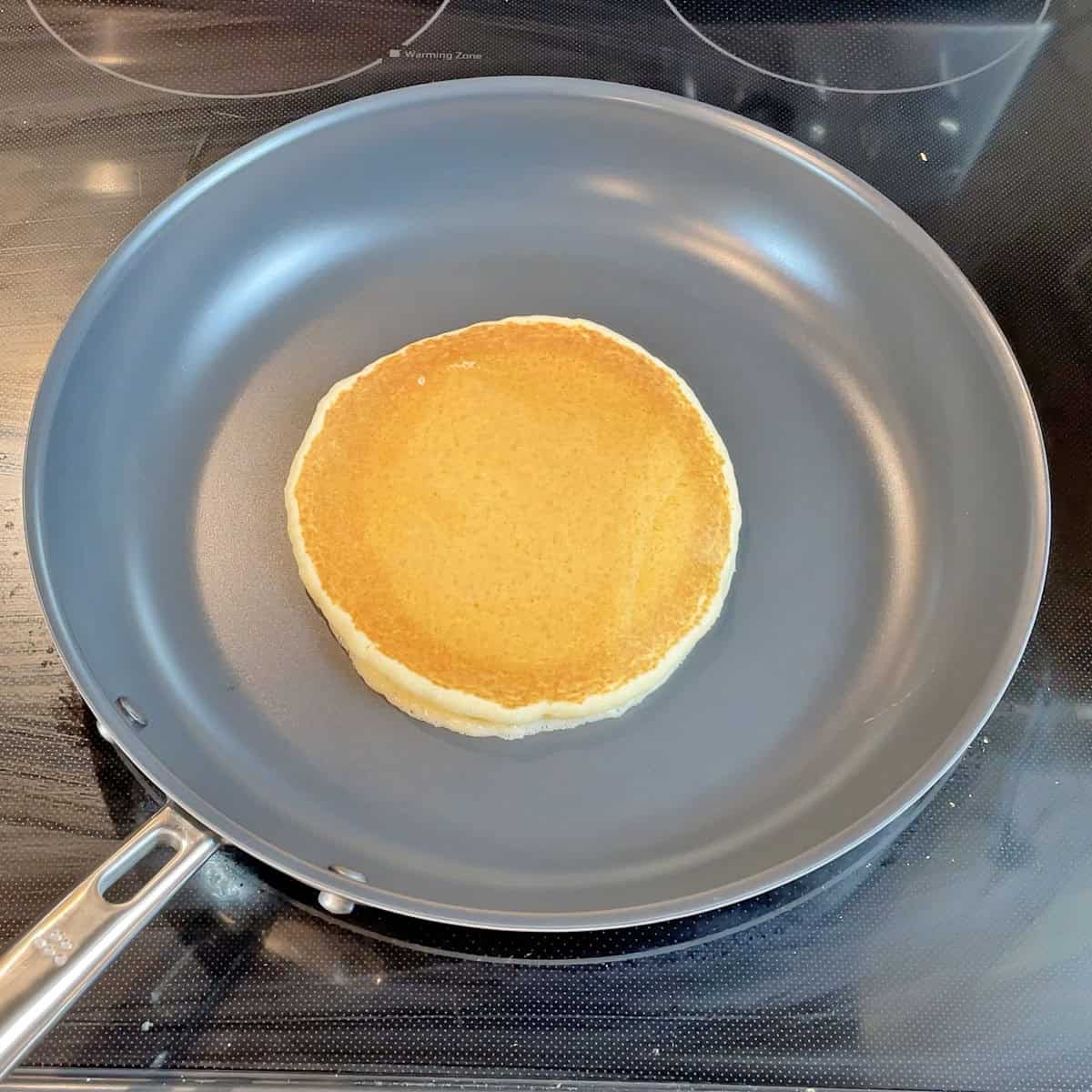
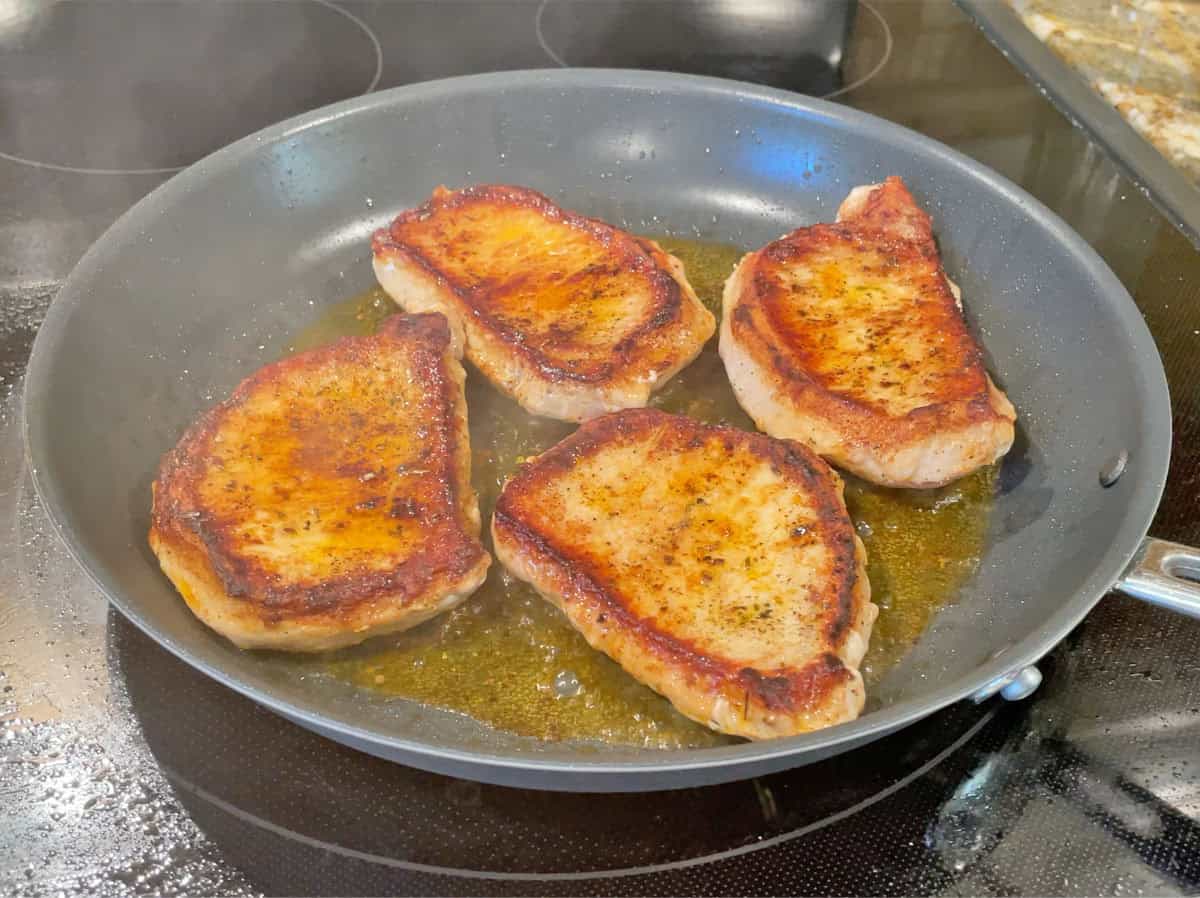
Scrambled eggs and omelets released cleanly. Pancakes, vegetables, burgers, and pork all cooked without sticking.
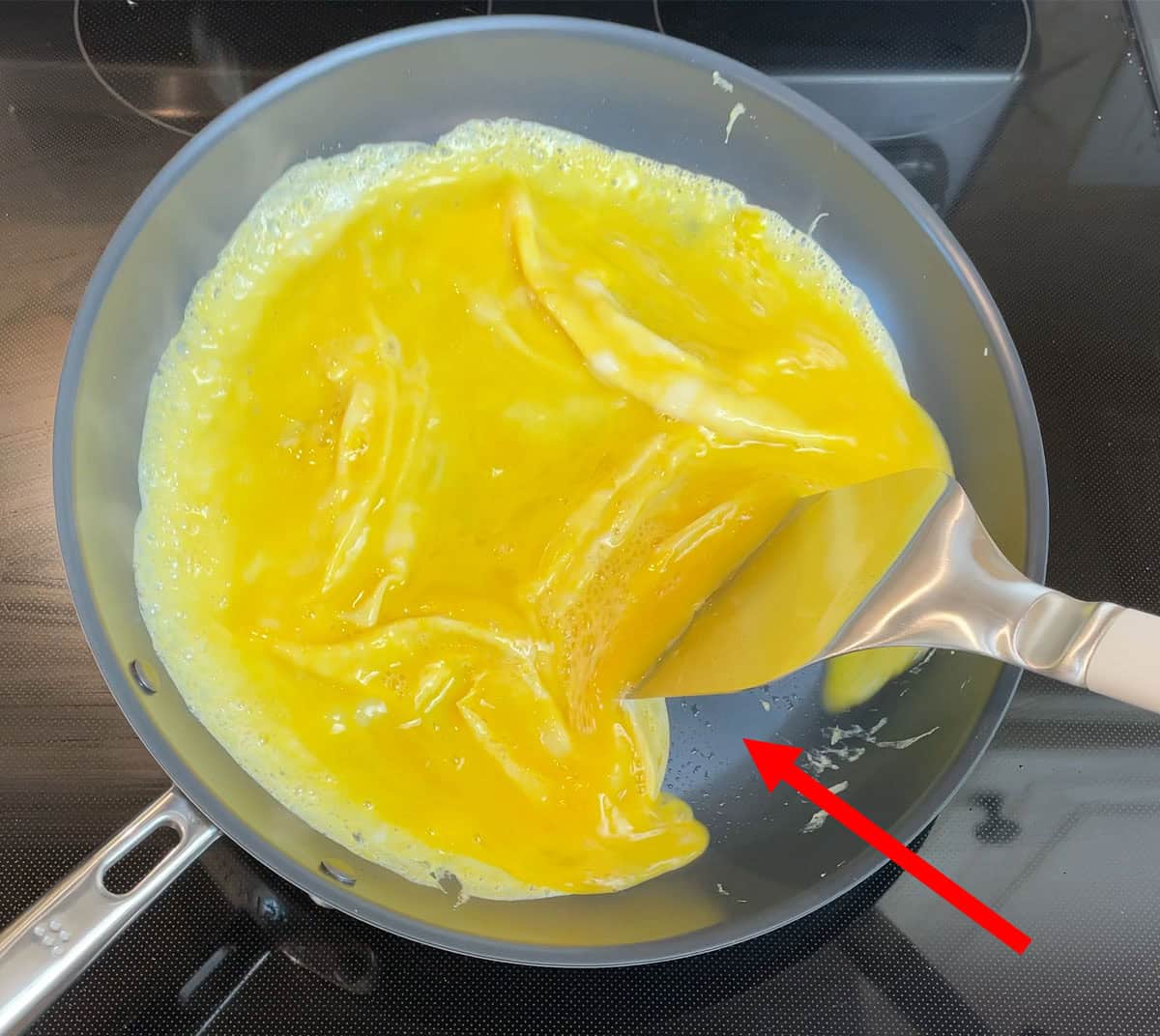
The only exceptions were salmon, which started to stick (likely because I tried to flip it before it was ready), and a few eggs that stuck when I clearly overheated the pan.
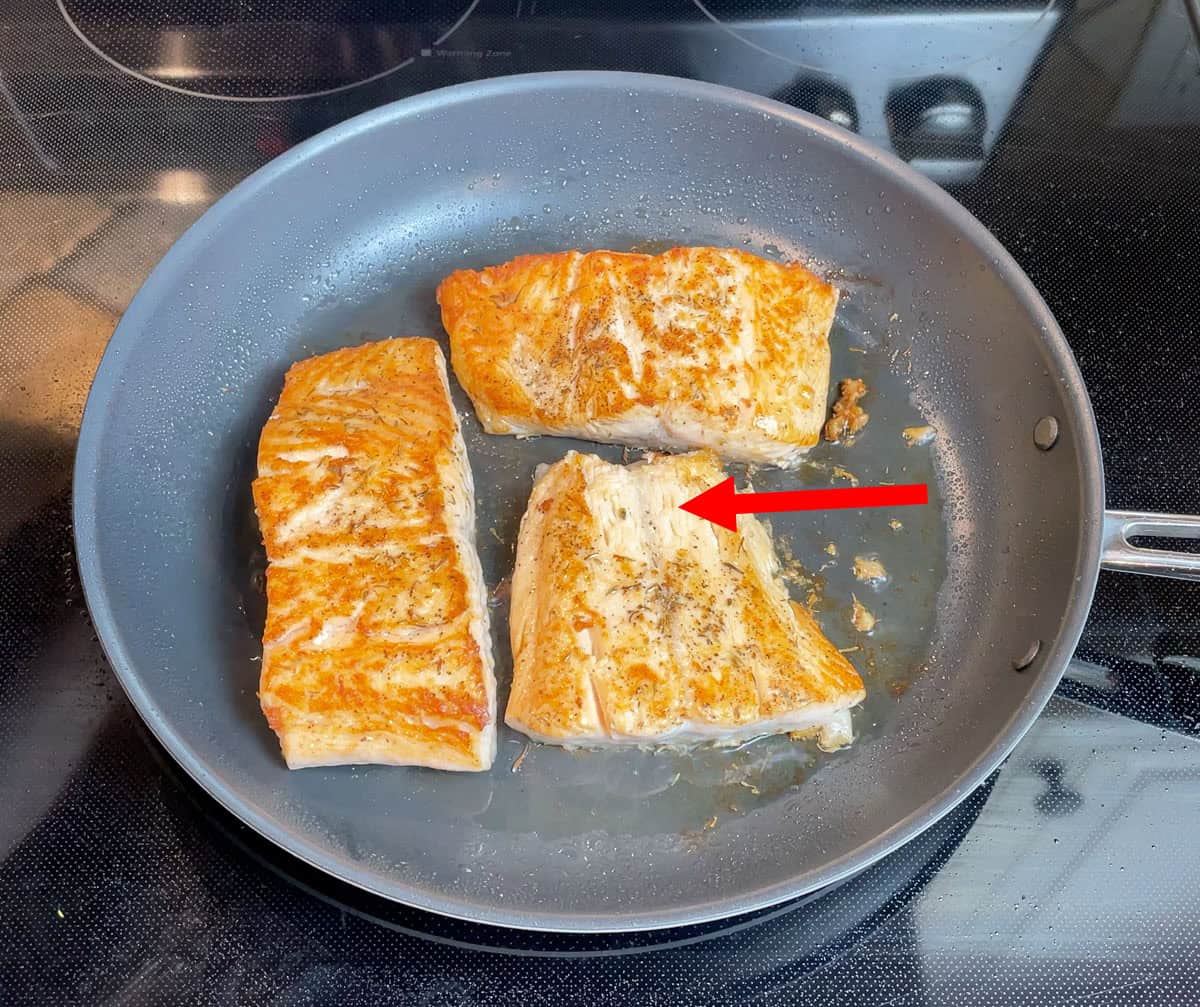
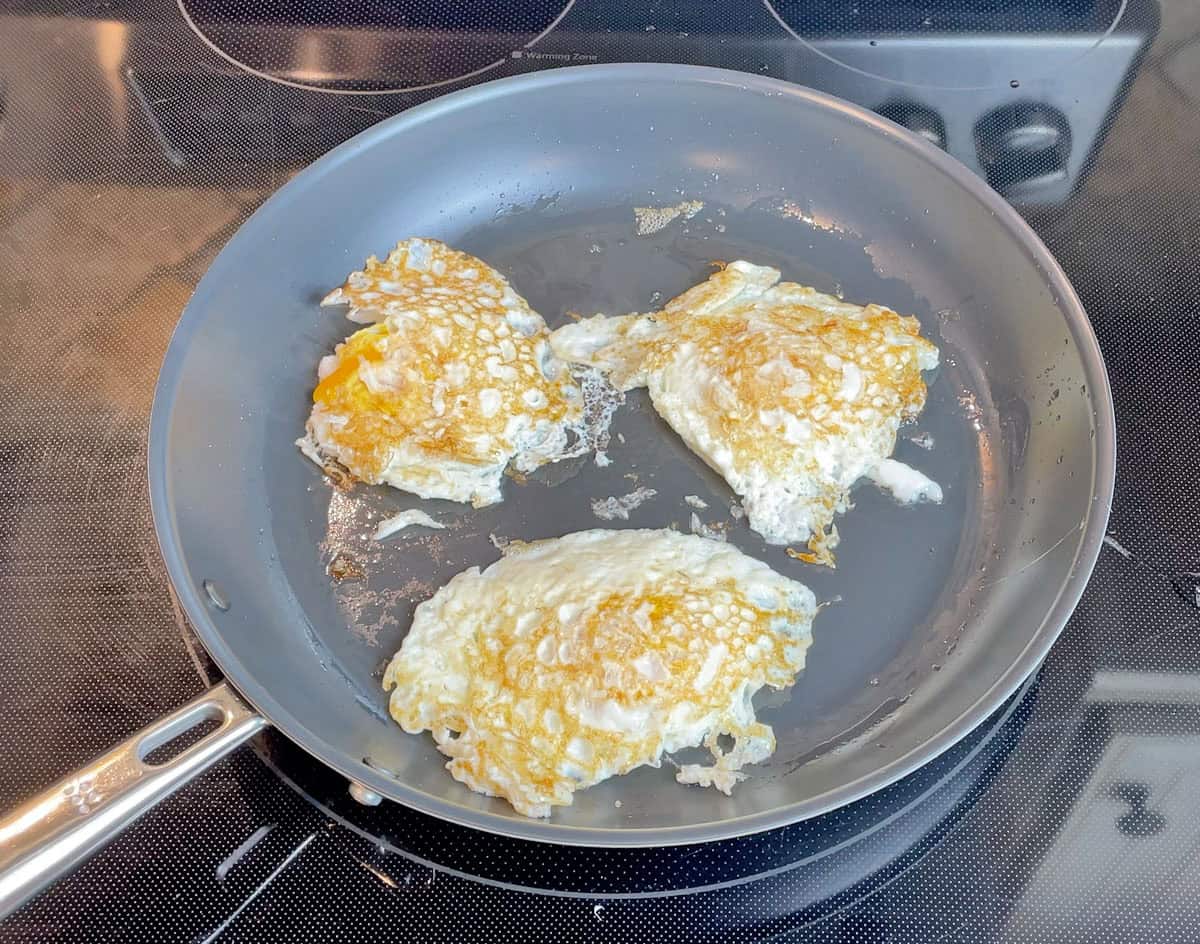
Overall, the performance was similar to a well-seasoned carbon steel pan. You still need to use a small amount of oil or butter, and it’s not as slippery as a brand-new Teflon pan, but it’s far easier to use right out of the box than traditional carbon steel.
Misen also claims the pan will become more nonstick as seasoning develops, but based on my testing, I’m not convinced that’s the case. I’ve found that the nitrided surface is what gives it its nonstick qualities, and adding layers of seasoning or carbon buildup can actually make food stick more.
I received my sample directly from Misen when the Kickstarter launched in July 2025 so I could start testing early. Since then, I’ve used it heavily and haven’t noticed any improvement from seasoning. If anything, the surface performs best when kept clean. I’ll continue testing and will update this review after six months and again after a year to report on long-term performance.
Claim 2: Durable
The next claim I tested was durability. Misen says the Carbon Nonstick Pan will last forever, resist warping, and handle metal utensils without scratching or peeling the surface.
To push it to the limit, I used metal utensils for every cooking test and also ran three controlled durability tests.
First, I attached a five-pound weight to a metal ladle and scraped it back and forth across the cooking surface 50 times.
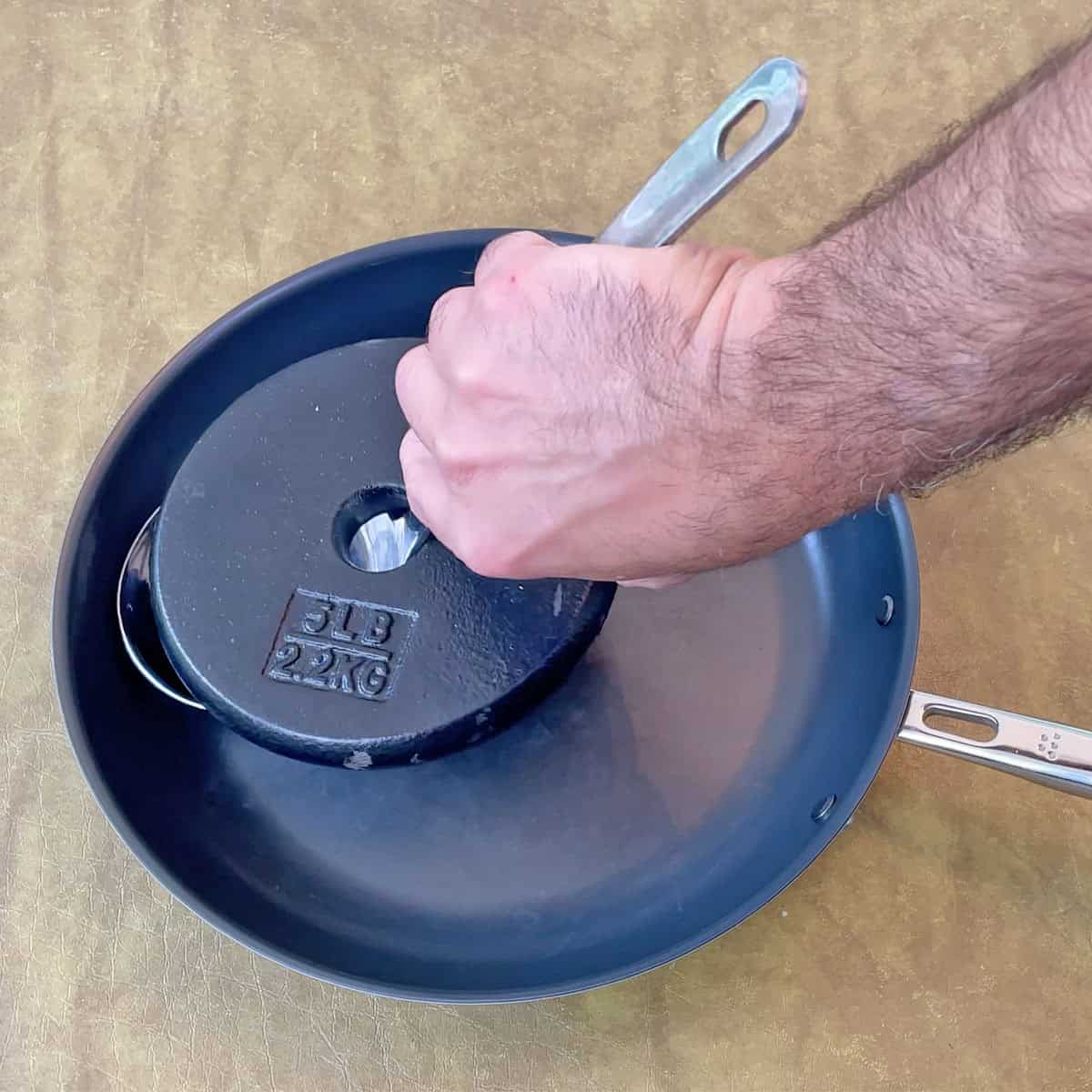
Then I repeated the process with a metal spatula.
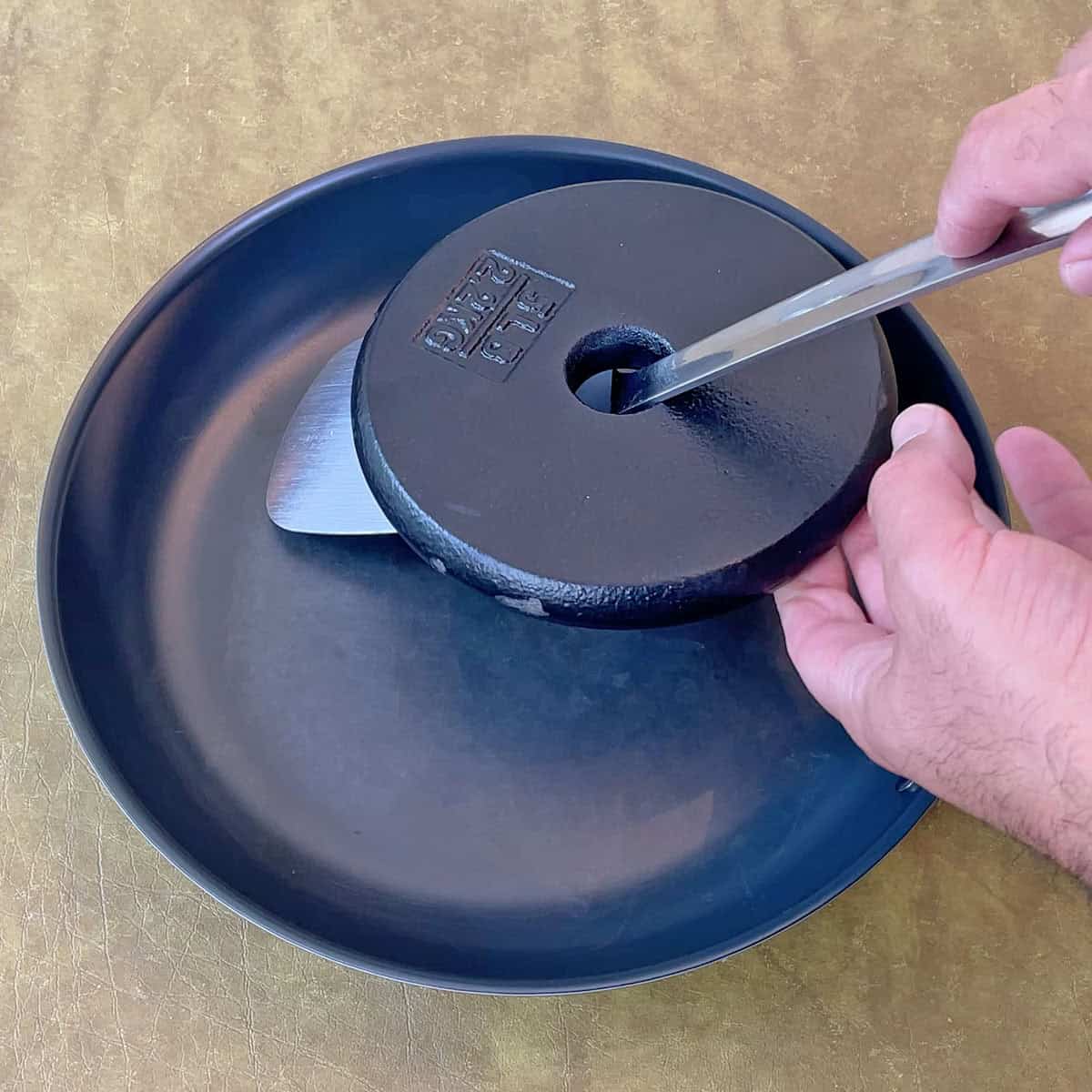
Finally, I propped the pan so a stand mixer whisk made full contact with the cooking surface and let it run on low for two minutes.
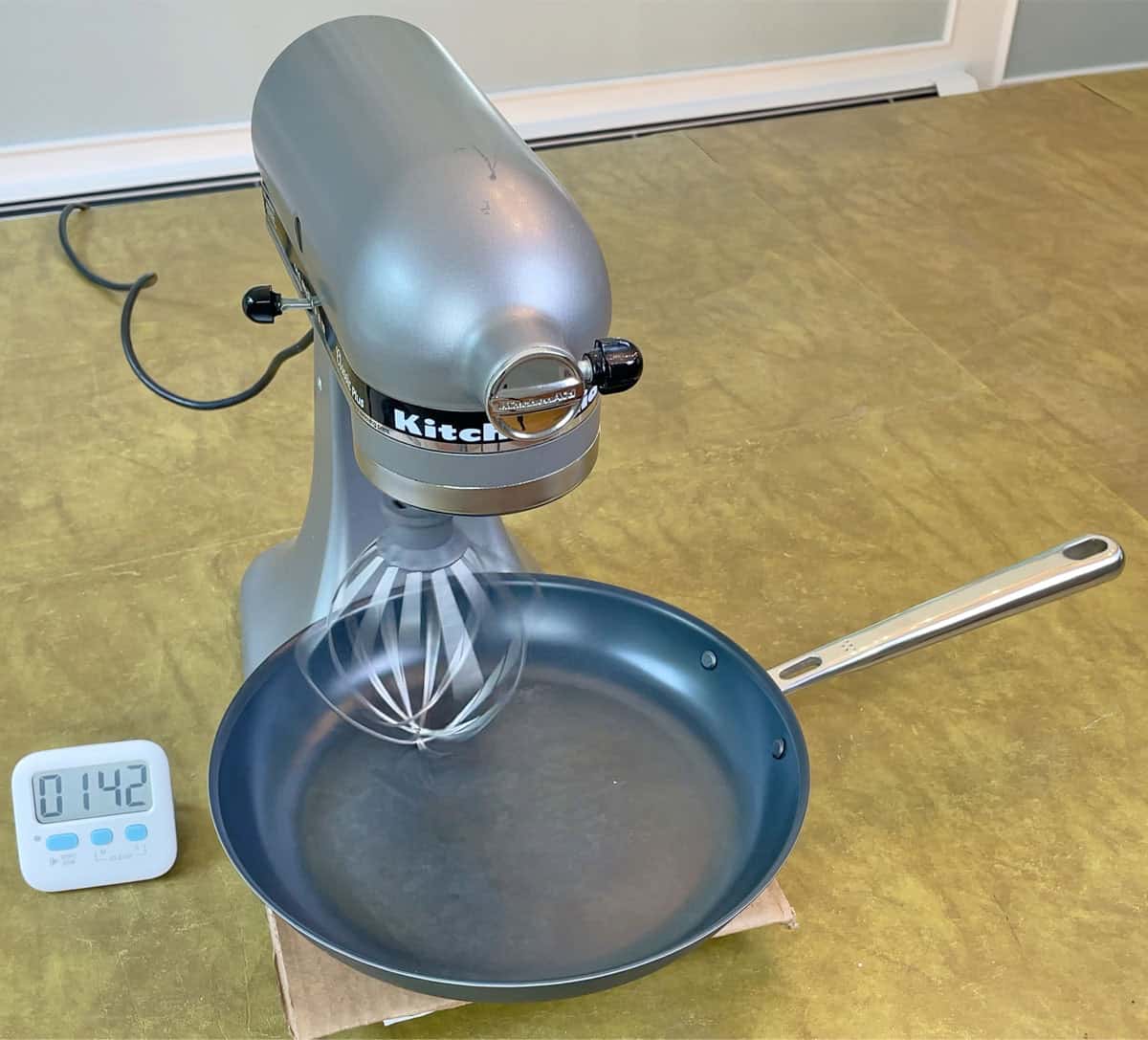
All three tests left light rub marks but no scratches, gouges, or coating damage. To confirm performance wasn’t affected, I cooked eggs immediately afterward and noticed no difference in food release.
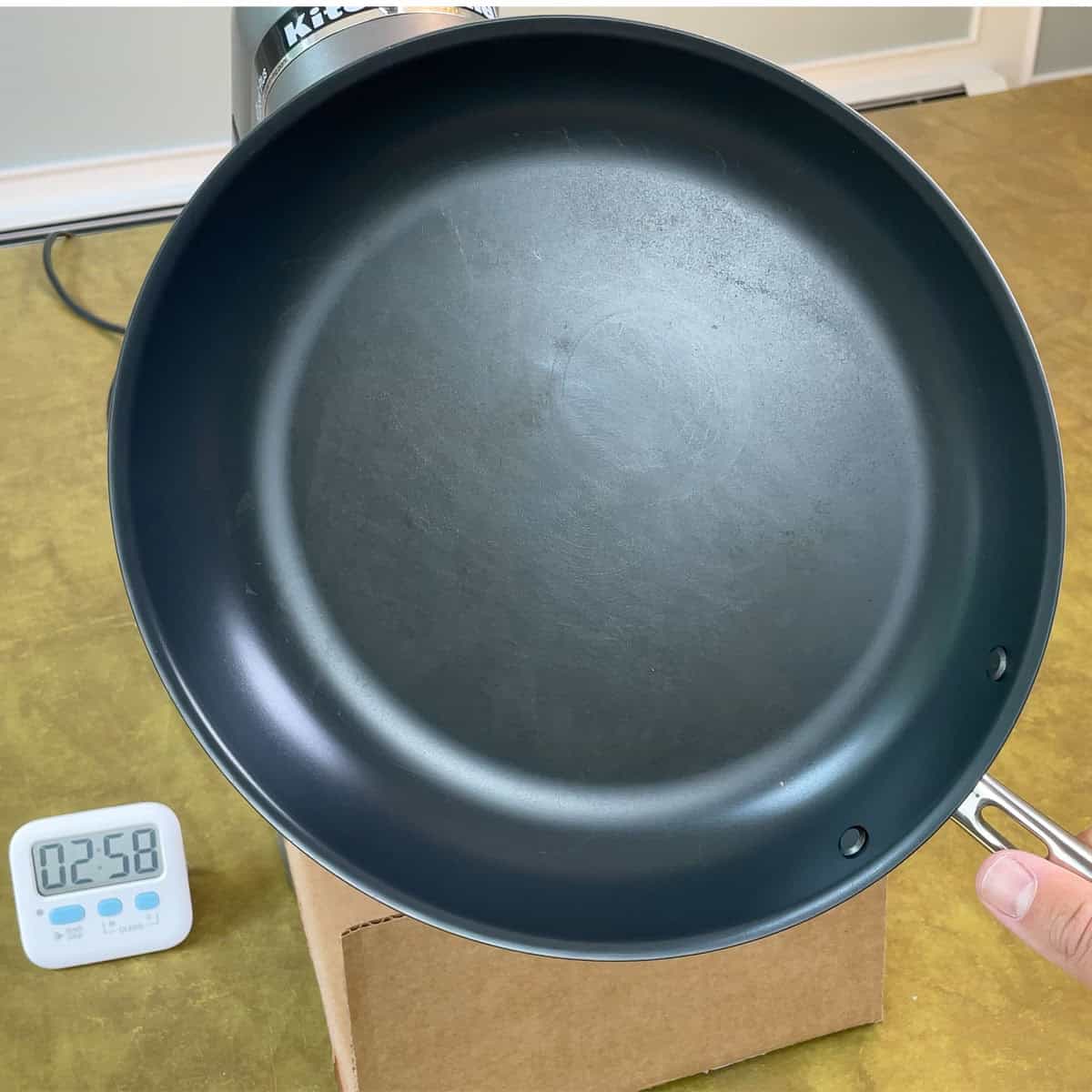
For context, I ran the same tests on a Teflon-coated Tramontina Professional pan, a ceramic GreenPan GP5 pan, and a HexClad pan. All three showed visible scratches or surface damage after one or more of the tests, proving the Misen’s nitrided carbon steel surface is significantly harder and more resilient.

Warping is another common issue, especially with carbon steel pans on induction cooktops that heat extremely fast. Traditional carbon steel is a single layer of metal, which can heat unevenly. When parts of the pan expand at different rates, it creates stress in the metal that can cause warping.
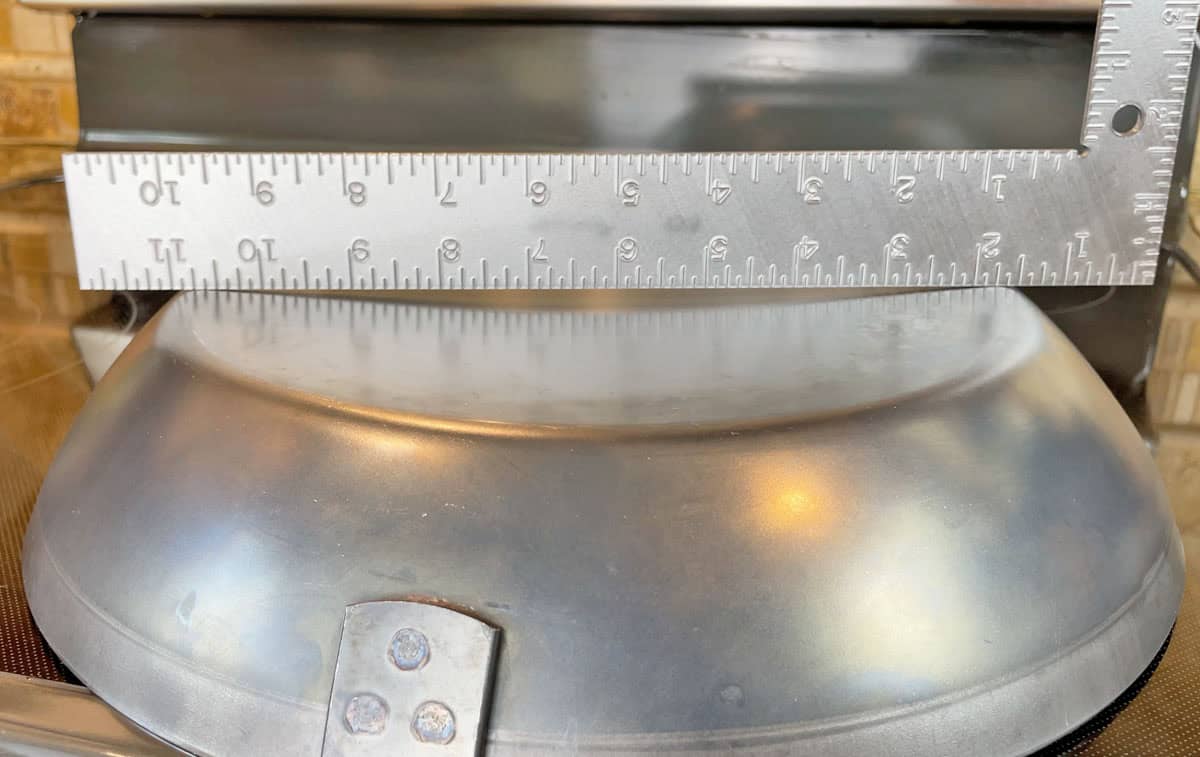
The Misen pan’s aluminum core should, in theory, distribute heat more evenly and reduce that stress. To test it, I measured the flatness of the base before and after heating it to 425°F for two minutes on an induction burner. It started out slightly concave, a deliberate design choice to account for expansion, and after heating, the shape didn’t change at all.
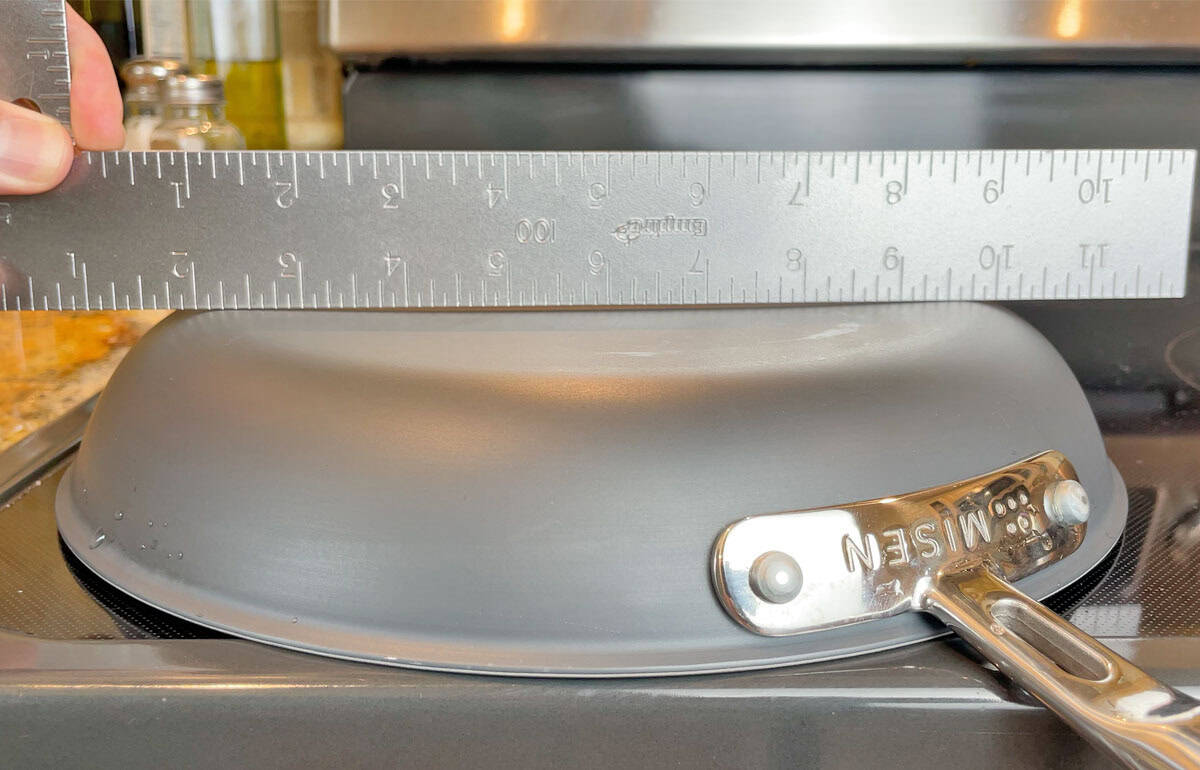
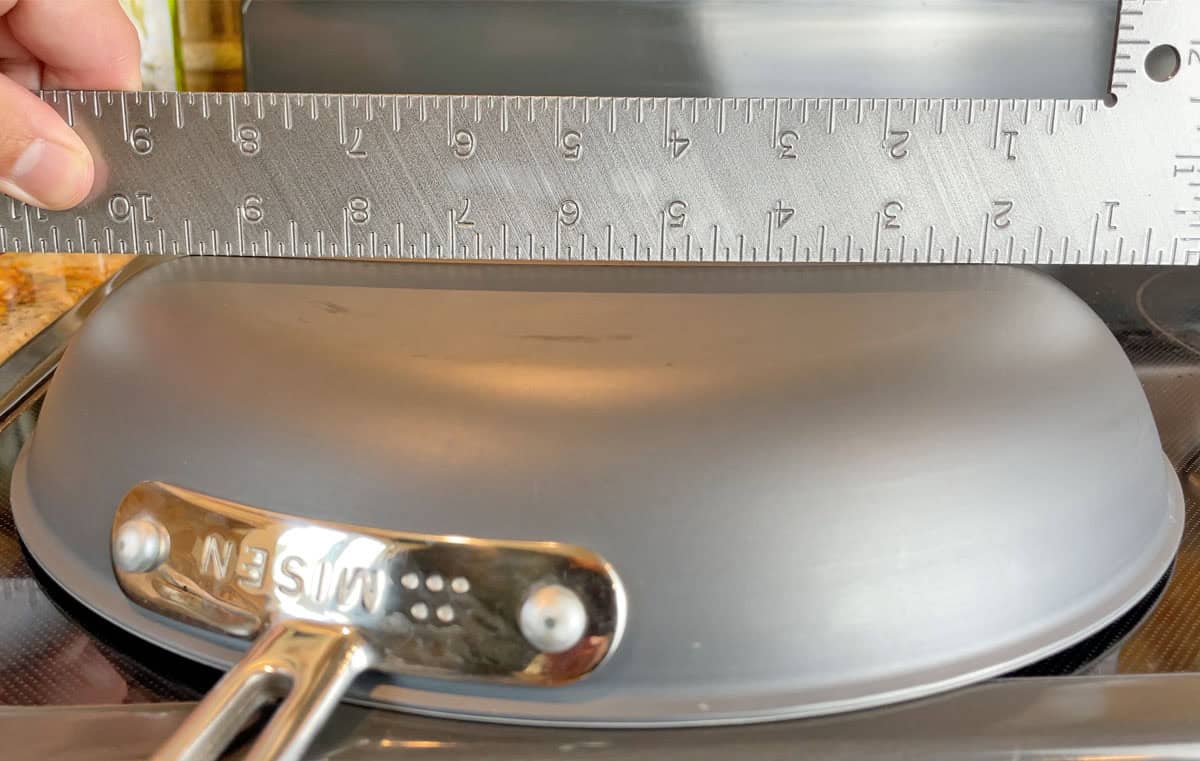
I ran the same test on several other carbon steel pans. Not all maintained their shape, and the de Buyer Blue Carbon Steel pan warped noticeably during the test.
Claim 3: Doesn’t Need Seasoning
Another bold claim Misen makes is that these pans don’t need to be seasoned. You can start cooking right away, even with acidic ingredients, and you can wash them with soap or soak them overnight without it rusting.
That’s very different from traditional carbon steel pans, which need to be seasoned to prevent rust. And even once they’re seasoned, that layer isn’t permanent. Acidic foods like tomato sauce can strip it. Boiling liquids can cause it to flake. And eventually, you’ll need to re-season it.
Misen says none of that is necessary because its nitrided surface resists rust on its own.
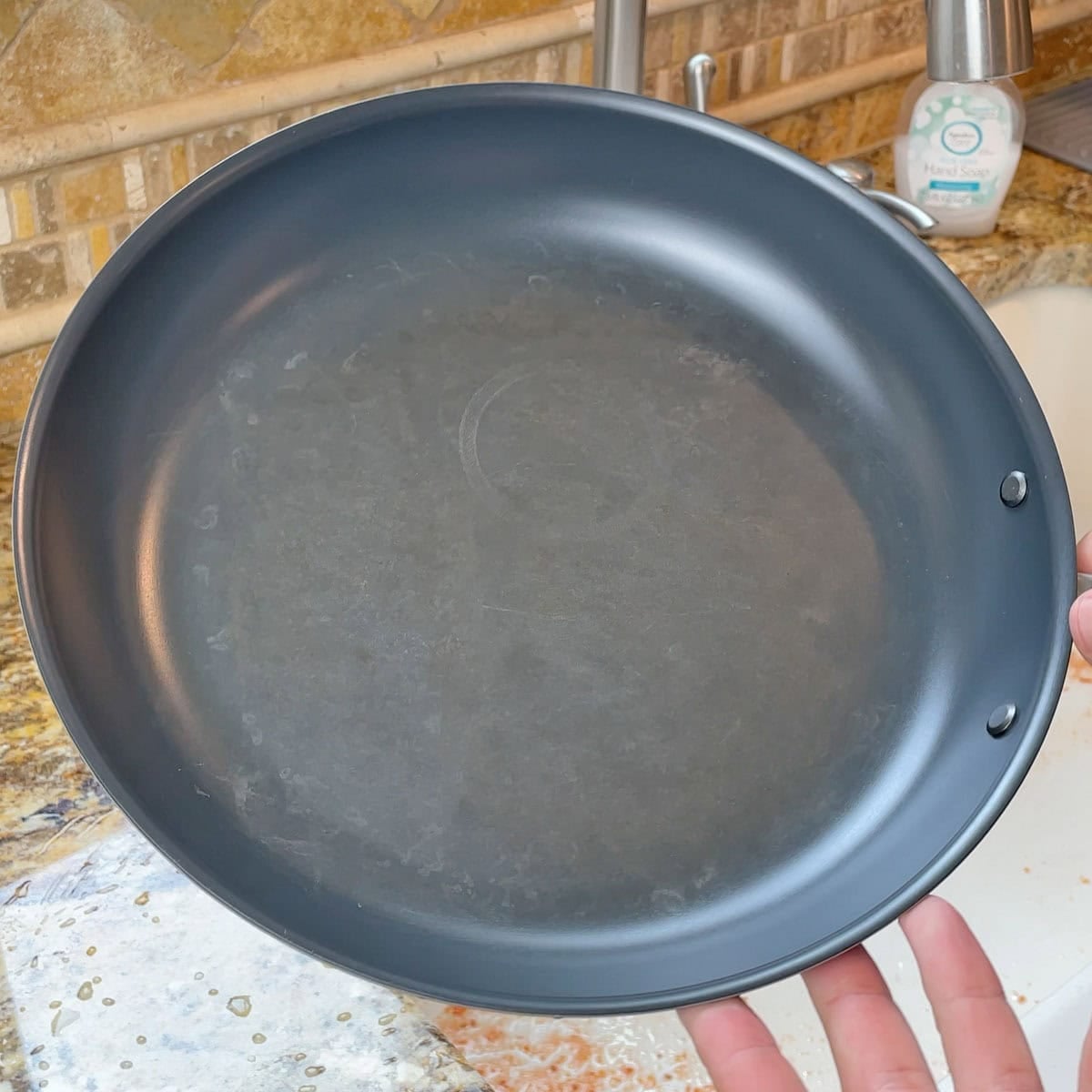
To test this, I wetted the Misen pan, a well-seasoned Lodge carbon steel pan, and a de Buyer carbon steel pan with spotty seasoning and some exposed steel, and left them wet overnight.
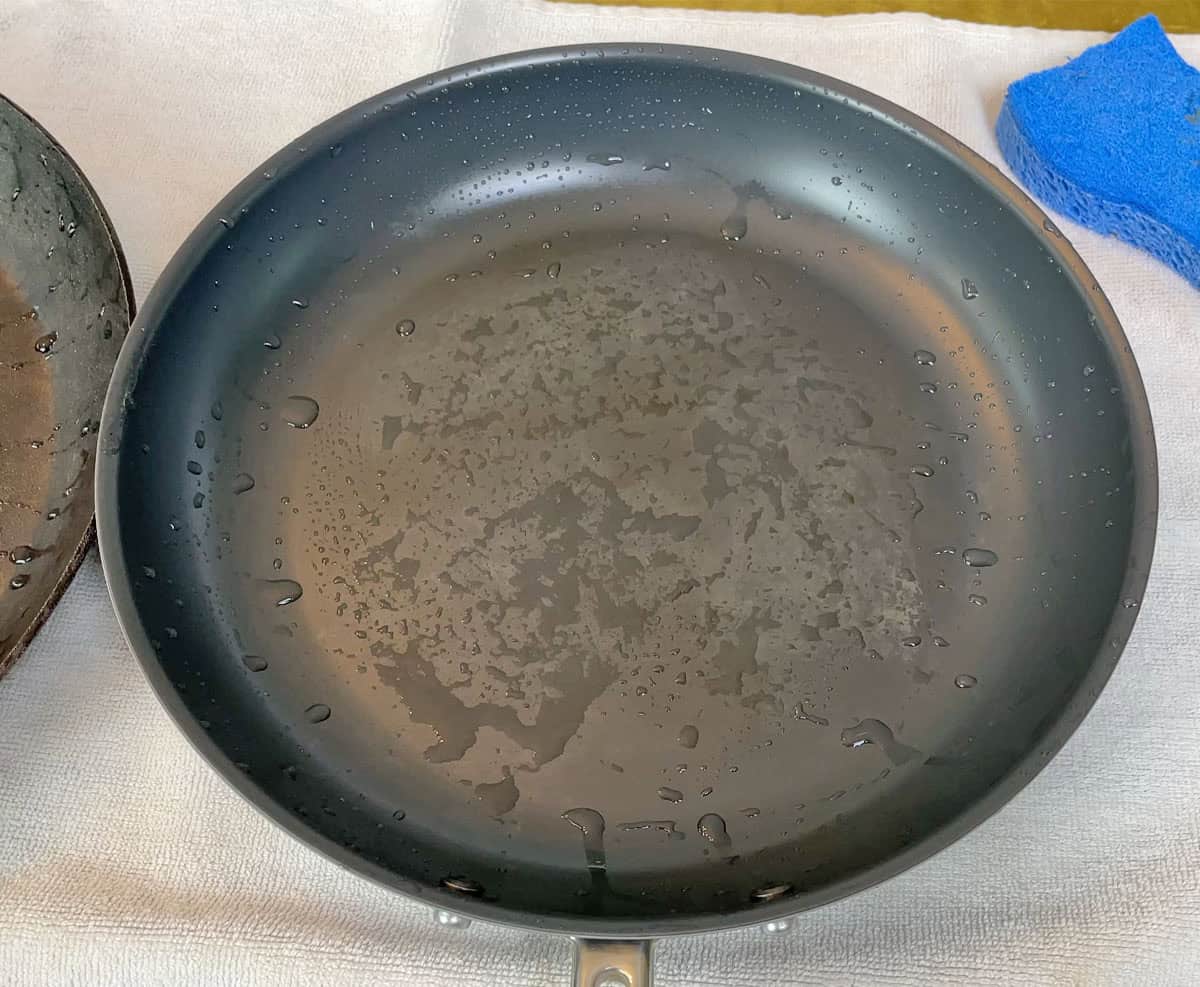
The next day, the de Buyer was rusty. The Lodge and Misen pans had no rust at all.
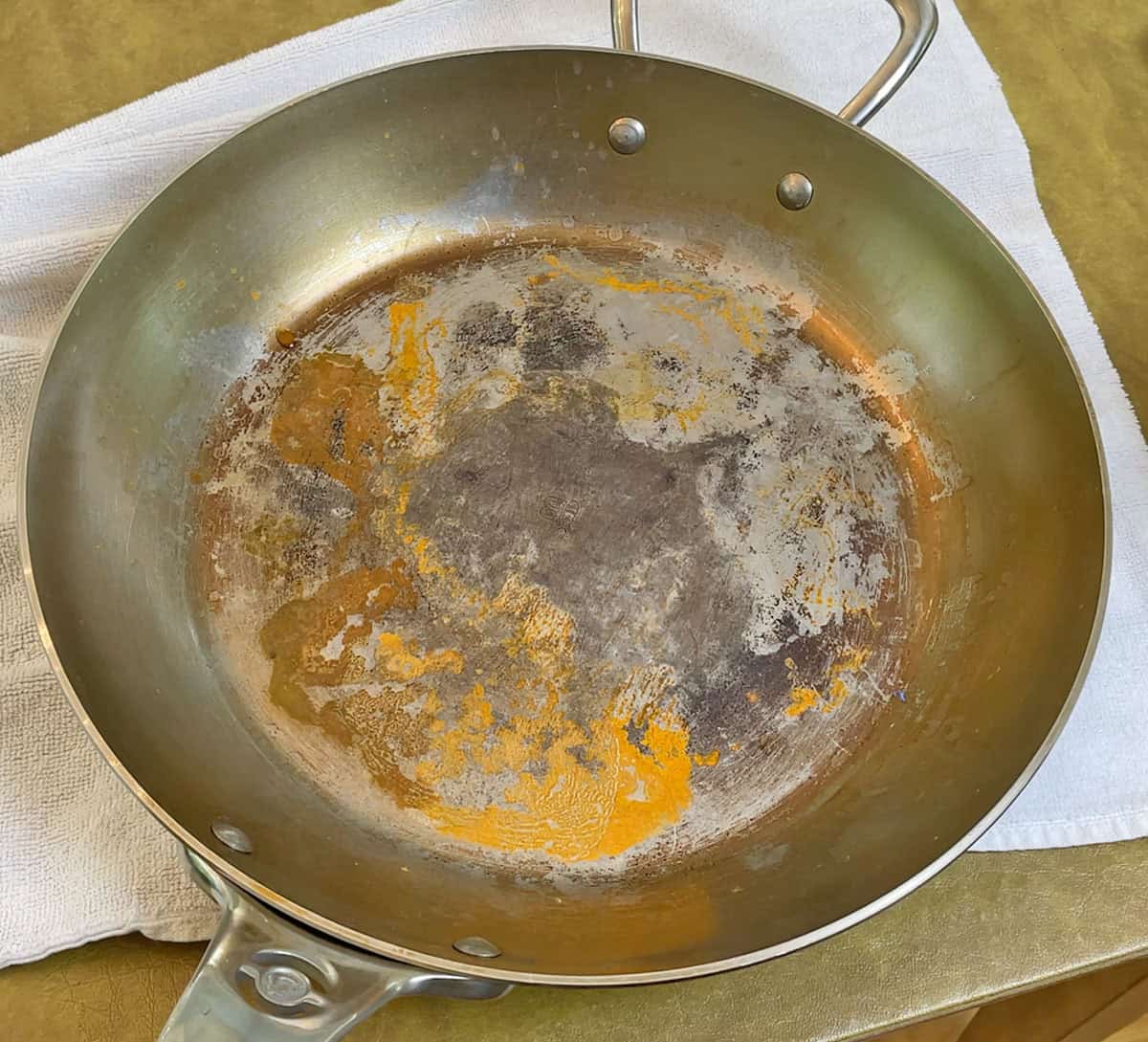
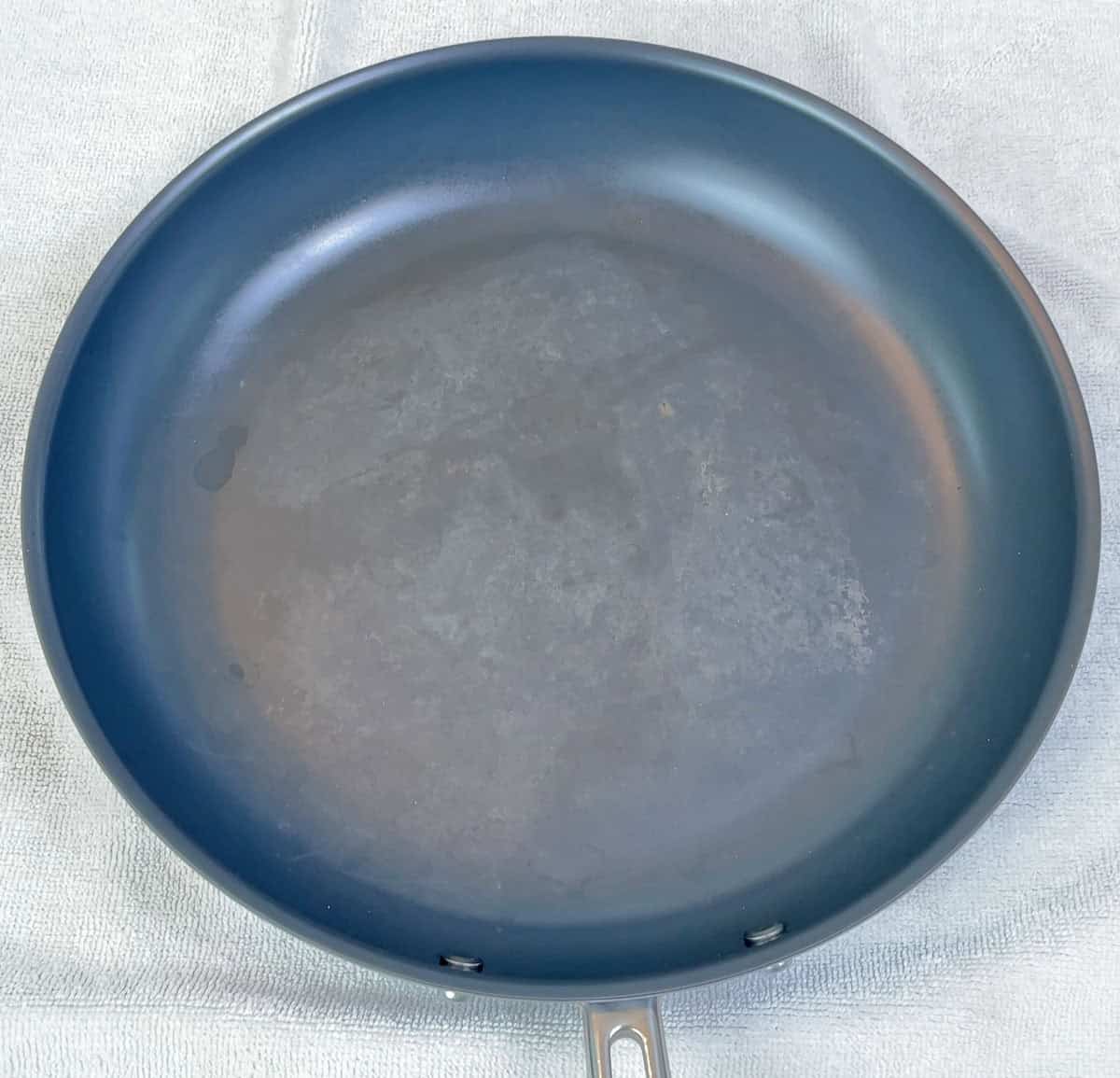
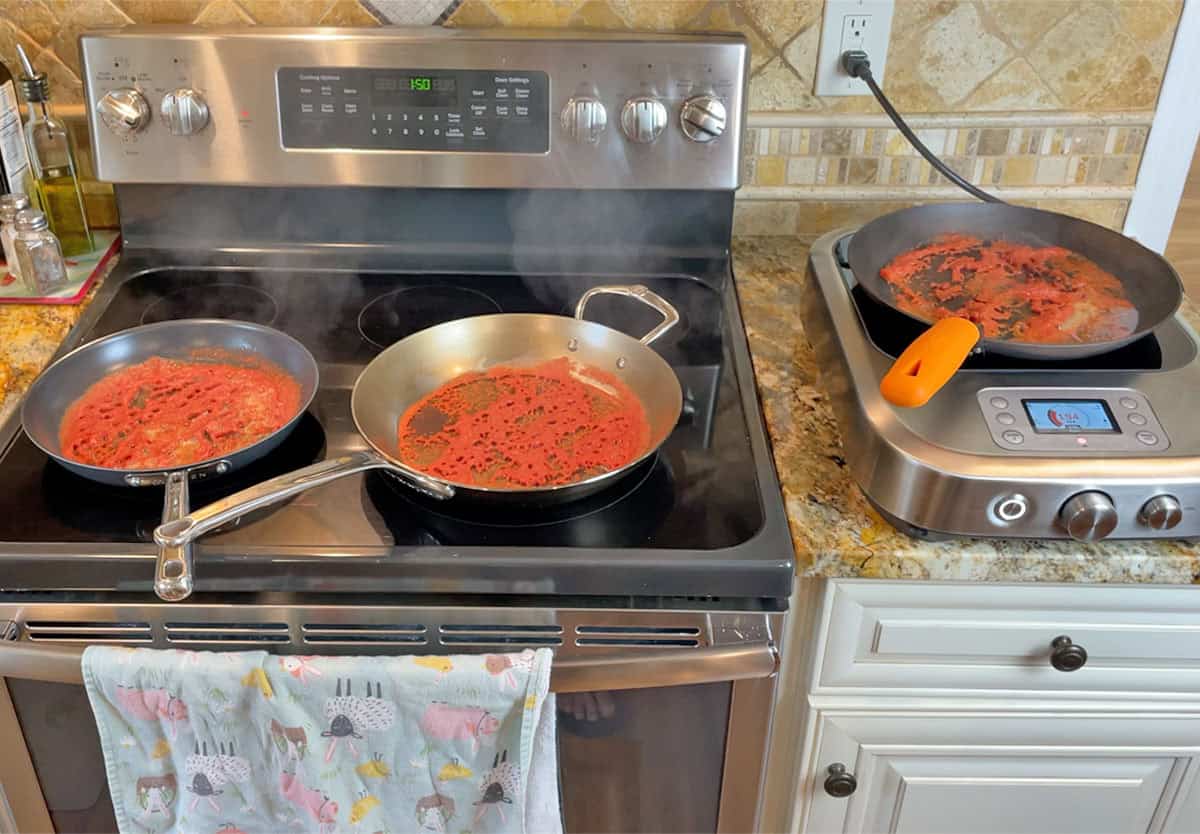
To test how each pan reacts to acidic foods, I poured crushed tomatoes into each pan and simmered them for 15 minutes.
After rinsing, the seasoning on the de Buyer was almost completely gone, and the Lodge looked noticeably lighter. The Misen had no visible change.
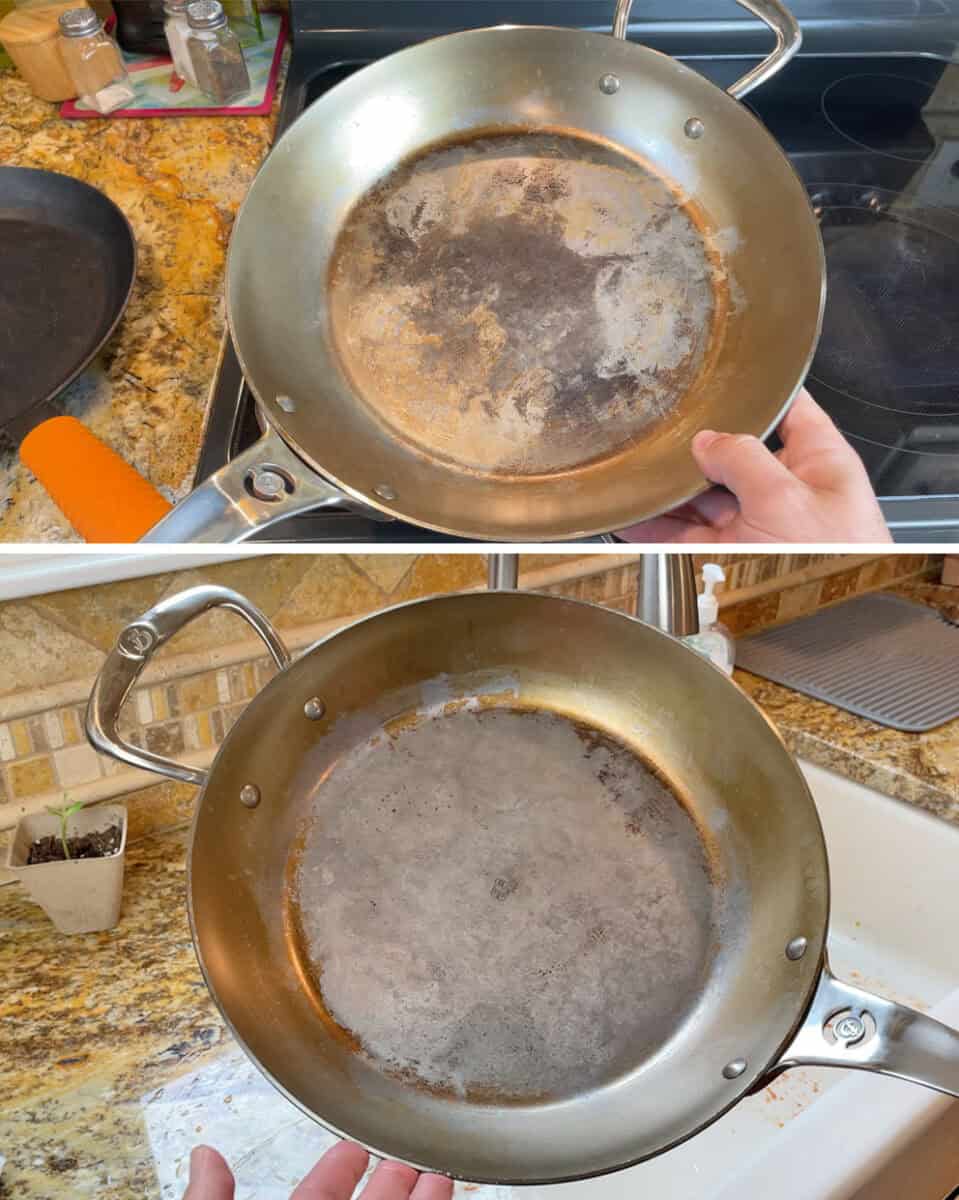
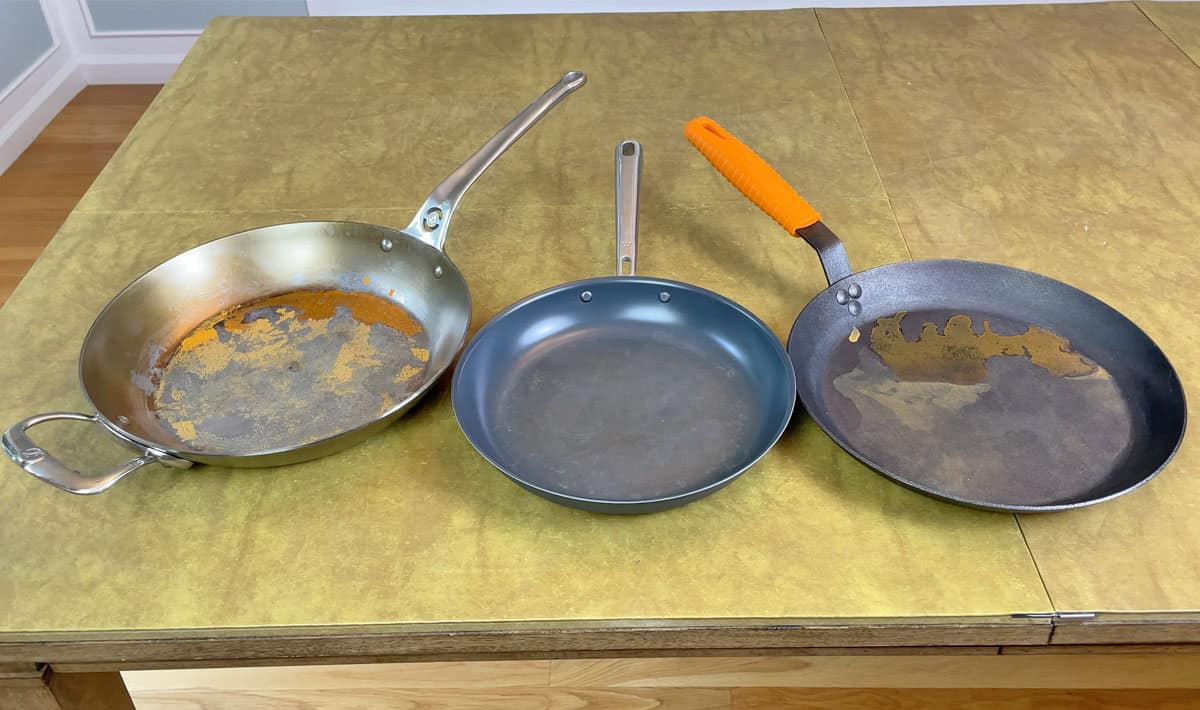
Then I repeated the water test and left all three pans wet overnight. This time, the de Buyer was heavily rusted, and now the Lodge was rusty too — likely because the tomatoes had degraded the seasoning layer. The Misen still showed no signs of rust.
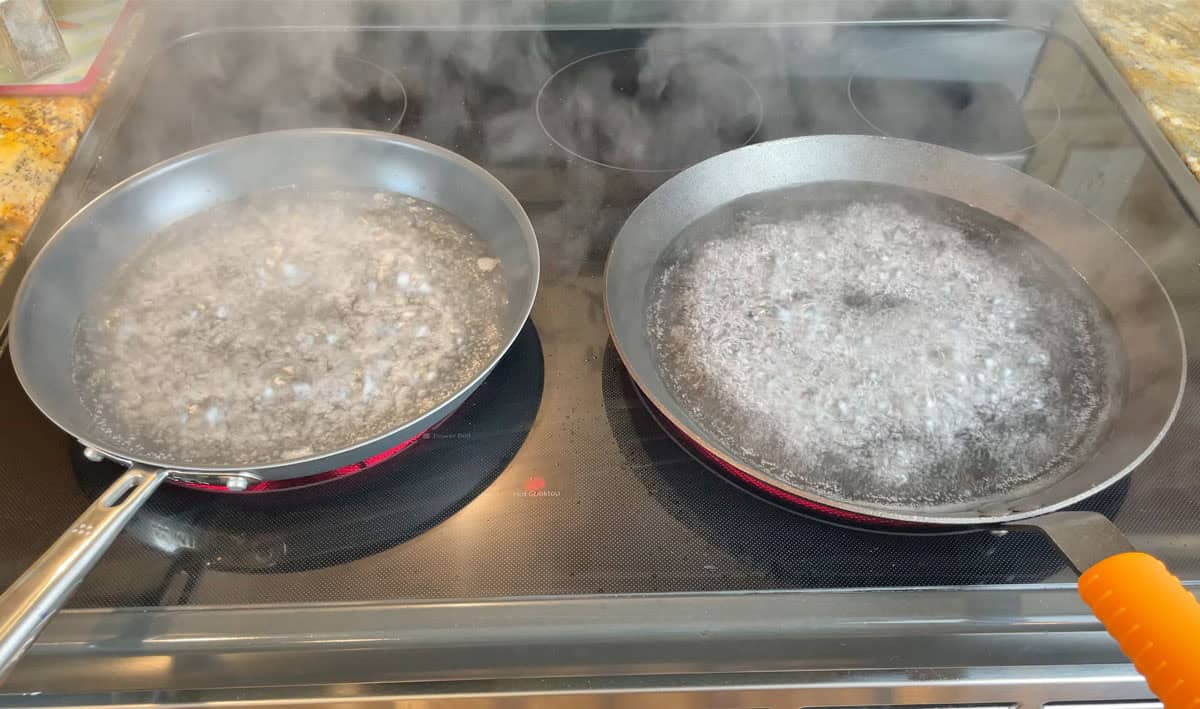
For one final test, I poured clean water into the Lodge and Misen pans, brought it to a boil for 10 minutes, then poured the water back into the glasses.
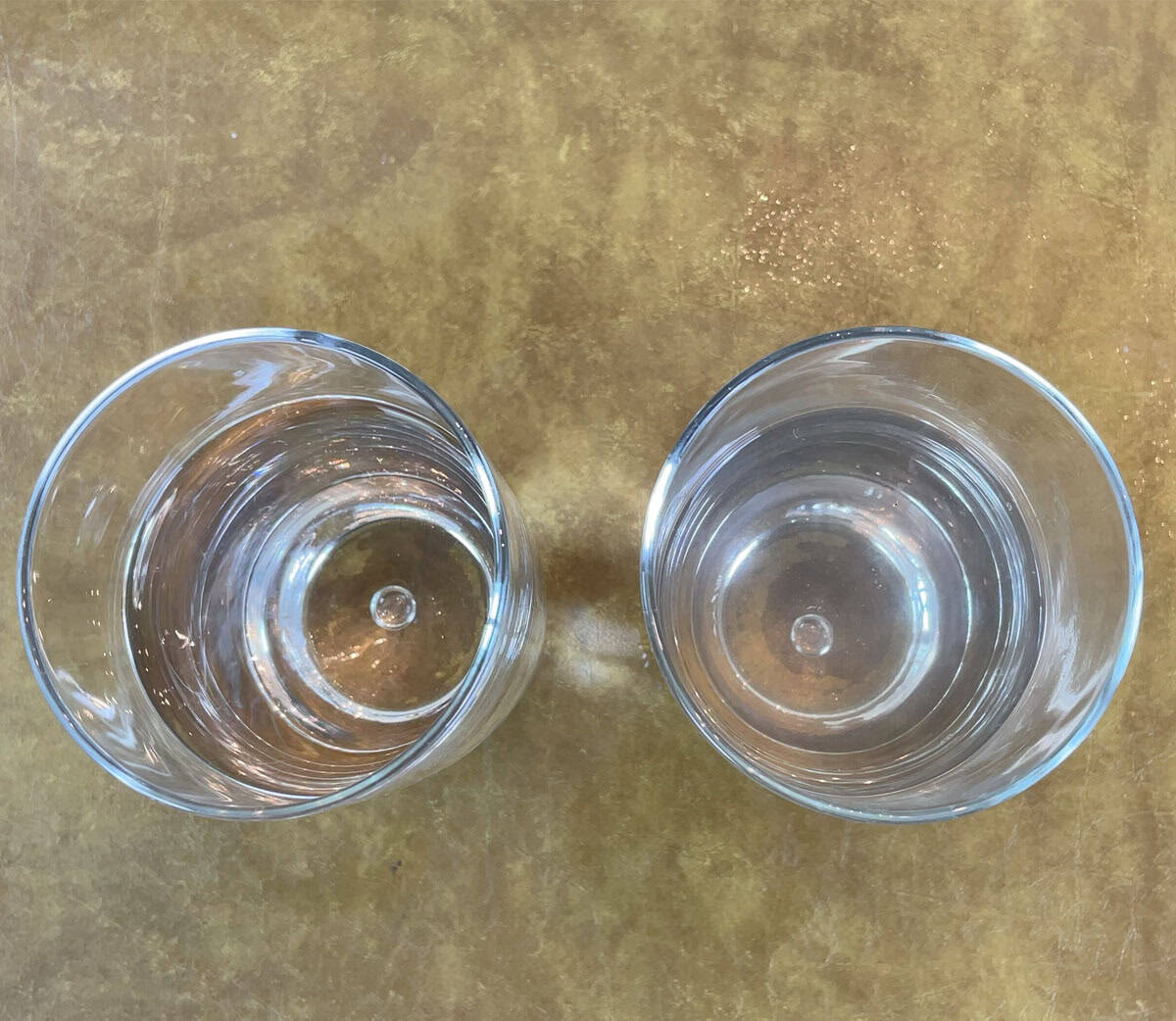
The water from the Misen pan was clear. The water from the Lodge pan was cloudy, which is a sign that bits of seasoning had leached into the water. That’s normal for seasoned carbon steel, but with the Misen, at least while it’s still unseasoned, it didn’t happen.
Claim 4: Responsive
Misen also claims the Carbon Nonstick Pan is more responsive to temperature changes thanks to its aluminum core.
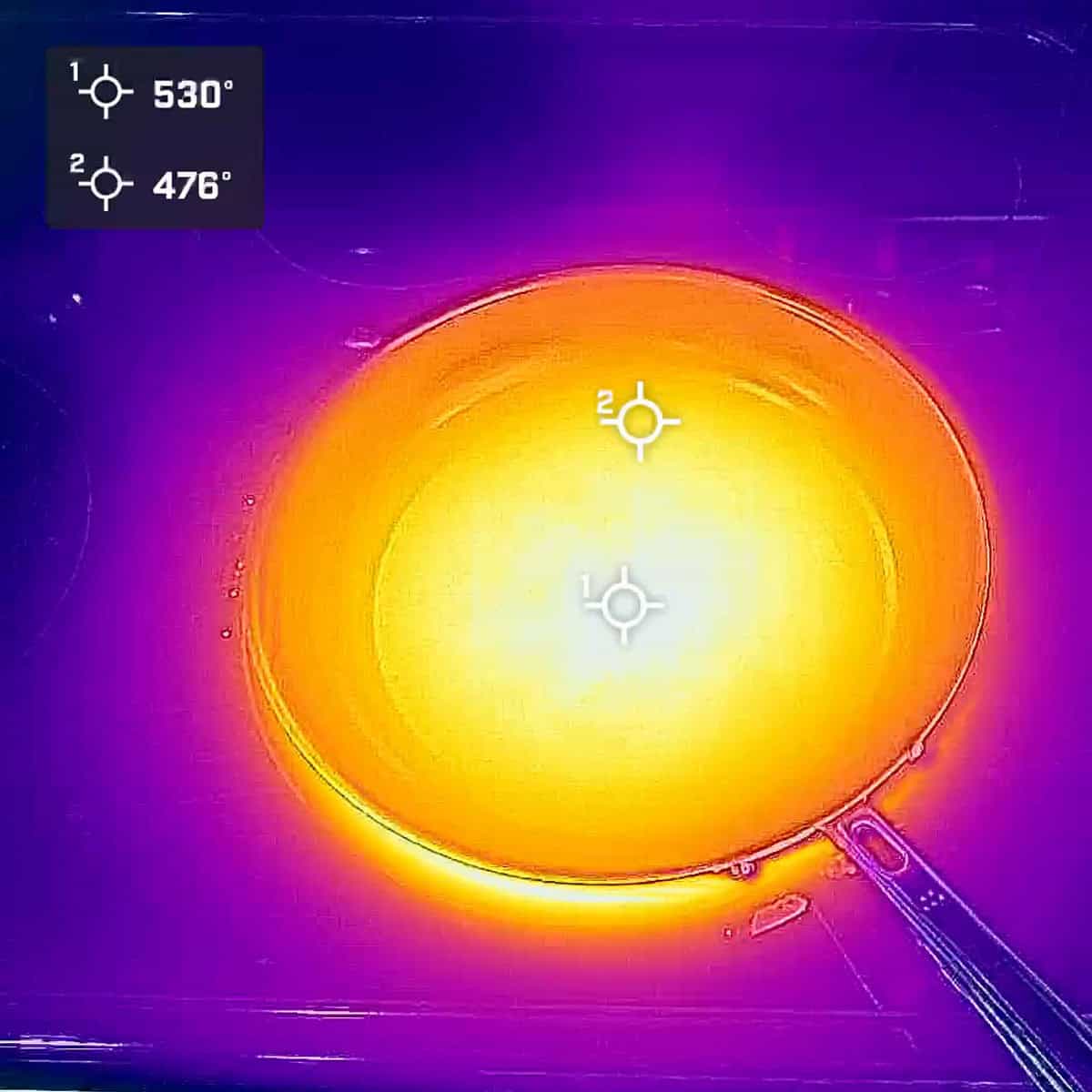
Aluminum conducts heat much faster than carbon steel, so when it’s layered inside a pan, it helps the cooking surface heat up quicker, spread heat more evenly, and cool down faster when you turn the heat down — all areas where traditional carbon steel can struggle.
To test heating speed, I placed the pan on medium heat and measured the surface temperature at the center after two minutes. The Misen reached 535°F, making it the fastest-heating carbon steel pan I’ve tested and the second-fastest pan overall, only behind the stainless steel de Buyer Alchimy 3-Ply, which got too hot to measure at the two-minute mark.
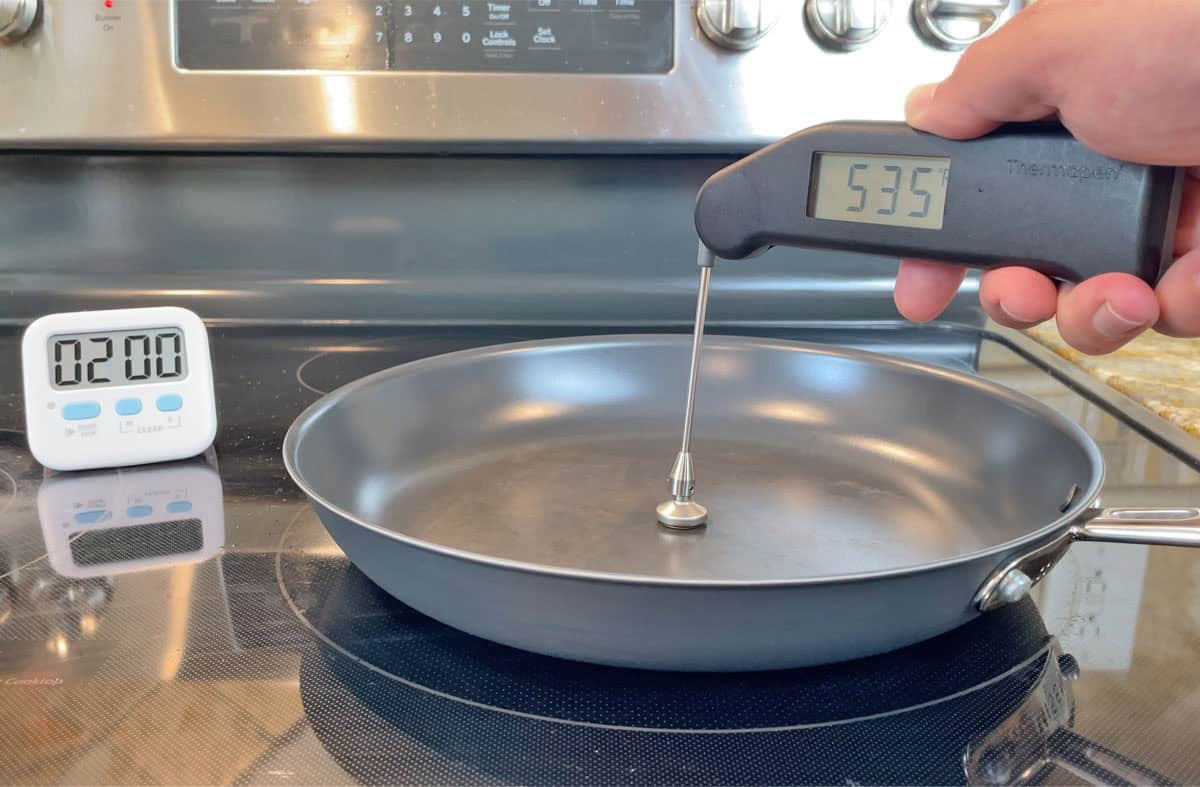
Heat distribution was also better than most carbon steel pans. After two minutes, the edge of the Misen measured 465°F, just 70°F cooler than the center. That was the third-smallest temperature difference among all the carbon steel pans I’ve tested, behind the Strata Carbon Clad (58°F) and the Smithey Carbon Steel (50°F). In real cooking, I noticed that food near the edge browned almost as evenly as food in the center.
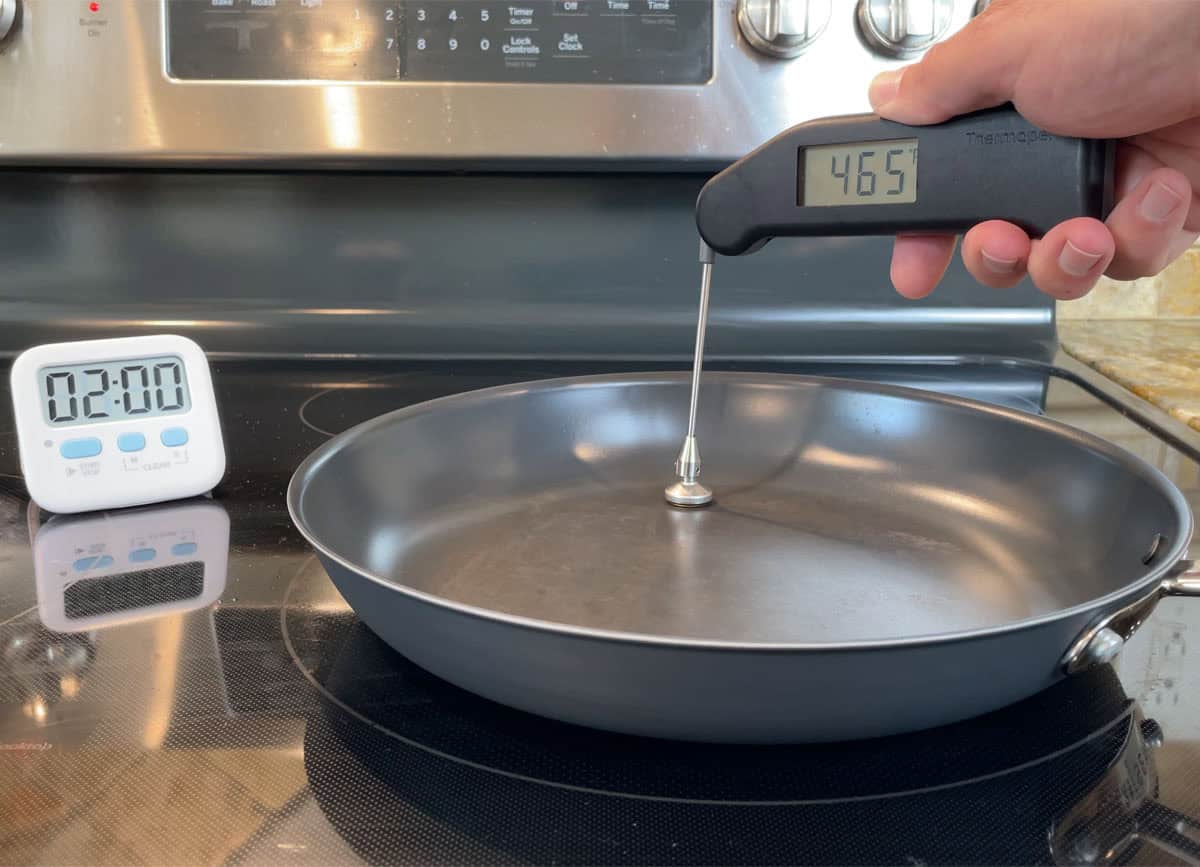
Here are the heat conduction and distribution results compared to other pans I’ve tested:
| Pan | Center Temperature After 2 Minutes (°F) | Edge Temperature After 2 Minutes (°F) | Temp Difference (°F) | Ranking for Smallest Difference (Carbon Steel Only) |
|---|---|---|---|---|
| Misen Carbon Nonstick – Carbon Clad (Nitrided Carbon Steel + Aluminum Core) | 535 | 465 | 70 | 3rd |
| Matfer Bourgeat Carbon Steel | 514 | 438 | 76 | — |
| de Buyer Mineral B Pro Carbon Steel | 501 | 423 | 78 | — |
| de Buyer Blue Carbon Steel | 500 | 421 | 79 | — |
| Made In Carbon Steel | 484 | 324 | 160 | — |
| de Buyer Mineral B Carbon Steel | 484 | 393 | 91 | — |
| Strata Carbon Clad | 455 | 397 | 58 | 2nd |
| Lodge Carbon Steel | 457 | 369 | 88 | — |
| Smithey Carbon Steel | 400 | 350 | 50 | 1st |
For cooling speed (i.e. heat retention), I heated the pan to exactly 400°F, removed it from the burner, and measured the surface temperature after five minutes. The Misen cooled to 117°F above room temperature, making it the third-fastest cooling carbon steel pan I’ve tested, just behind the Strata Carbon Clad (114°F) and the Made In Carbon Steel (112°F).
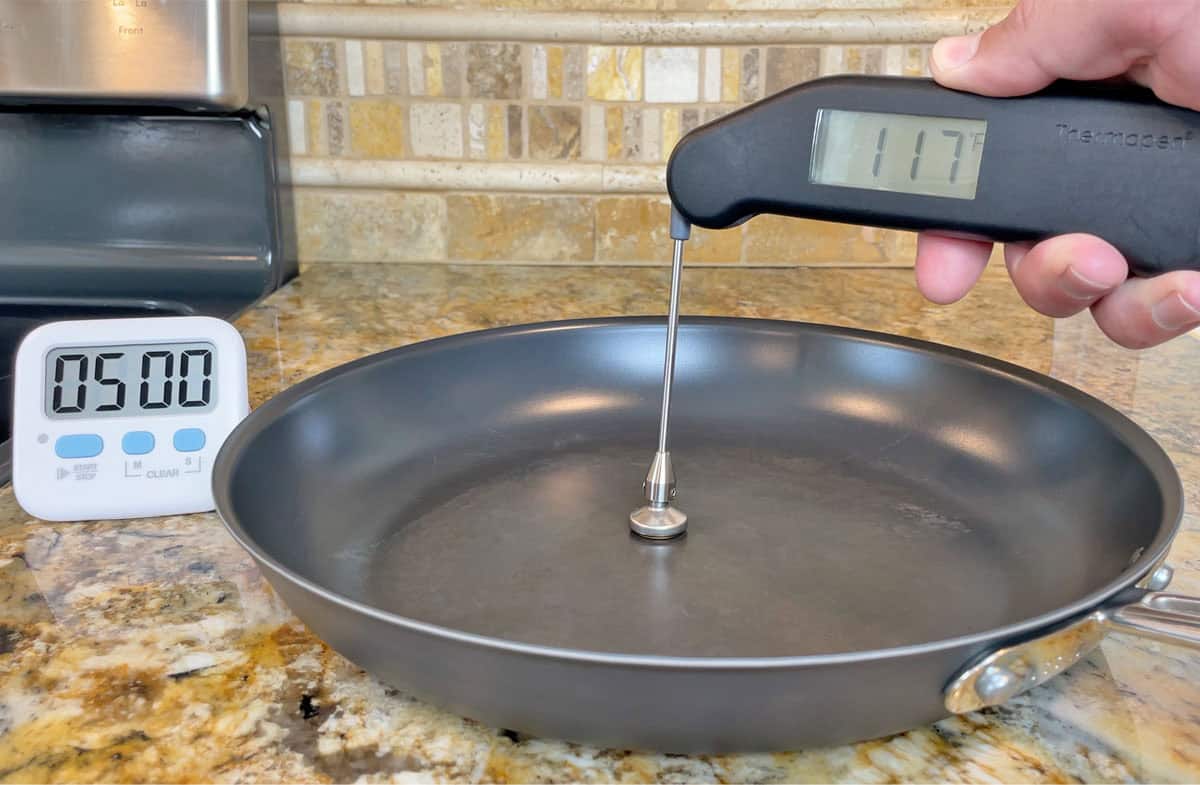
Here are the full results of the popular carbon steel pans I’ve tested:
| Pan | Temperature After 5 Minutes (°F) |
|---|---|
| Made In Carbon Steel | 112 |
| Strata Carbon Clad | 114 |
| Misen Carbon Nonstick – Carbon Clad (Nitrided Carbon Steel + Aluminum Core) | 117 |
| de Buyer Blue Carbon Steel | 126 |
| Matfer Bourgeat Carbon Steel | 149 |
| Lodge Carbon Steel | 153 |
| de Buyer Mineral B | 154 |
| de Buyer Mineral B Pro | 162 |
| Smithey Carbon Steel | 162 |
These results confirm Misen’s claims. The aluminum core allows it to heat quickly, distribute heat more evenly than most carbon steel pans, and cool rapidly when you lower the heat or take it off the burner. That combination makes it easier to control cooking temperatures and avoid overcooking delicate foods.
Claim 5: Lightweight
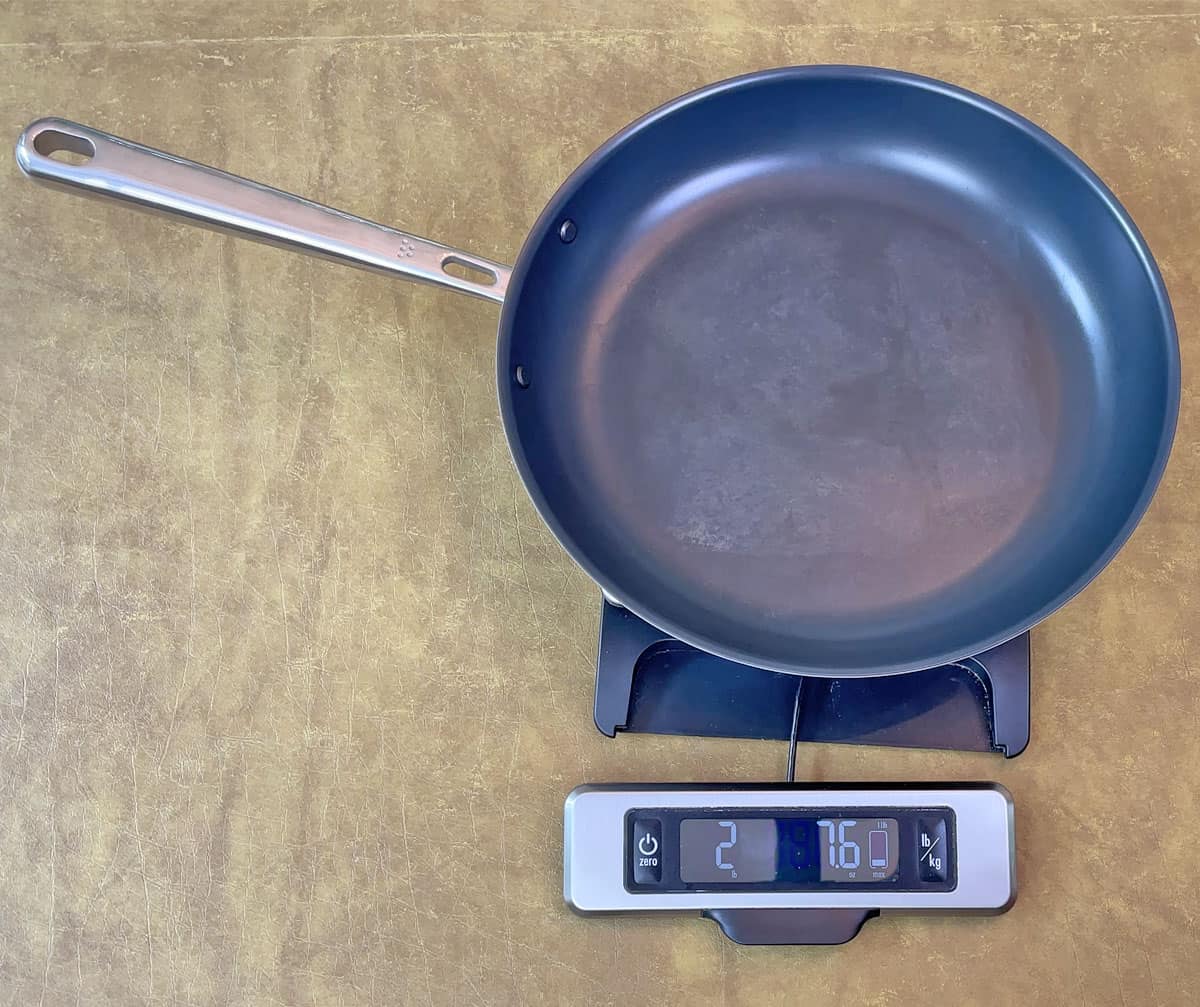
One of the most underrated benefits of the Misen Carbon Nonstick Pan is how light it is. The 12-inch version weighs just 3 pounds (the 10-inch version pictured below is 2.4 lb), which is significantly lighter than most traditional carbon steel or cast iron pans and even some stainless steel and aluminum ones.
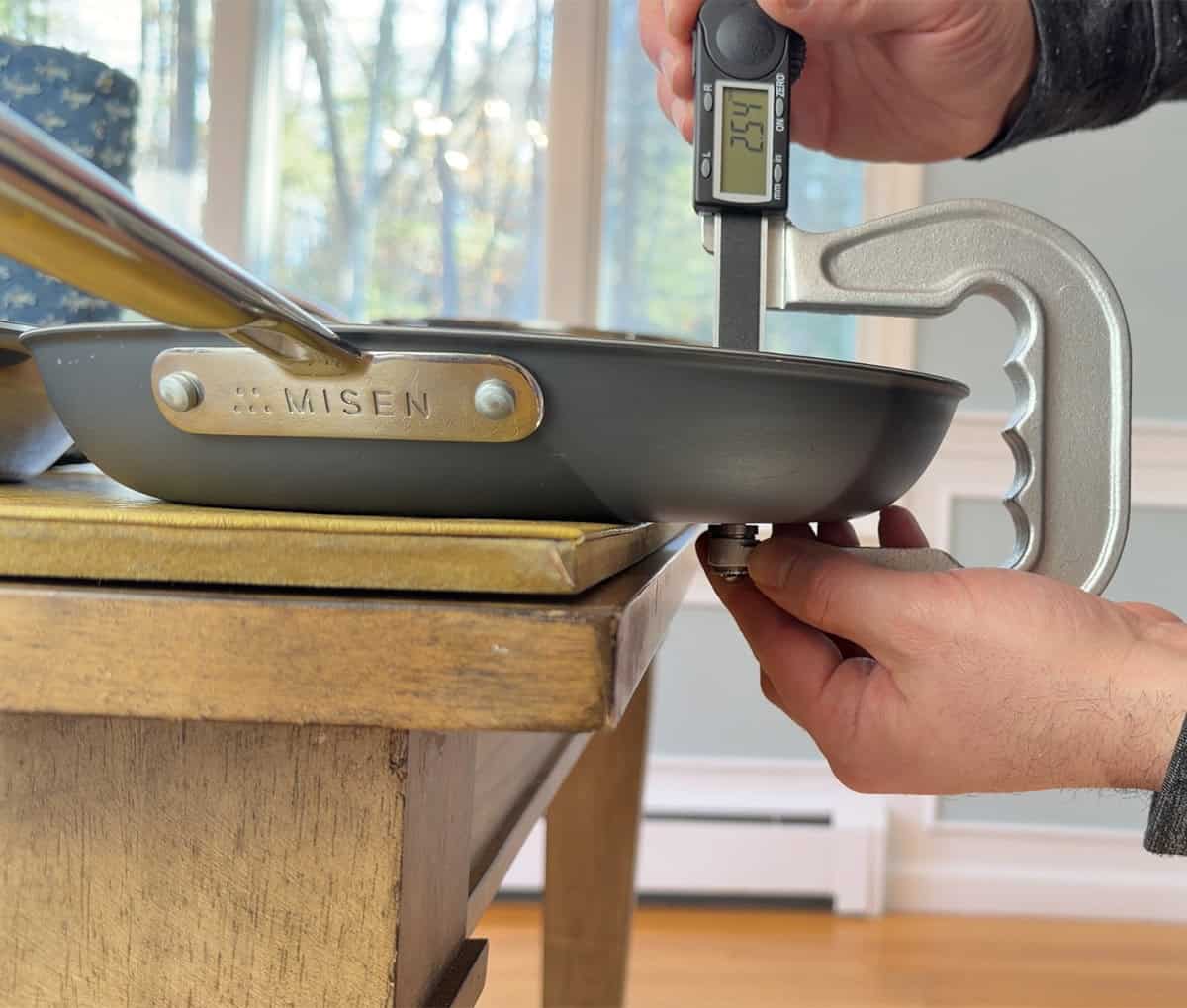
The base is about 2.5 mm thick, which is slightly thinner comparable to other high-quality pans in this size.
The aluminum core, which is much less dense than carbon steel, allows the Misen to maintain durability and heat performance while still being easy to lift, tilt, and maneuver with one hand.
For context, many carbon steel pans in this size weigh 4 pounds or more, and most cast iron skillets are 5 to 8 pounds. Even some multi-ply stainless steel pans with aluminum cores exceed the Misen’s weight.
Here’s how the Misen compares to other 12-inch pans I’ve tested:
| Pan (Material) | Weight (lb) |
|---|---|
| Lodge Classic Cast Iron (Cast Iron) | 8.1 |
| Lodge Chef Collection Cast Iron (Cast Iron) | 6.3 |
| de Buyer Mineral B Pro (Carbon Steel) | 6.9 |
| de Buyer Mineral B (Carbon Steel) | 6.0 |
| Field Company No. 10 (Cast Iron) | 5.5 |
| Matfer Bourgeat Copper (Copper with Stainless Steel Interior) | 5.8 |
| Legend Copper Core (5-Ply Stainless Steel – Copper Core) | 5.5 |
| Stargazer (Cast Iron) | 6.5 |
| Smithey No.12 (Cast Iron) | 7.2 |
| Smithey Farmhouse Carbon Steel (Carbon Steel) | 5.2 |
| Demeyere Atlantis (7-Ply Stainless Steel – Aluminum Core) | 5.2 |
| Hestan CopperBond (5-Ply Stainless Steel – Copper Core) | 4.1 |
| de Buyer Blue Carbon Steel (Carbon Steel) | 4.2 |
| Lodge Carbon Steel (Carbon Steel) | 4.6 |
| Matfer Bourgeat Carbon Steel (Carbon Steel) | 4.9 |
| All-Clad Copper Core (5-Ply Stainless Steel – Copper Core) | 3.7 |
| Cuisinart MultiClad Pro (3-Ply Stainless Steel – Aluminum Core) | 3.7 |
| de Buyer Affinity (5-Ply Stainless Steel – Aluminum Core) | 3.6 |
| All-Clad HA1 (Hard Anodized Aluminum – Non-Stick) | 3.6 |
| All-Clad NS Pro (Hard Anodized Aluminum – Non-Stick) | 3.5 |
| Hestan NanoBond (3-Ply Stainless Steel – Titanium Reinforced) | 3.5 |
| Hestan ProBond (3-Ply Stainless Steel – Aluminum Core) | 3.5 |
| Hestan ProBond TITUM (3-Ply Stainless Steel – Aluminum Core, Non-Stick) | 3.5 |
| Titanium Always Pan Pro (3-Ply Stainless Steel – Aluminum + Titanium) | 3.4 |
| Goldilocks (3-Ply Stainless Steel – Aluminum Core) | 3.3 |
| All-Clad D5 (5-Ply Stainless Steel – Aluminum + Steel Core) | 3.2 |
| Made In Stainless Steel (5-Ply Stainless Steel – Aluminum Core) | 3.2 |
| Made In Non-Stick (3-Ply Stainless Steel – Aluminum Core) | 3.2 |
| Cooksy (3-Ply Stainless Steel – Aluminum Core, Hybrid Non-Stick) | 3.1 |
| All-Clad D3 Everyday (3-Ply Stainless Steel – Aluminum Core) | 3.1 |
| HexClad (3-Ply Stainless Steel – Aluminum Core, Hybrid Non-Stick) | 3.1 |
| Misen Carbon Nonstick (Carbon Clad – Nitrided Carbon Steel + Aluminum Core) | 3.0 |
| Tramontina Tri-Ply Clad (3-Ply Stainless Steel – Aluminum Core) | 3.0 |
| Sardel Stainless Steel (5-Ply Stainless Steel – Aluminum Core) | 3.0 |
| Henckels Clad H3 (3-Ply Stainless Steel – Aluminum Core) | 3.0 |
| Strata (Carbon Steel Interior – Aluminum Core – Stainless Exterior) | 3.0 |
| Heritage Titanium Series (5-Ply Stainless Steel – 316Ti + Aluminum Core) | 2.9 |
| Heritage Steel Eater Series (5-Ply Stainless Steel – Aluminum Core) | 2.8 |
| All-Clad D3 (3-Ply Stainless Steel – Aluminum Core) | 2.8 |
| All-Clad G5 Graphite Core (5-Ply Stainless Steel – Graphite Disc) | 2.2 |
Downsides
So far, this pan lives up to its claims — but there are a few downsides worth mentioning.
First, the handle is comfortable, but the rounded edges make it a little slippery, especially if you’re wearing an oven mitt or washing it with soapy hands.
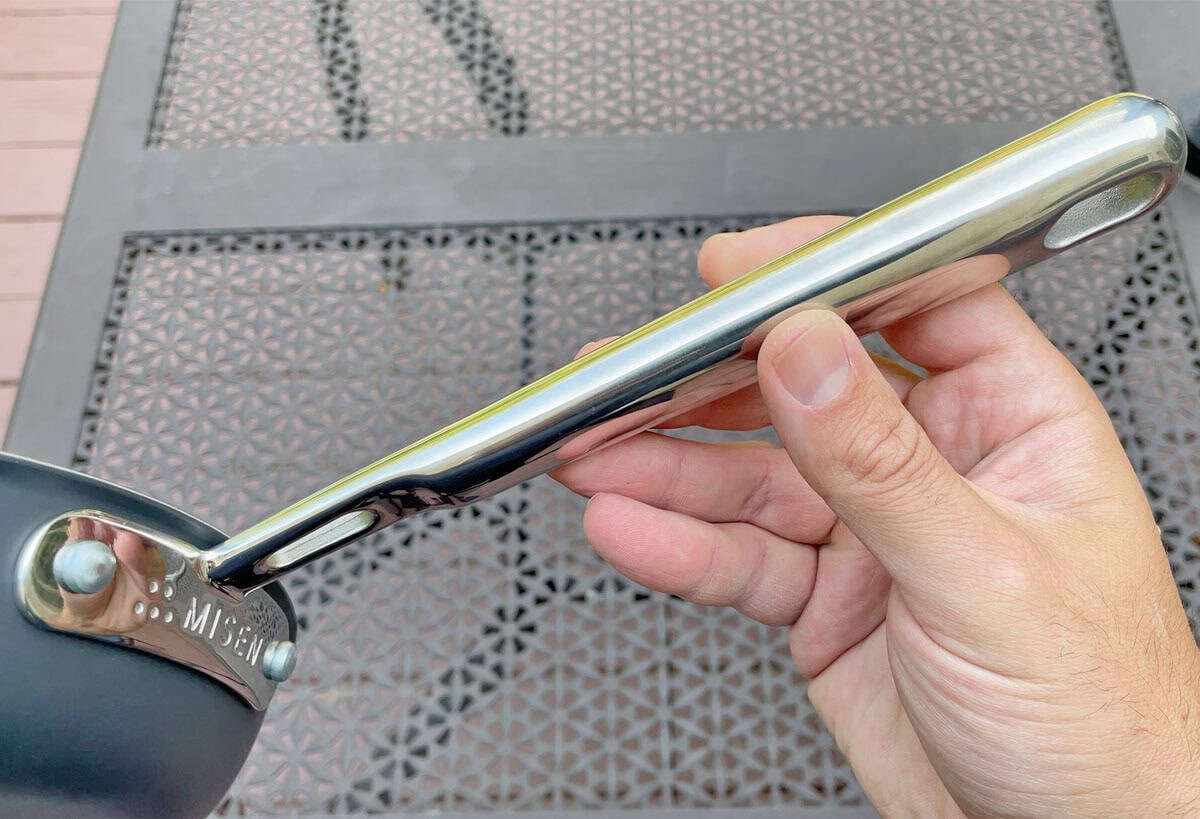
I prefer handles like the one on the Strata pan, which has a subtle groove on top that gives you a more secure grip and helps prevent rotation.

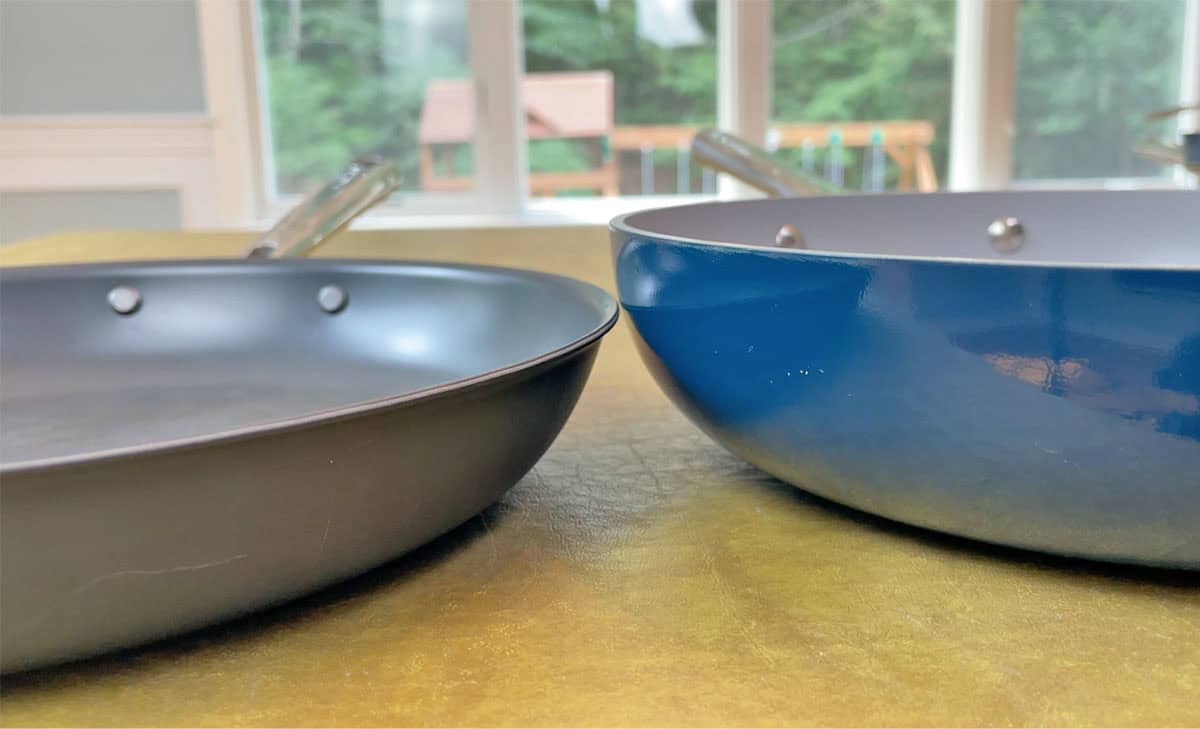
Another design element I didn’t love about the original version was the shallow sidewalls. On the 10- and 12-inch pans, the walls were only 1.75 inches tall, and the 8-inch pan was even shallower at 1.3 inches. For comparison, most pans in those sizes are closer to 2 inches or higher.
Lower walls don’t contain splatter as well, and more importantly, they limit how much food, liquid, or sauce you can fit in the pan. Since publishing this review, Misen released a deeper version that addresses this issue. The deeper 8-inch pan has 1.8-inch walls, the 10-inch has 2-inch walls, and the 12-inch has 2.2-inch walls.
Heat retention is another tradeoff. Misen designed this pan to be responsive, so it cools quickly, which is great for many things. But it can also be a drawback. Even Misen admits their regular carbon steel holds heat better, which makes it more effective for heavy-duty searing.
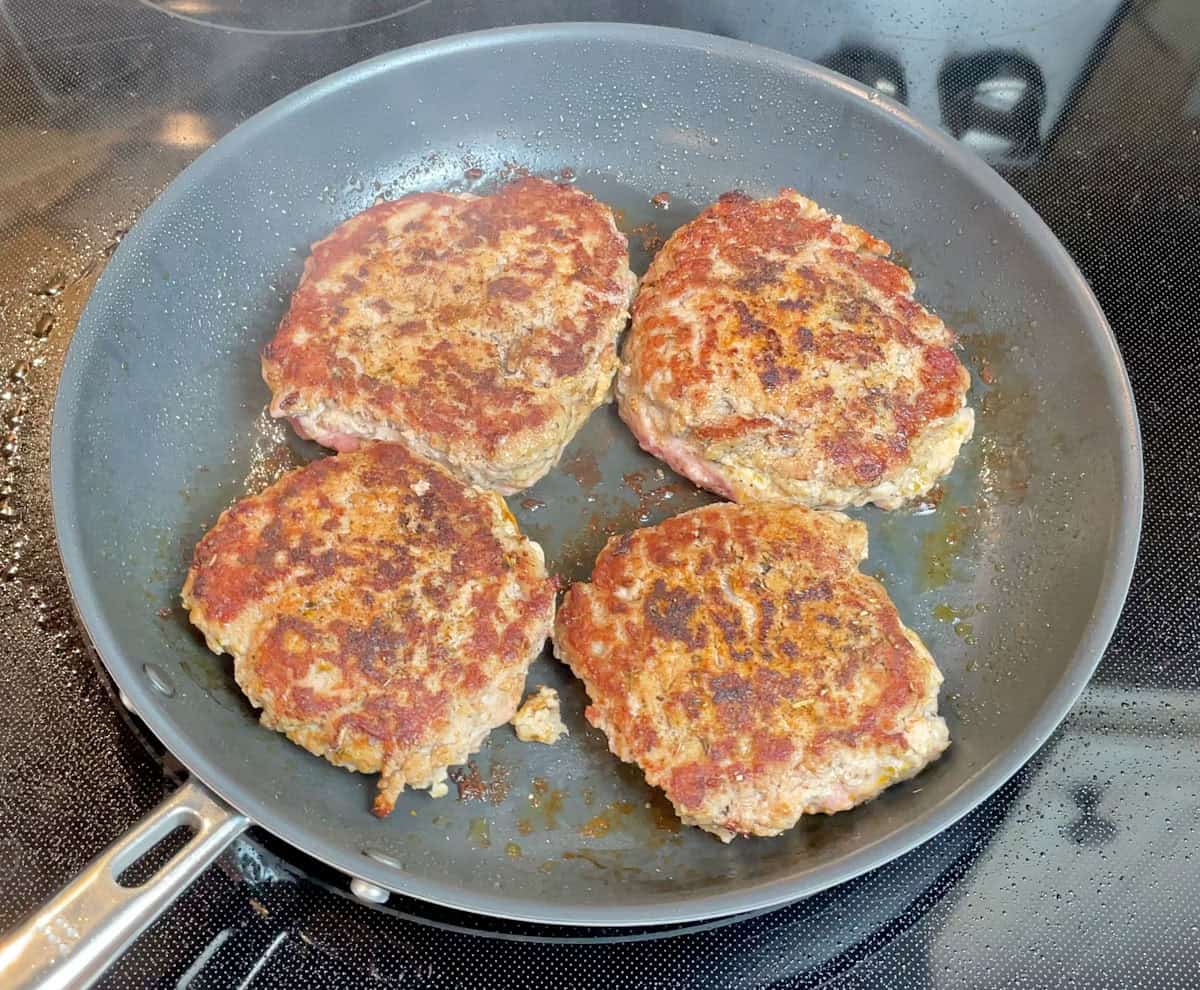
I noticed this when cooking turkey burgers. Once the pan got crowded, it lost heat and took a while to recover, which made it harder to get a good sear.
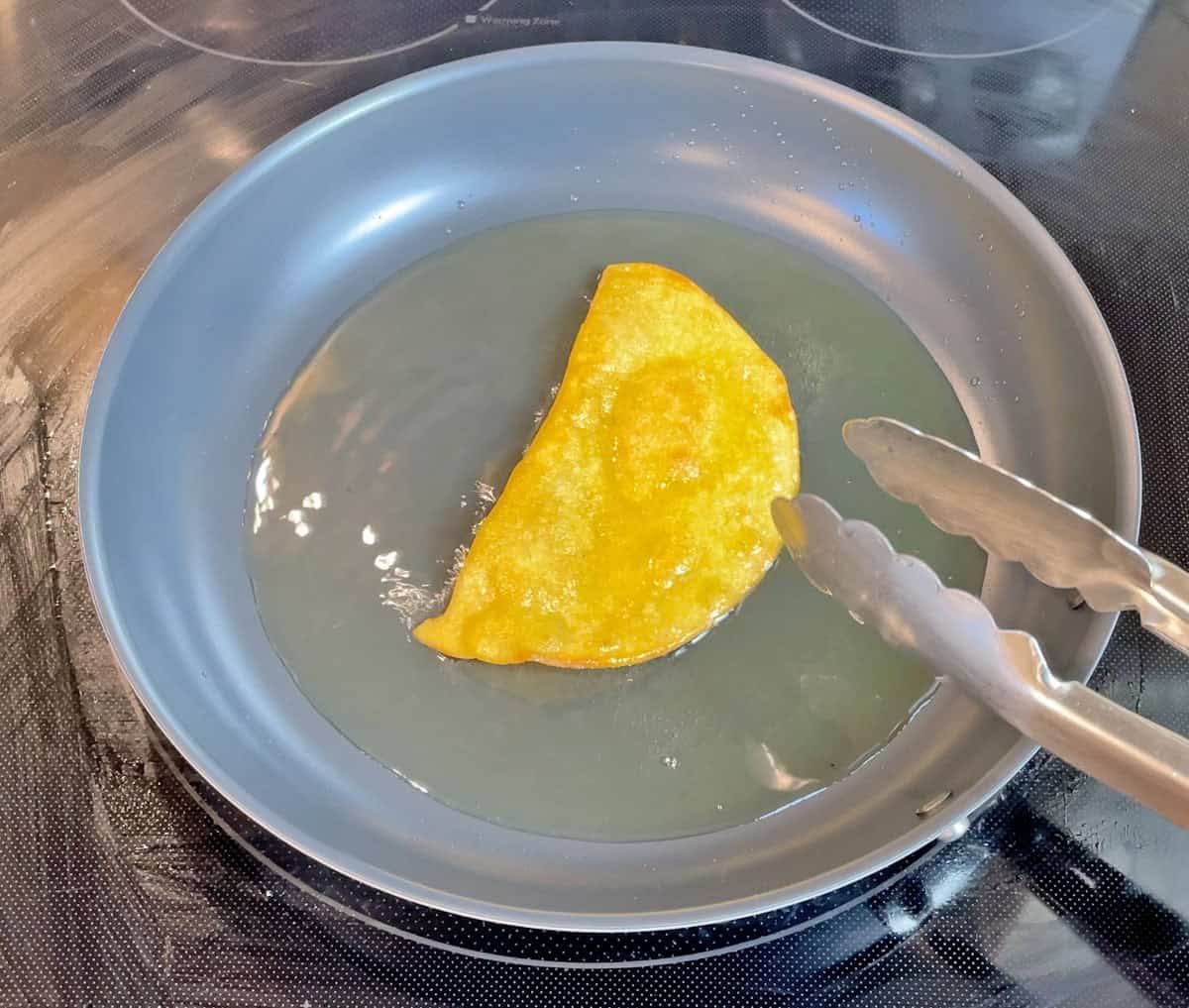
I also noticed it when shallow frying tortillas — the heat wasn’t as steady, and I had to adjust the dial a few times to keep it from getting too hot.
The end results were fine in both cases, but this kind of heat loss could be an issue with thick steaks or anything that requires steady heat over longer periods.
Bottom Line: Is the Misen Carbon Nonstick Pan Worth It?
So after all that testing, is the Misen Carbon Nonstick pan worth buying?
The short answer is yes, it is worth buying. It’s not as slick as a brand-new Teflon pan, but the hardened surface is noticeably more nonstick than stainless steel, cast iron, or even preseasoned carbon steel. It’s built to last, and you don’t have to worry about seasoning, rust, or acidic foods damaging the surface.
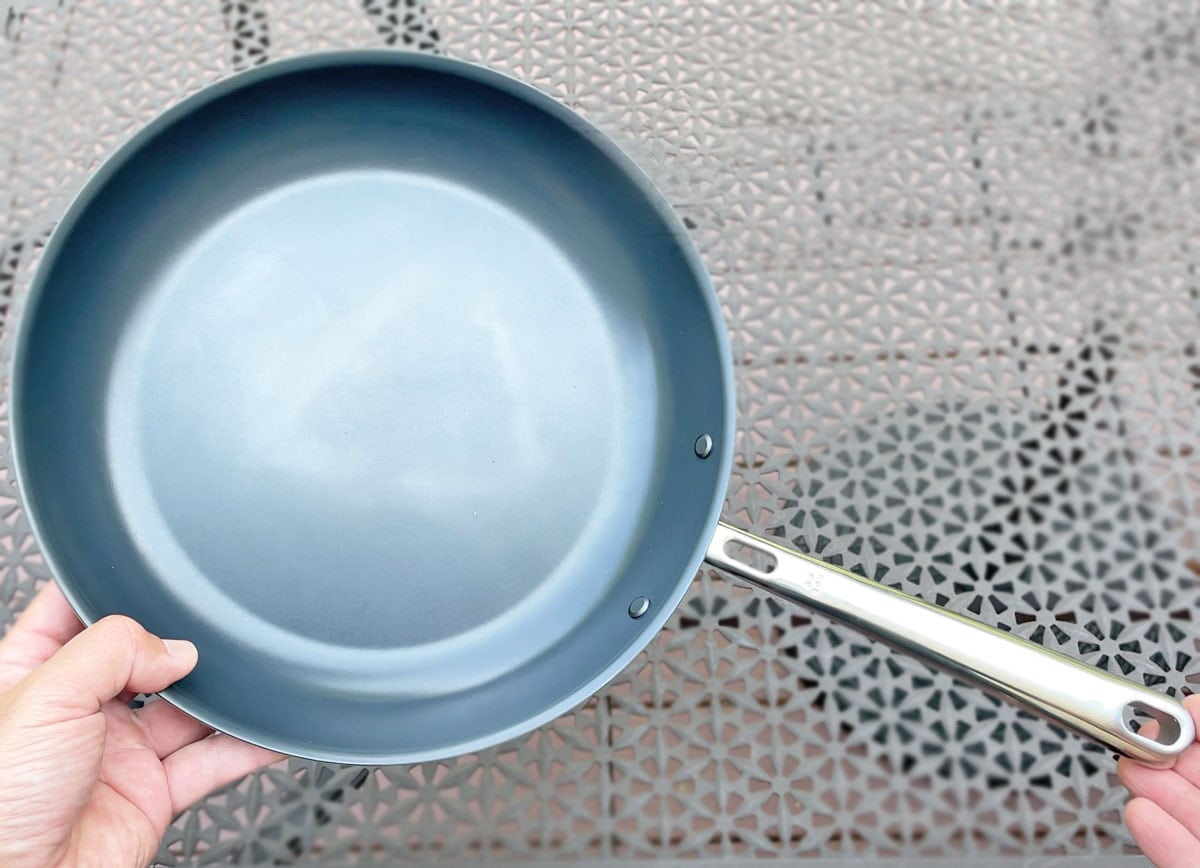
It’s a great option for anyone looking to replace their nonstick pan with something more durable, but without the weight or maintenance of traditional carbon steel.
The biggest argument against it is that it’s not that different from a fully-clad stainless steel pan. And many stainless steel options, like Heritage Steel, are made in the U.S. and cost about the same.
You won’t get quite the same level of food release, but as I’ve shown in other videos, stainless steel can become nonstick with the right heat and fat.
That said, I’m a big fan of this Misen pan. It lives up to its claims, and it’s a meaningful step toward reducing the need for disposable cookware.
The Misen Carbon Nonstick Pan is available at Misen.com and Amazon, where you can check the current prices, read more reviews, and buy.
If you’re interested in Misen, you’ll definitely want to check out my review of the Strata pan or my head-to-head comparison of Strata vs. Misen Carbon Nonstick. It uses a similar multilayer carbon steel construction, but there are some key differences you need to know before you decide between the two.
Related Topics
- Misen Carbon Nonstick vs. Anolon EverLast N2 vs. Strata (Test Results)
- Misen Cookware In-Depth Review (With Pictures)
- Misenware Food Storage Containers Review: I Tested Every Claim
- Misen 8-Inch Chef’s Knife Review (With Pictures)
- Misen Carbon Steel Pan Review: Everything You Need to Know
- Misen vs. All-Clad Cookware: 11 Key Differences
- Misen Non-Stick Cookware: Unboxing, Initial Testing, and First Impressions
- HexClad vs. Misen Cookware: An In-Depth Comparison
- Made In vs. Misen: Which Cookware and Kitchen Knives Are Better?

