

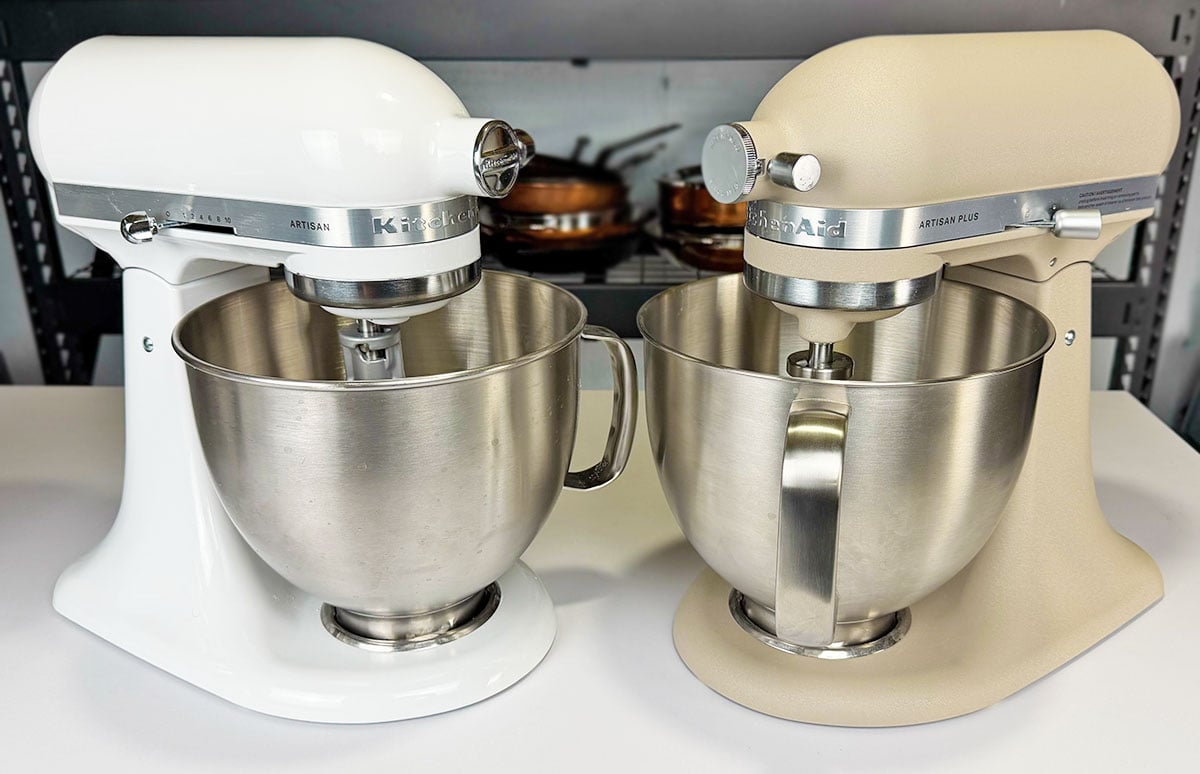
KitchenAid’s Artisan and Artisan Plus stand mixers look nearly identical on the shelf, but the newer Artisan Plus model is $100 more expensive.
To find out if the extra investment is worth it, I bought both and put them through the exact same tests. I whipped cream and made chocolate chip cookies and pizza dough from scratch. For each test, I used the same ingredients, quantities, and speed settings.
I also compared their key specs like weight, cord length, noise levels, power consumption, safety features, and much more.
In this comparison, you’ll see exactly what that extra $100 gets you, where it doesn’t matter at all, and which one I’d actually buy.
Key Takeaways
Both mixers come with a 5-quart bowl and a handle, and both have a similar die-cast metal body and weigh about the same. They performed almost identically in my whipped cream test, and both ended up producing great cookies and great pizza dough by the end.
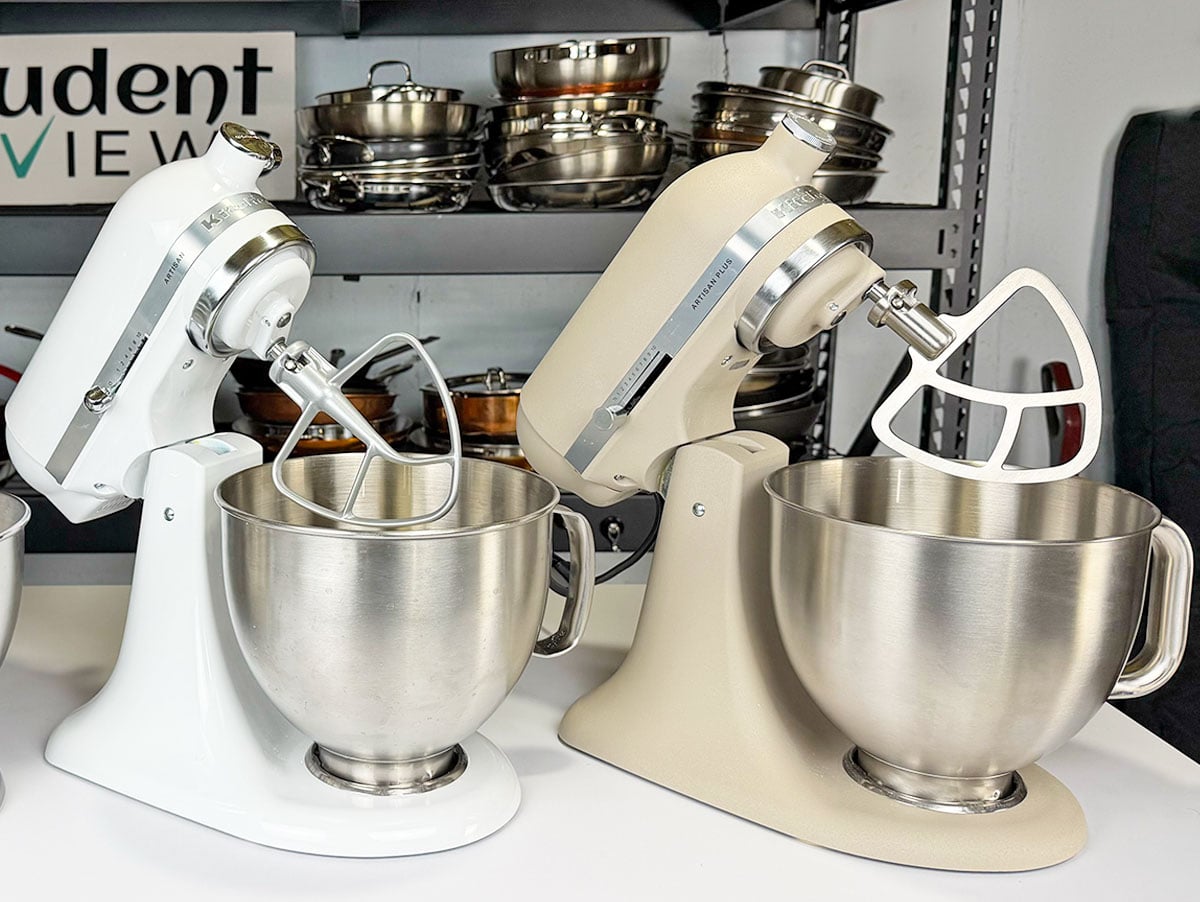
Where they actually differ is in convenience and stability along the way, not the final result. The Artisan Plus comes out ahead with heavier stainless steel attachments that are all dishwasher-safe, a beater that handles most of the scraping for you, noticeably more stability while kneading, and a redesigned dial with a safety feature the Artisan doesn’t have.
The Artisan’s main advantages are price and color selection. It costs $100 less and comes in more colors than the Artisan Plus. So this really comes down to whether those extra upgrades are worth $100 to you.
You can check the latest prices for both mixers at the links below:
- KitchenAid Artisan on Amazon and KitchenAid.com
- KitchenAid Artisan Plus on KitchenAid.com
Use the links below to navigate the comparison:
- Comparison Chart
- Attachments
- Whipped Cream Test
- Chocolate Chip Cookie Test
- Pizza Dough Test
- Speed Control, Safety, and Lighting
- Power Draw and Noise
- Bottom Line: Should You Buy the KitchenAid Artisan or Artisan Plus?
Comparison Chart
| Feature | KitchenAid Artisan | KitchenAid Artisan Plus |
|---|---|---|
| Price | $$$ (check price on Amazon) | $$$$ (check price on KitchenAid.com) |
| Bowl size | 5 qt | 5 qt |
| Bowl handle | Yes | Yes |
| Bowl finish | Brushed stainless steel | Brushed stainless steel |
| Color options | More than 20 | 14 |
| Rated motor | 325W | 350W |
| Speed control | Traditional lever with 10 speeds; only even numbers marked | Dial with a marked position for every speed, plus smooth variable adjustment |
| Housing | Die-cast zinc metal with enamel coating | Die-cast zinc metal with enamel coating |
| Weight without bowl or attachments | 20 lb | 19.7 lb |
| Height with head closed | 14 in | 14 in |
| Height with head raised | 17 in | 18 in |
| Cord length | 41 in | 44 in |
| Included attachments | Flat beater, dough hook, and wire whisk | Standard flat beater, double flex-edge beater, dough hook, and wire whisk |
| Attachment material | Coated aluminum beater and dough hook; wire whisk with aluminum hub | Stainless steel |
| Dough hook weight | 151 g | 285 g |
| Flat beater weight | 123 g | 286 g standard beater; 283 g double flex-edge beater |
| Dishwasher-safe attachments | Flat beater and dough hook only; whisk must be hand-washed | All four attachments |
| Pouring shield | No | Yes |
| Bowl light | No | Yes, turns on automatically when the head is lowered |
| Accessory hub | Yes | Yes |
| Locks with head raised | No | No |
| Starts when plugged in with speed above 0 | Yes | No; control must be returned to 0 first |
| Whipped cream result | Stiff peaks in about 2 minutes; no scraping needed | Stiff peaks in about 2 minutes; no scraping needed |
| Bowl scraping during cookie test | Several times | Once |
| Cookie result | Mixed well; cookies baked evenly | Easier mixing with less scraping; cookies baked similarly |
| Pizza dough result | Smooth, elastic dough; finished pizza came out well | Smooth, elastic dough; finished pizza came out well |
| Stability during pizza dough test | More head bouncing; lock lever shifted toward unlocked | Less head bouncing; lock lever stayed in place |
| Power draw while kneading pizza dough | 90–110W | 75–120W |
| Measured power draw, low | 28W | 22W |
| Measured power draw, medium | 55W | 49W |
| Measured power draw, high | 125W | 107W |
| Measured noise, low | 70 dBA | 66 dBA |
| Measured noise, medium | 74 dBA | 75 dBA |
| Measured noise, high | 81 dBA | 85 dBA |
| Warranty | 1 year | 1 year |
Attachments
Before getting into how these two mixers actually performed, it helps to understand what comes in the box.
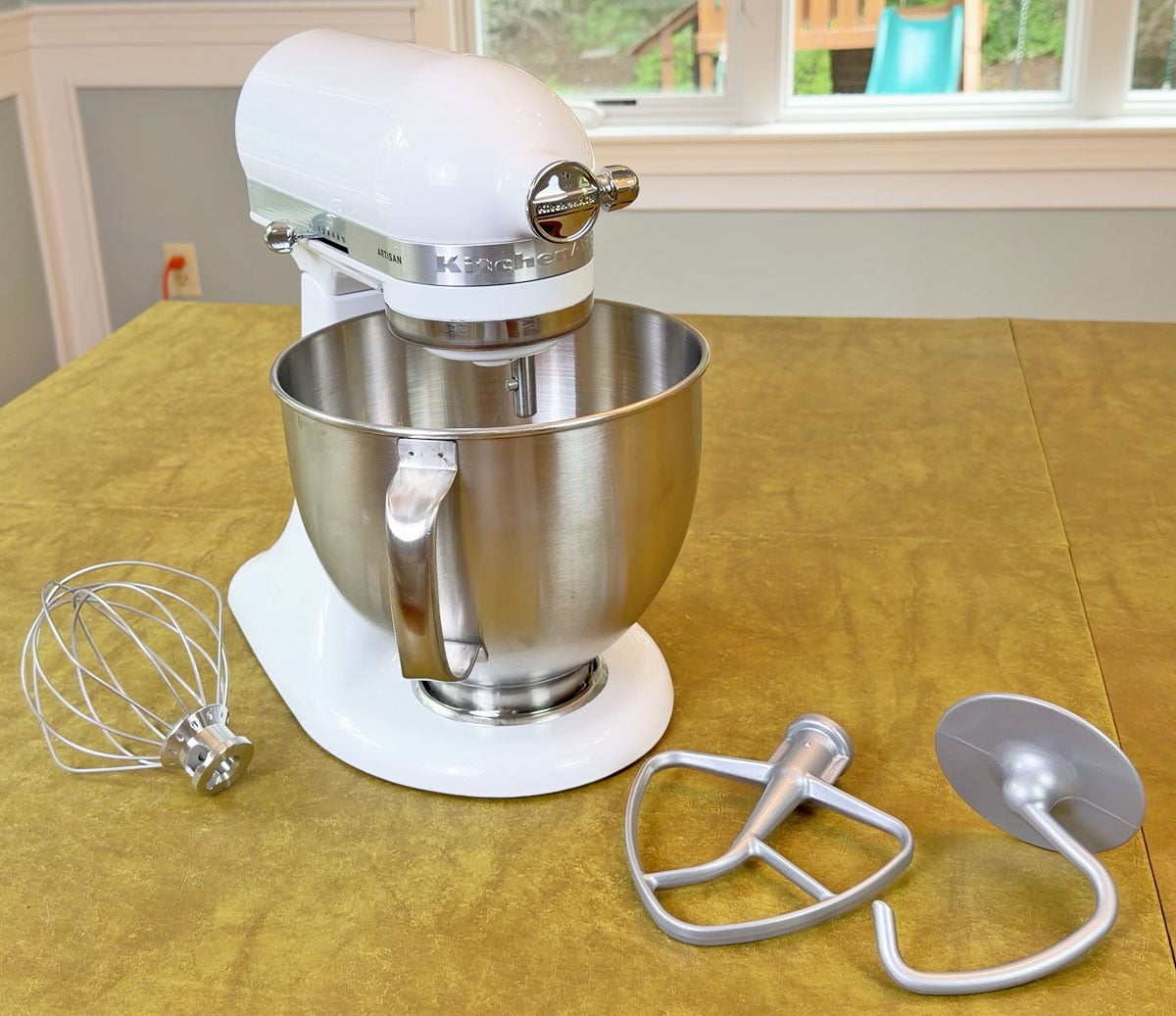
The Artisan comes with three attachments: a coated aluminum flat beater, a coated aluminum dough hook, and a wire whisk with an aluminum hub. The beater and hook are dishwasher-safe, but the whisk isn’t because its hub is aluminum and can discolor over time even when it’s clean.
The Artisan Plus comes with four attachments instead of three, and all of them are stainless steel and fully dishwasher-safe. It comes with a standard flat beater, a double flex-edge beater, a dough hook, and a whisk.
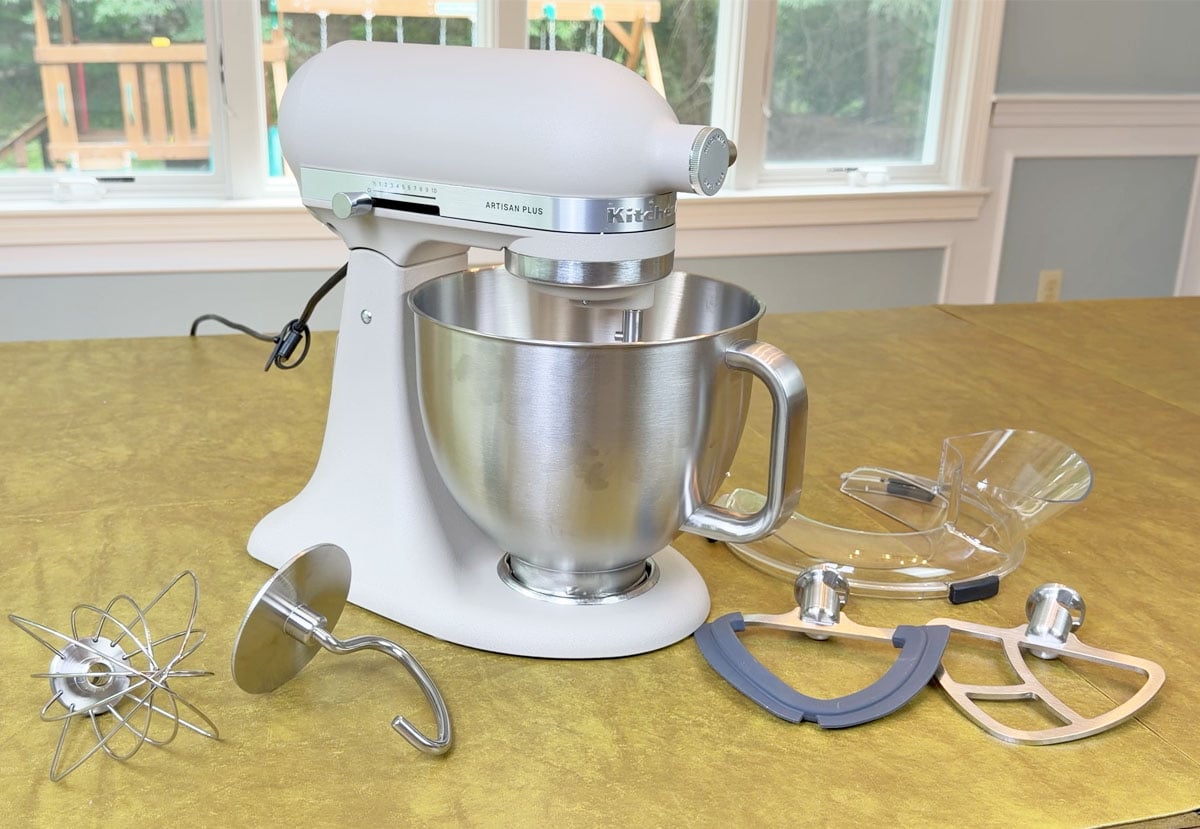
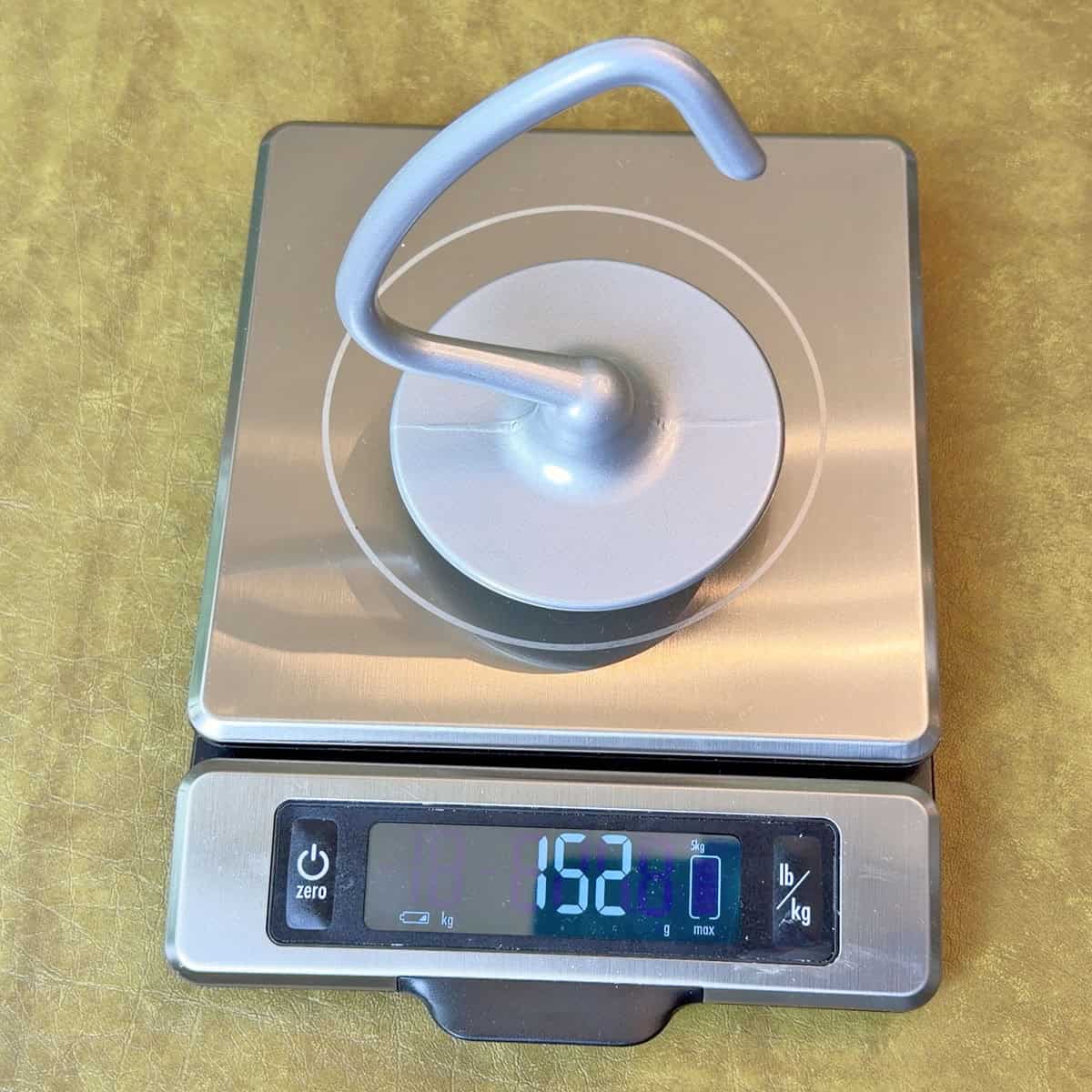
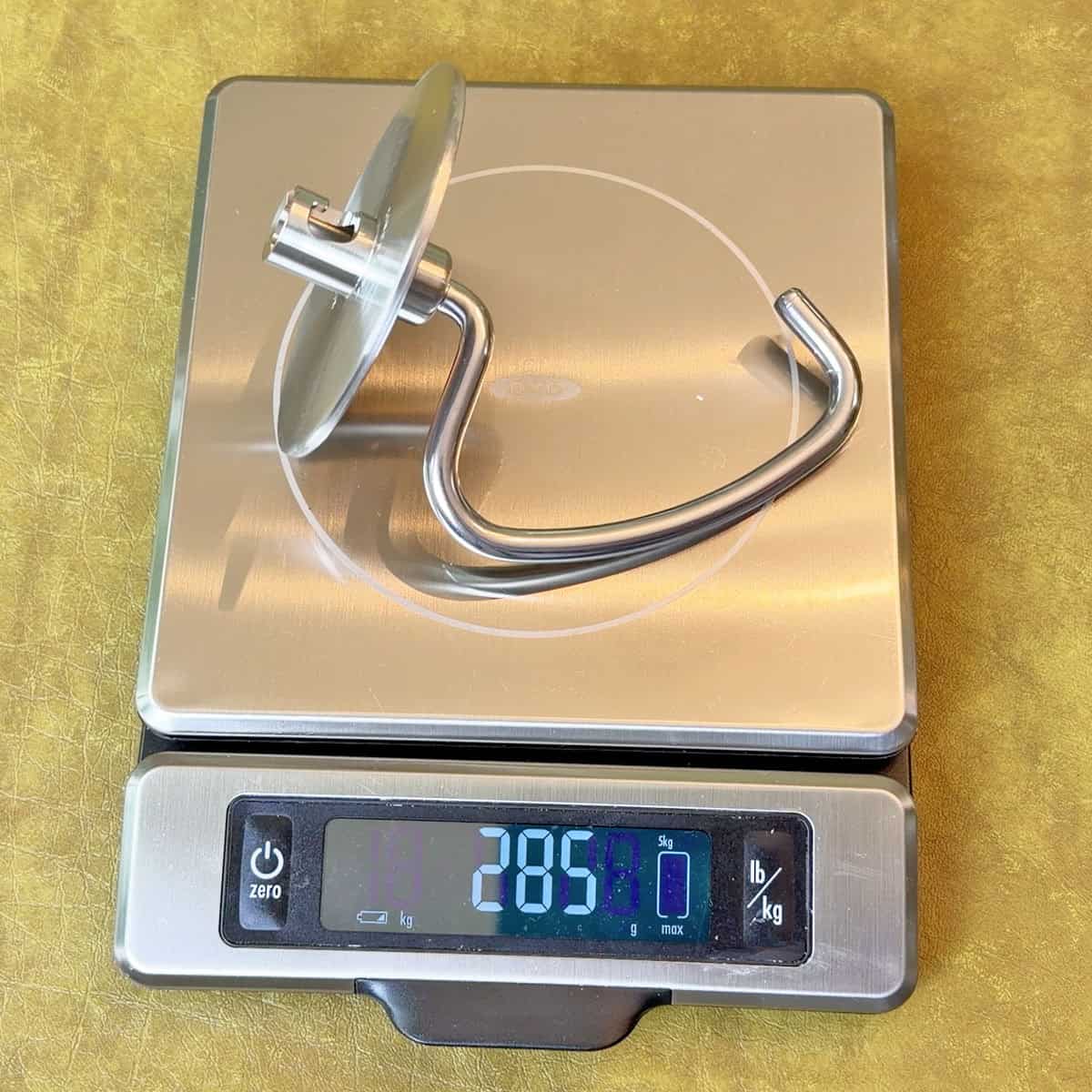
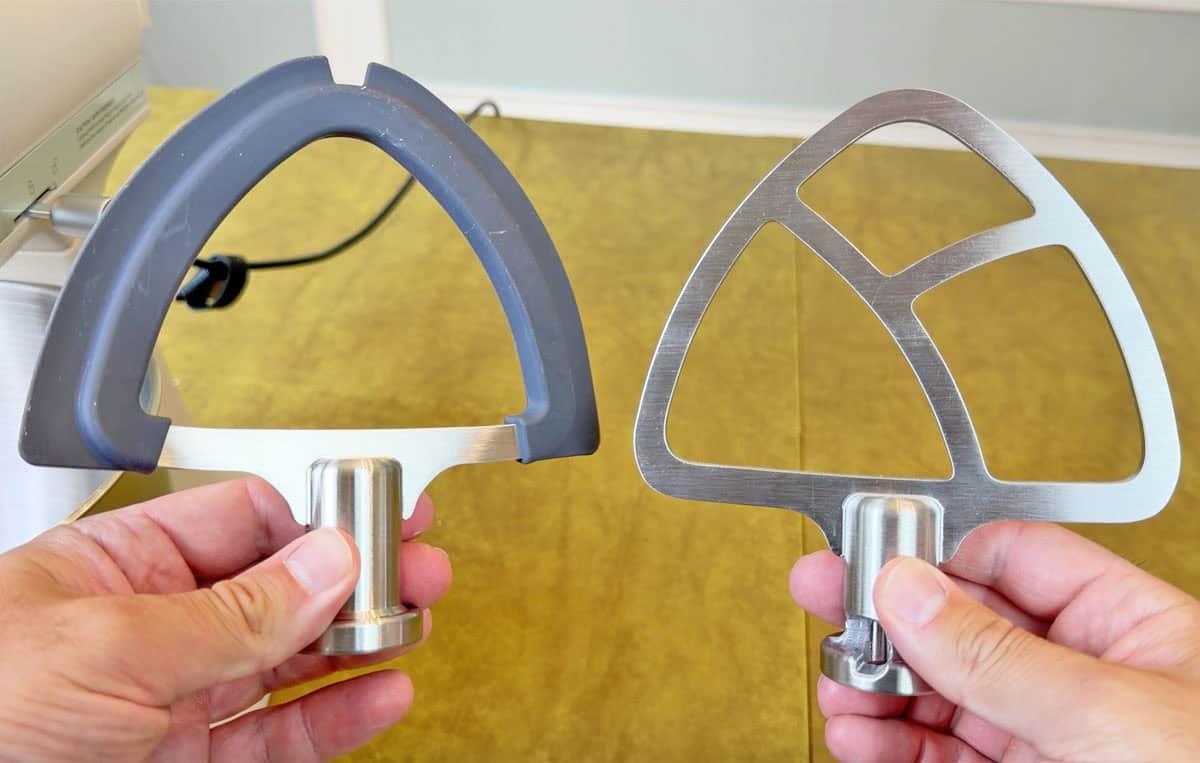
The Artisan Plus attachments are noticeably heavier and more substantial. You can feel that difference as soon as you pick them up. The dough hook weighs 285 grams compared to 151 grams for the Artisan’s, almost twice as heavy. The difference was even more noticeable with the beaters. The Artisan Plus beaters weighed 283 and 286 grams, compared with 123 grams for the Artisan beater.
The double flex-edge beater is the attachment that matters most here. It has rubber edges on both sides that scrape the bowl while it mixes, and it has an open center without crossbars, so dough doesn’t build up in the middle the way it does with a standard beater.
Whipped Cream Test
For this test, I used a half cup of cold heavy cream, powdered sugar, and vanilla in each mixer, using the same process and speed settings. I kept the batch small on purpose, since small amounts of cream can be tricky for a whisk that doesn’t reach far enough into the bowl.
Both mixers reached stiff peaks in about 2 minutes. I didn’t need to scrape either bowl, and both whisks made enough contact with the bottom to fully incorporate the cream.
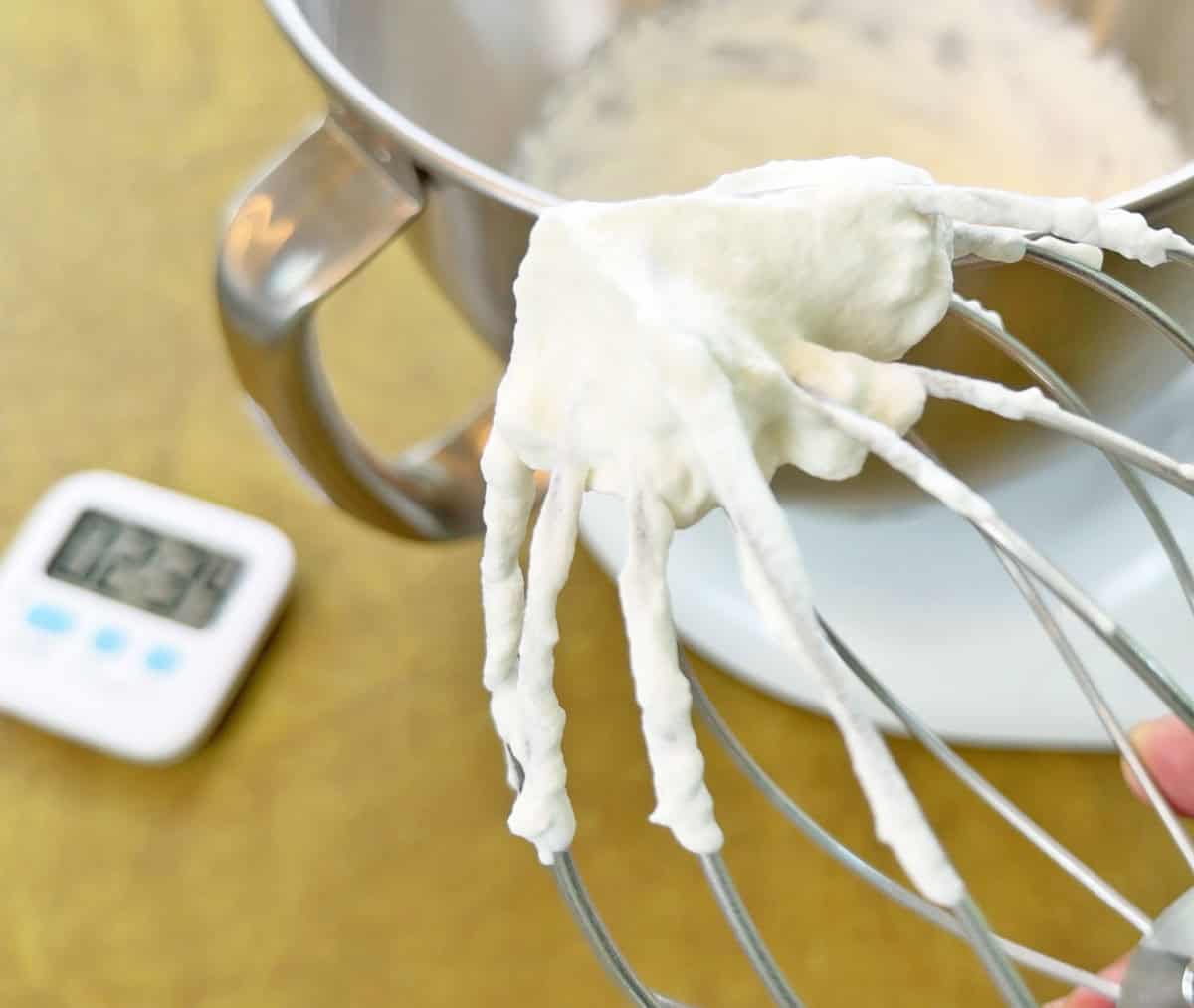
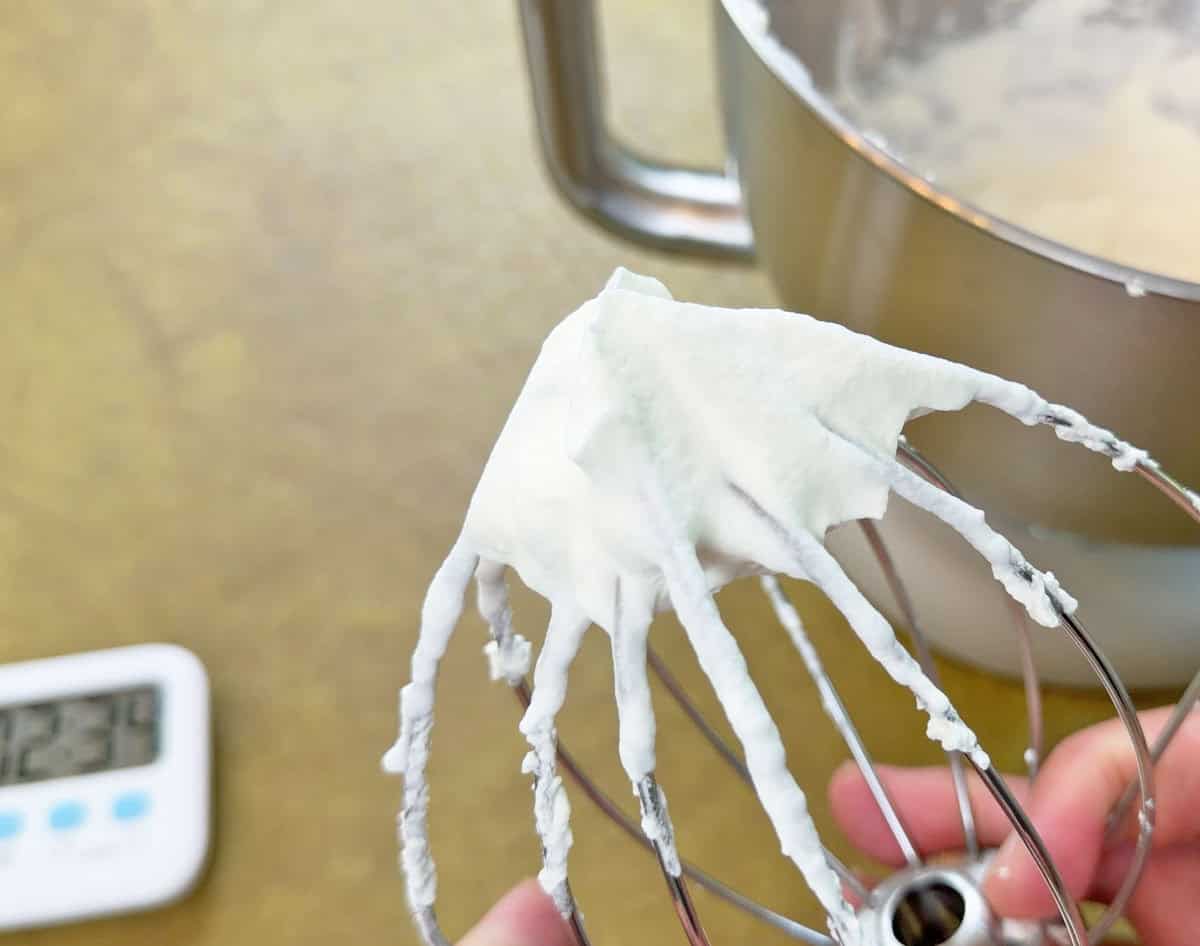
I accidentally let the first Artisan Plus batch run about 15 seconds too long while adjusting my camera, so I repeated the test. The second batch reached stiff peaks in about two minutes, just like the Artisan.
Chocolate Chip Cookie Test
My cookie test is where I started to see a real gap. I weighed every ingredient and made the same full batch of cookies in each mixer, creaming the butter and sugar first, then adding the eggs and vanilla, then the dry ingredients, then the chocolate chips last.
The Artisan mixed the dough well, but I had to stop and scrape the bowl a few times, especially after the flour went in. Some of it kept collecting higher up on the walls where the flat beater just doesn’t reach. That’s a pretty normal limitation for stand mixers in general, not something specific to the Artisan, but it still means more hands-on work.
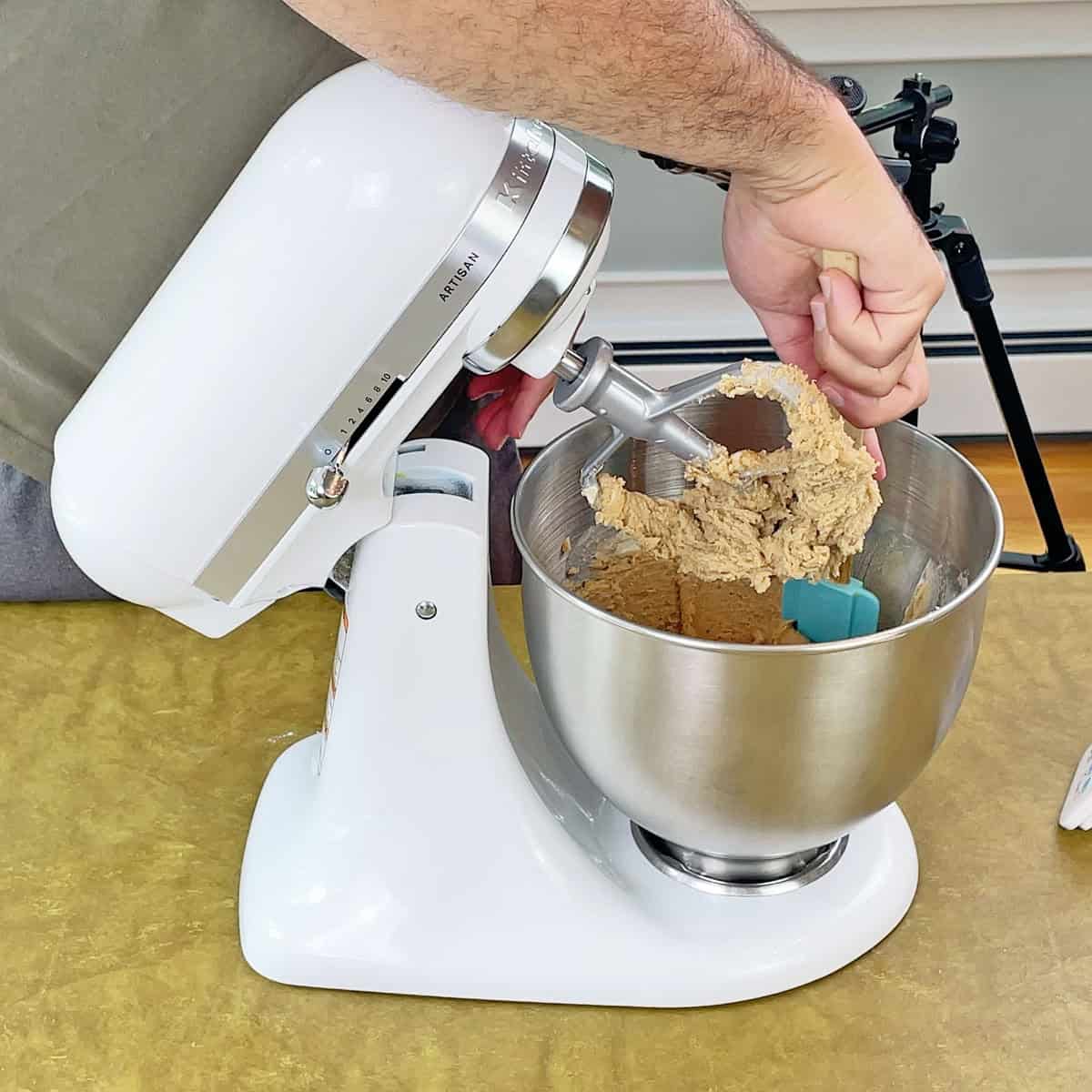
The Artisan Plus only needed one scrape, right after I added the dry ingredients, because a small amount of flour remained near the top out of the beater’s reach. Everything below that got handled automatically.
As the beater turned, its rubber edges stayed pressed against both sides of the bowl and kept wiping the dough off the walls and pulling it back into the center, so the dough never had a chance to sit untouched along the sides the way it does in the Artisan. I also didn’t have to dig a clump of dough out from the middle of the beater the way I sometimes do with a standard one, since there are no crossbars for it to collect on.
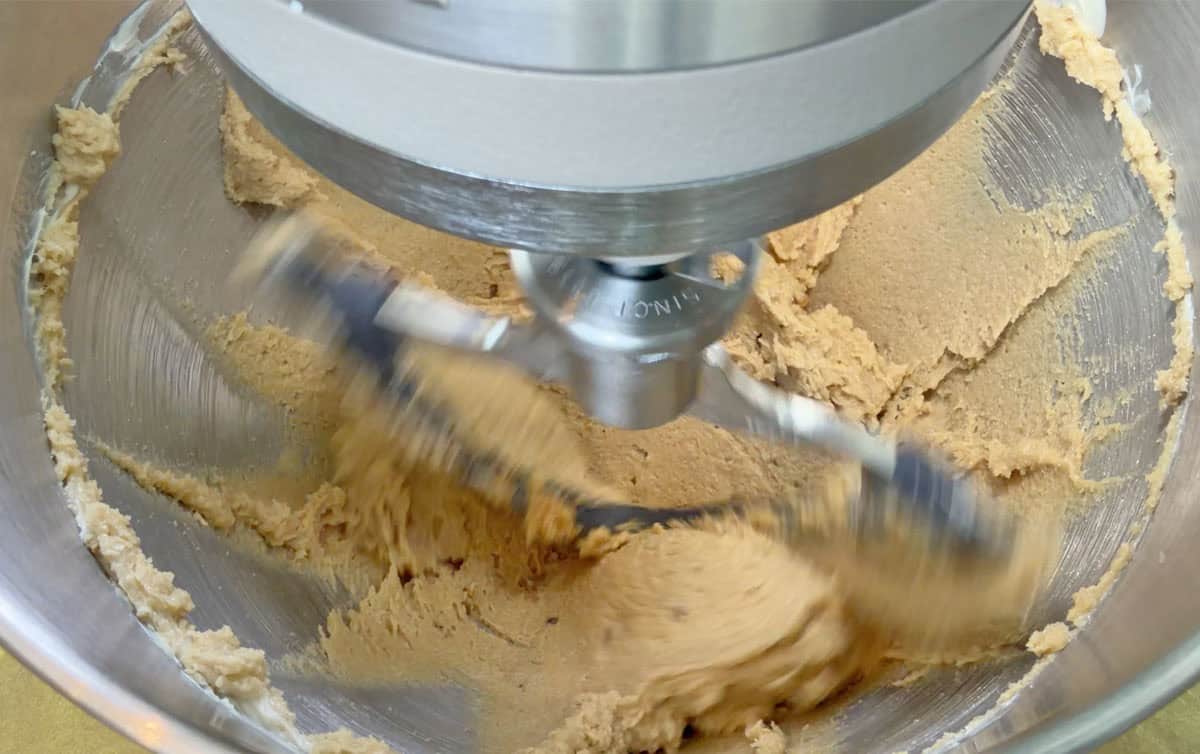
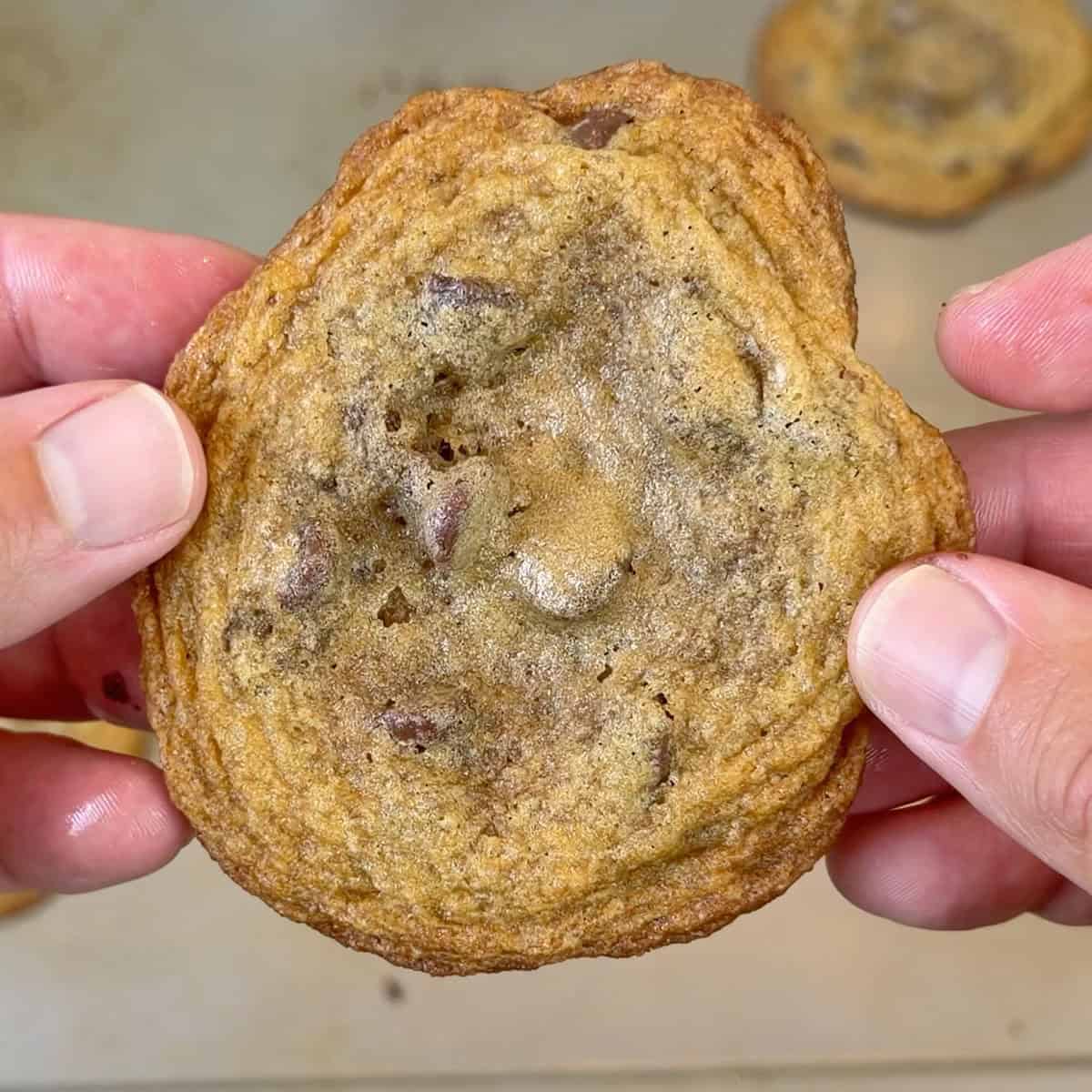
Both batches of cookies baked up almost identical in spread, browning, and taste. The difference isn’t really in the final cookie. It’s in how much work you have to put in to get there, and the Artisan Plus requires a lot less of it.
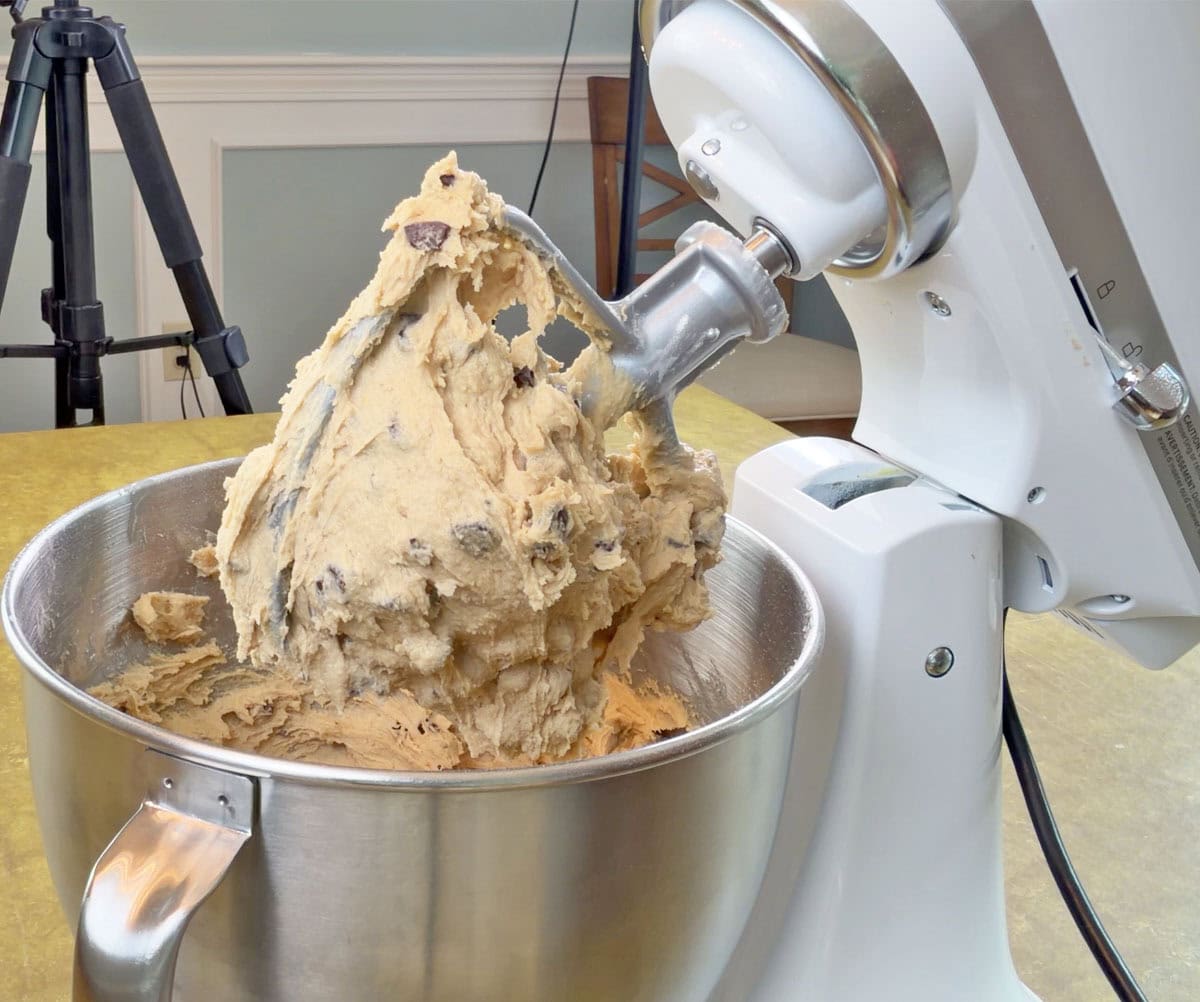
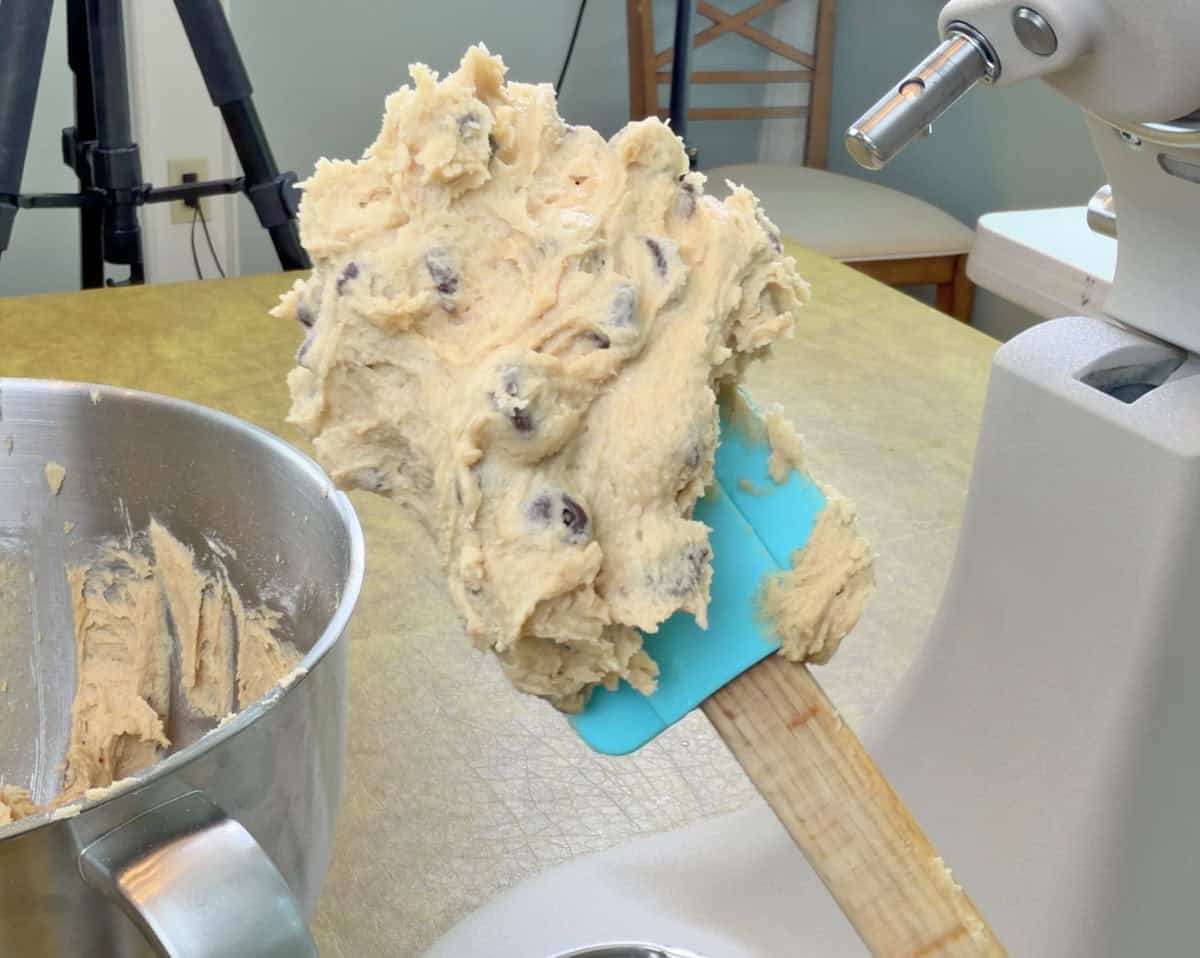

I also noticed a shared design issue during this test. Neither mixer locks with the head raised. While I was scraping dough from the beater, the head dropped unexpectedly and smeared dough onto the mixer.
That can catch you off guard, create a mess, or potentially pinch your fingers if your hand is underneath the head. Some competing mixers lock in both the raised and lowered positions, and I prefer that design. This issue doesn’t separate the Artisan from the Artisan Plus, but it’s something you should know before buying either one.
Pizza Dough Test
Pizza dough was the toughest test because it’s thick, sticky, and has to knead for several minutes, which is exactly the kind of thing that reveals how stable a tilt-head mixer really is.
Each batch contained 500 grams of bread flour, 325 grams of water, 10 grams of salt, 7 grams of instant yeast, and 10 grams of olive oil.
I mixed each batch on the lowest speed until no loose flour remained, then kneaded for about 8 minutes on speed 2, which is the highest speed KitchenAid recommends for this type of dough.
The Artisan’s head bounced noticeably as the dough moved around the bowl, and that movement caused the lock lever to gradually shift away from fully locked, sometimes settling partway between locked and unlocked. Once that happened, the bouncing got even worse, and I had to move the lever back into place several times during a single knead.
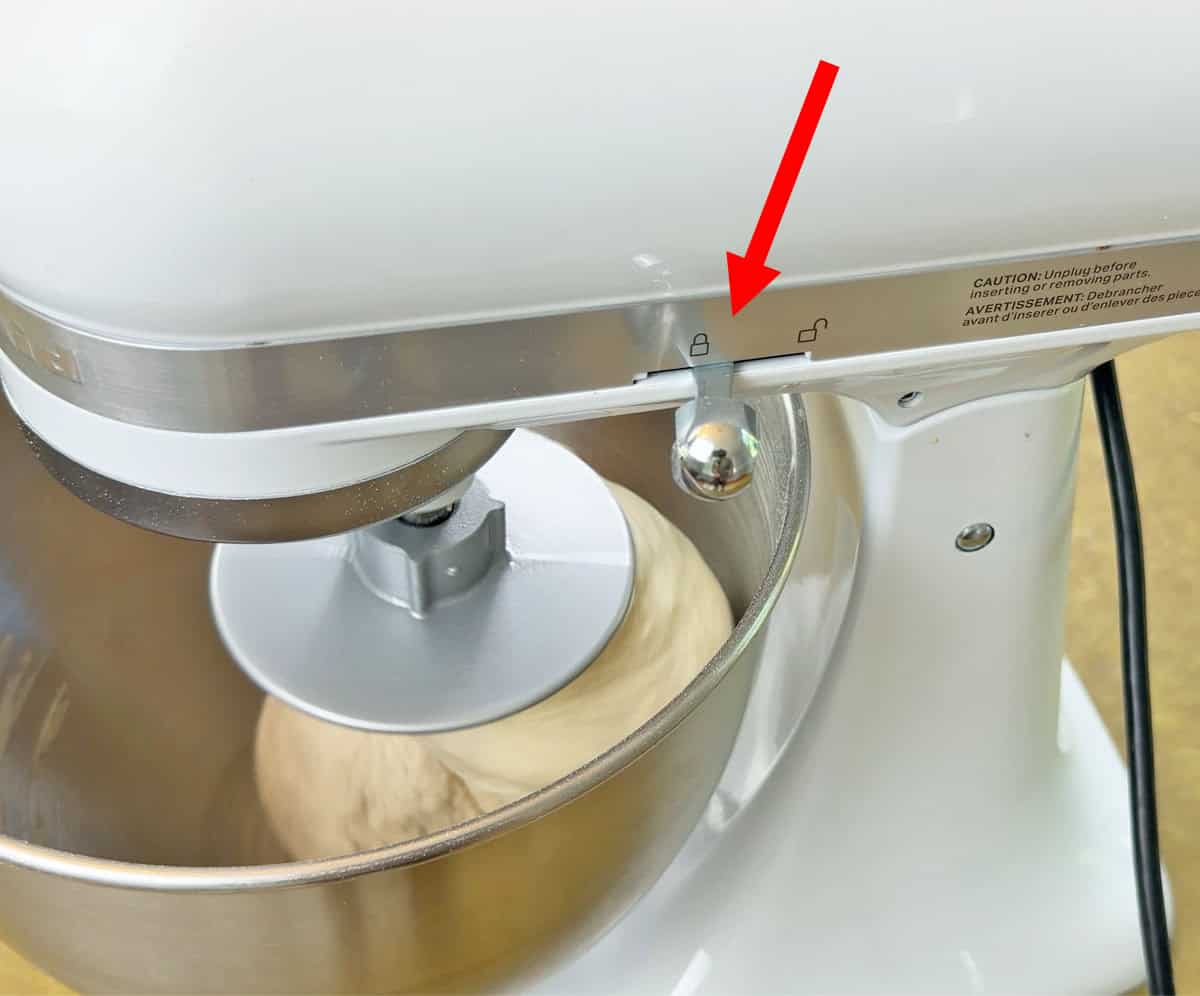
The Artisan Plus was much more stable. Its head still moved, but it bounced noticeably less, and the lock lever stayed in position for the entire kneading cycle.
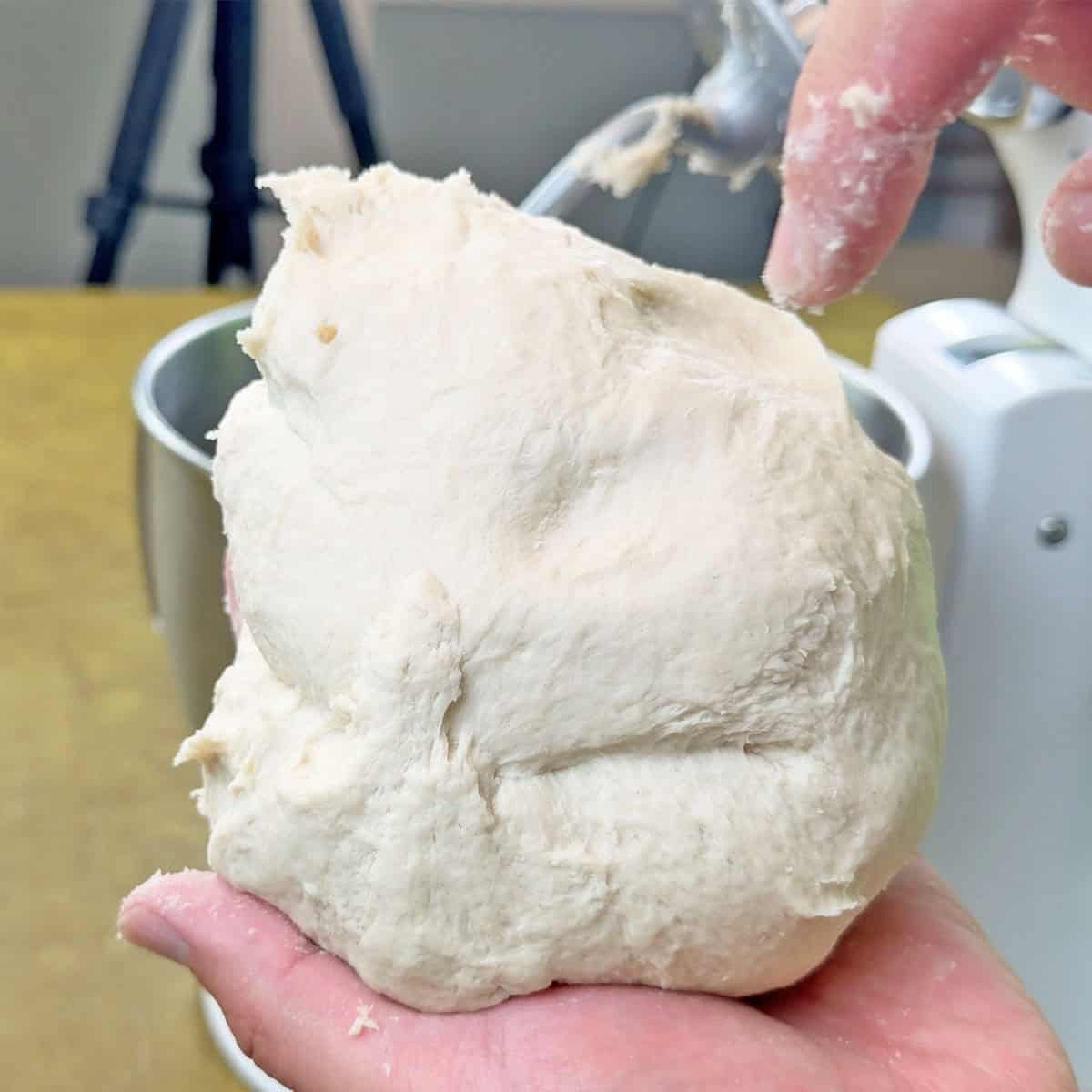
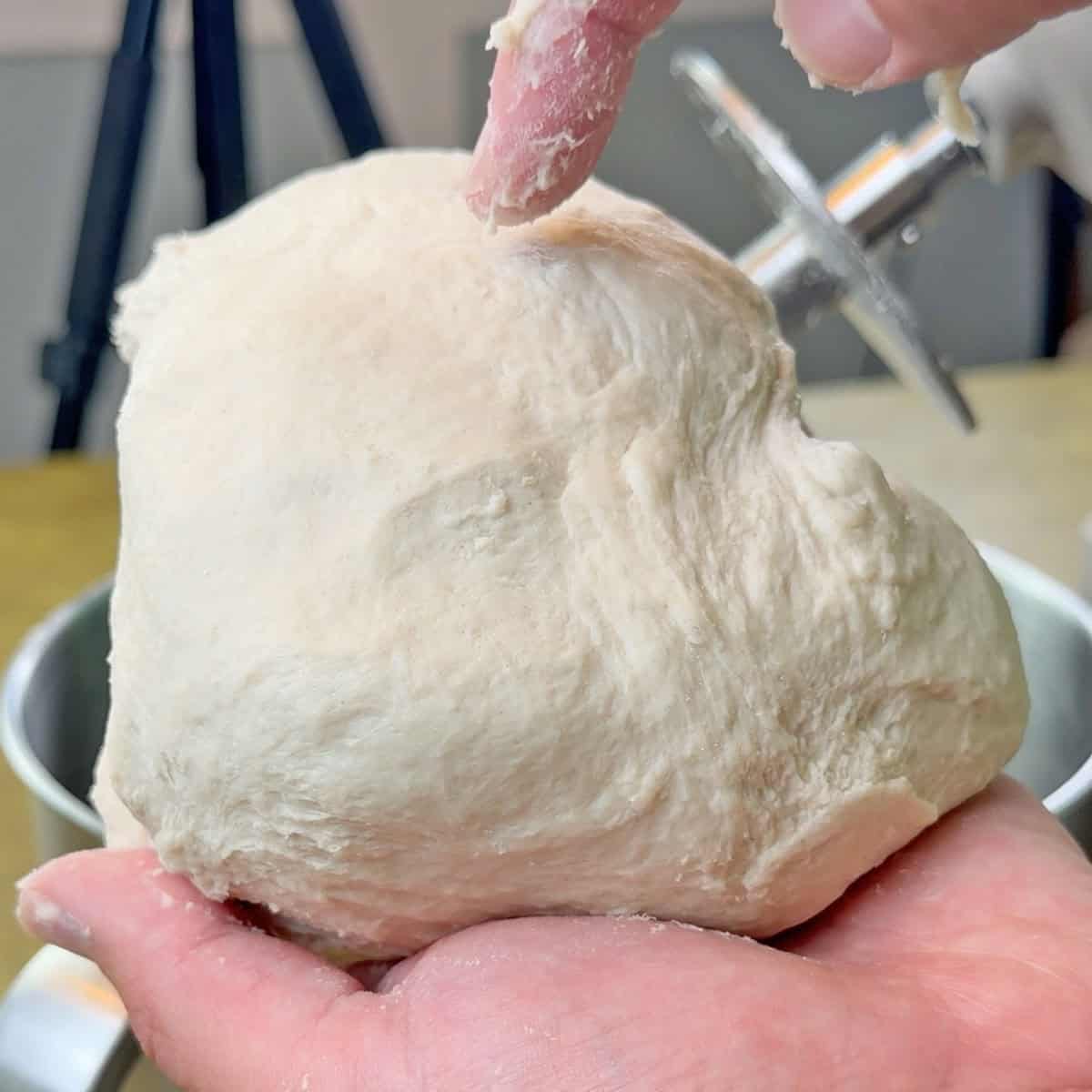
Both doughs came out smooth and elastic, and the finished pizzas were nearly identical in texture and browning. But if you make bread or pizza dough on any kind of regular basis, the added stability of the Artisan Plus is something you’ll actually notice.

Speed Control, Safety, and Lighting
The Artisan uses KitchenAid’s traditional speed lever, and it clicks firmly into place at each numbered speed. But only the even numbers are marked, so getting to an odd speed means parking the lever in the gap between two clicks instead of on one.
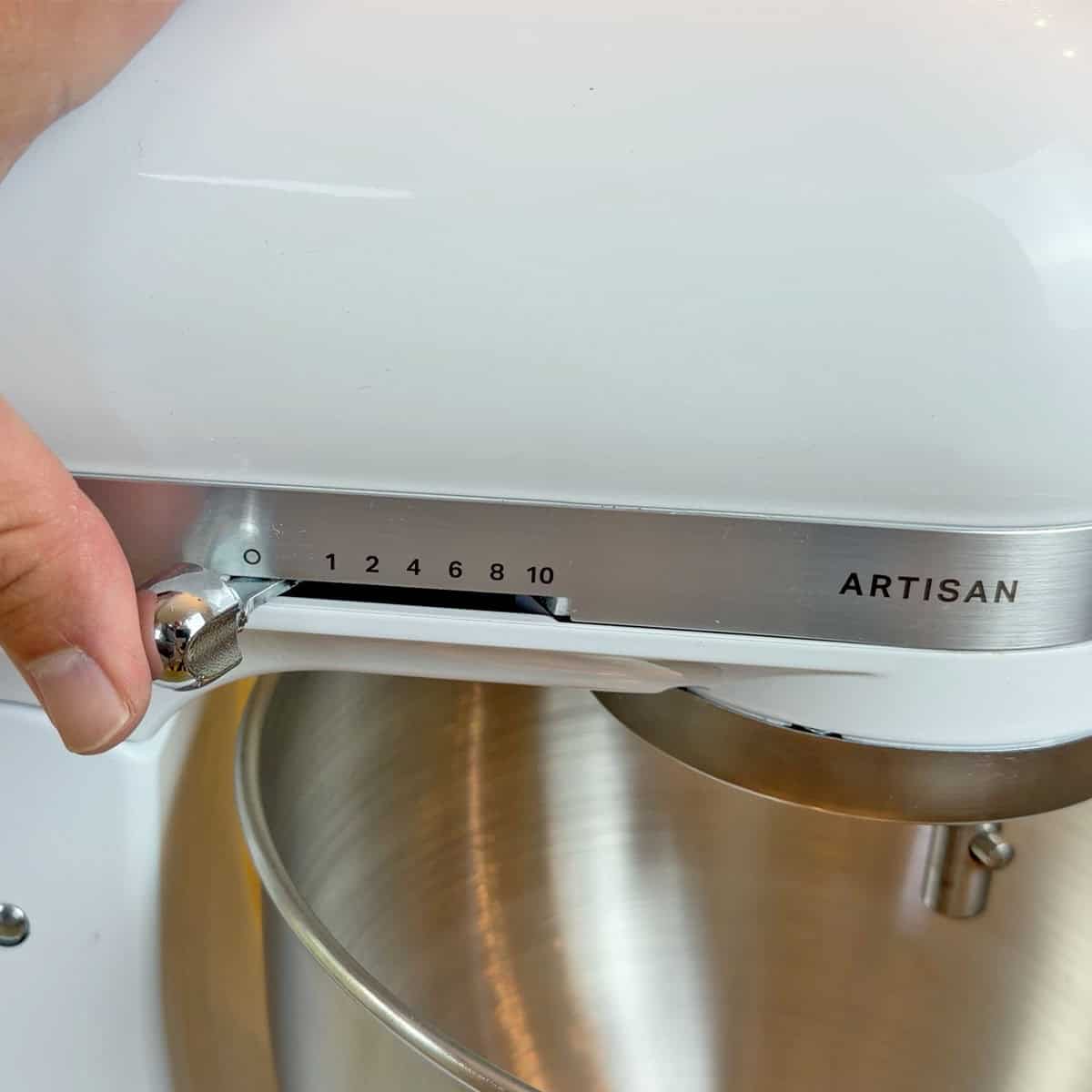
There’s nothing to lock it into that in-between spot, so you have to ease it into position carefully. Push a little too far and it snaps into the next click up, past where you actually wanted it.
The Artisan Plus replaces that with a redesigned dial that has a clear, marked position for every one of its 11 speeds. It still clicks into place at each numbered setting, but you can also twist it into a smooth slider mode if you want to land on a more precise in-between speed.
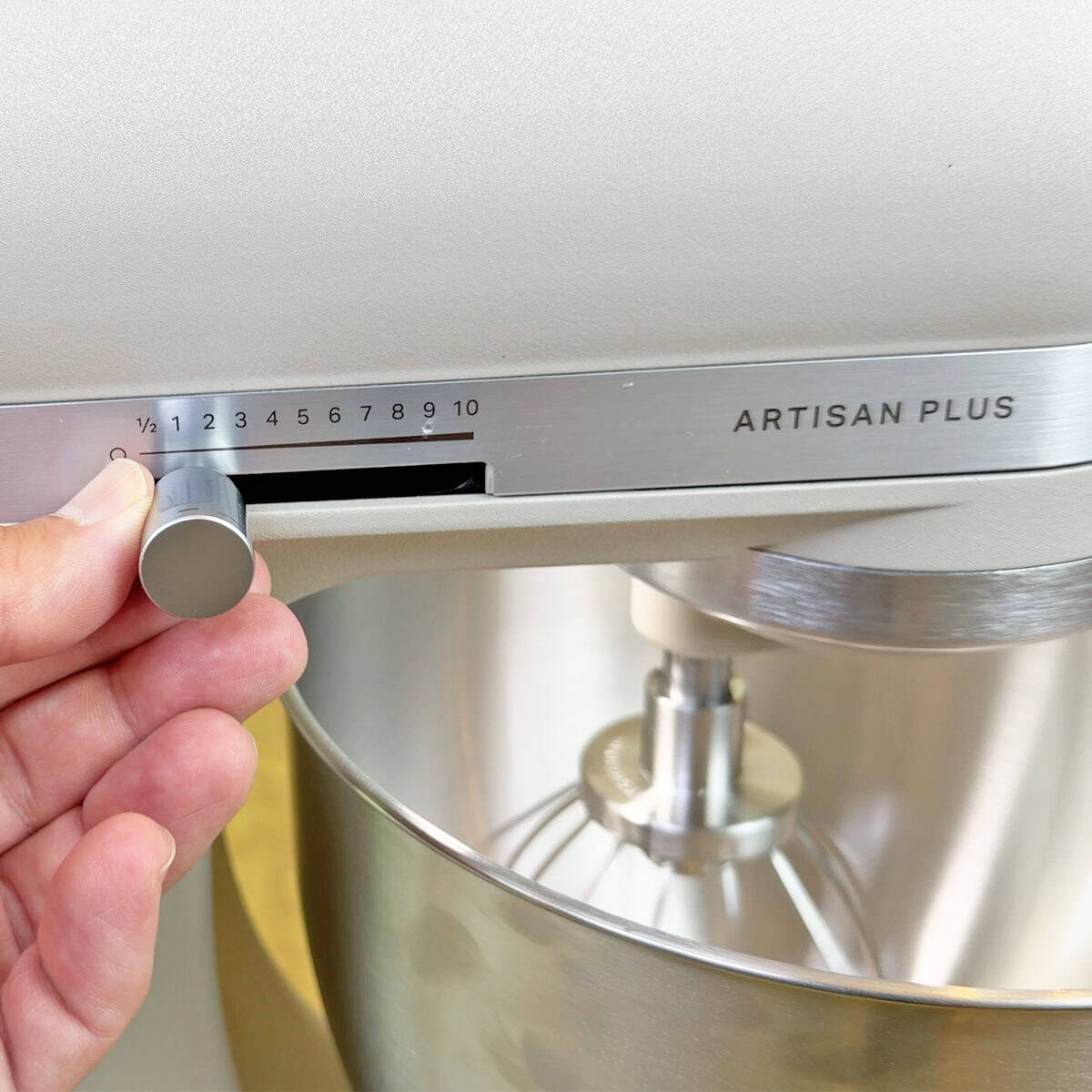
There’s also a safety difference worth knowing about before you buy. If you leave the Artisan’s speed lever above zero and then plug it in, the mixer starts running right away. The Artisan Plus won’t do that. You have to bring the dial back to zero before it will turn on.
The Artisan Plus also has an automatic bowl light that turns on when you lower the mixer head. It shines directly into the bowl, making it easier to see whether flour is still sitting along the sides, whether ingredients are fully incorporated, or whether a mixture is reaching the right consistency.
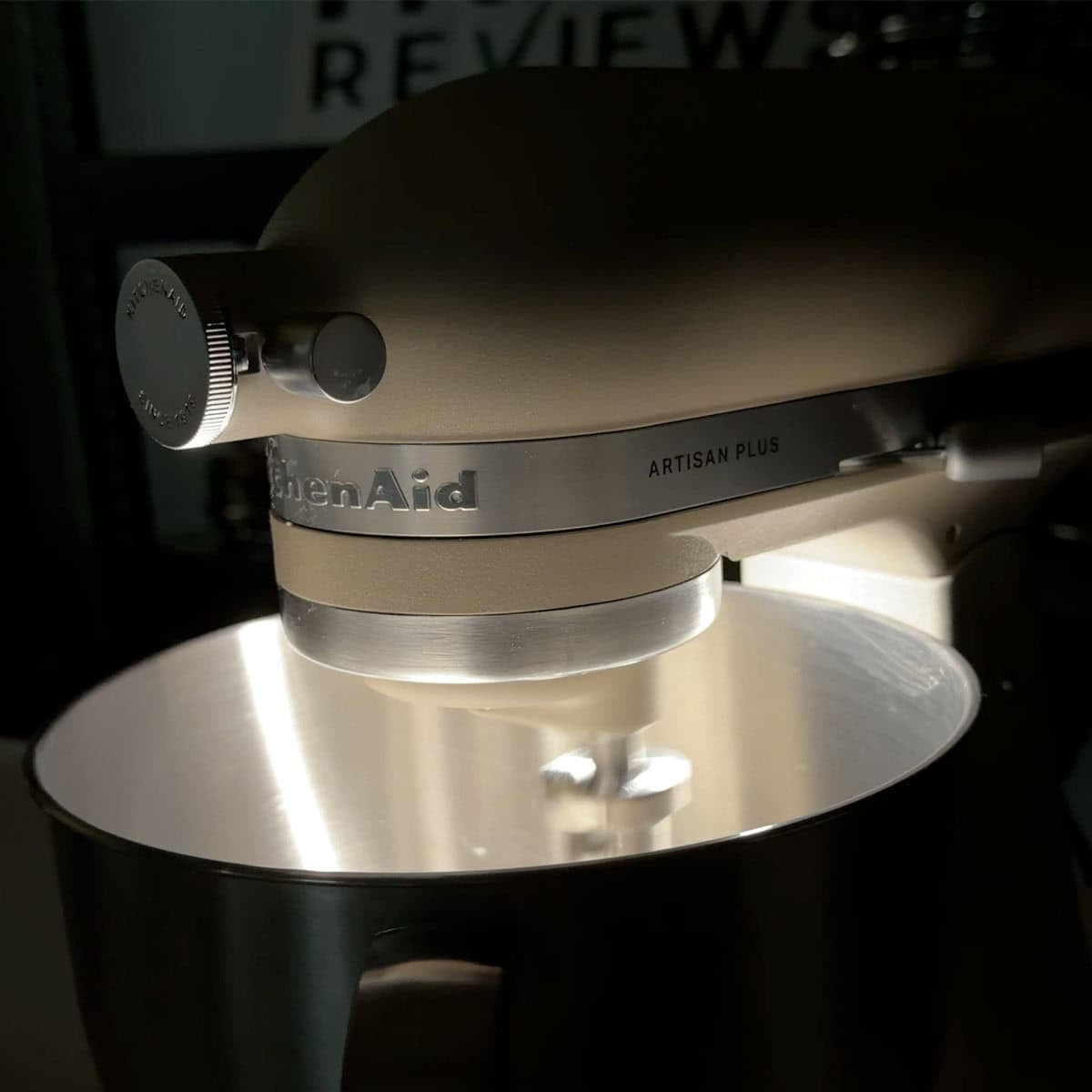
I wouldn’t pay an extra $100 for the light alone, but I found it useful during testing. It’s one of several smaller convenience upgrades that make the Artisan Plus easier to use.
Power Draw and Noise
KitchenAid rates the Artisan Plus’s motor at 350 watts compared to 325 watts for the Artisan, which makes it sound like you’re getting more power as you move up.
My measurements showed that the higher motor rating didn’t translate into higher power consumption during these tests. At low, medium, and high speeds, the Artisan Plus drew 22, 49, and 107 watts. The Artisan drew 28, 55, and 125 watts.
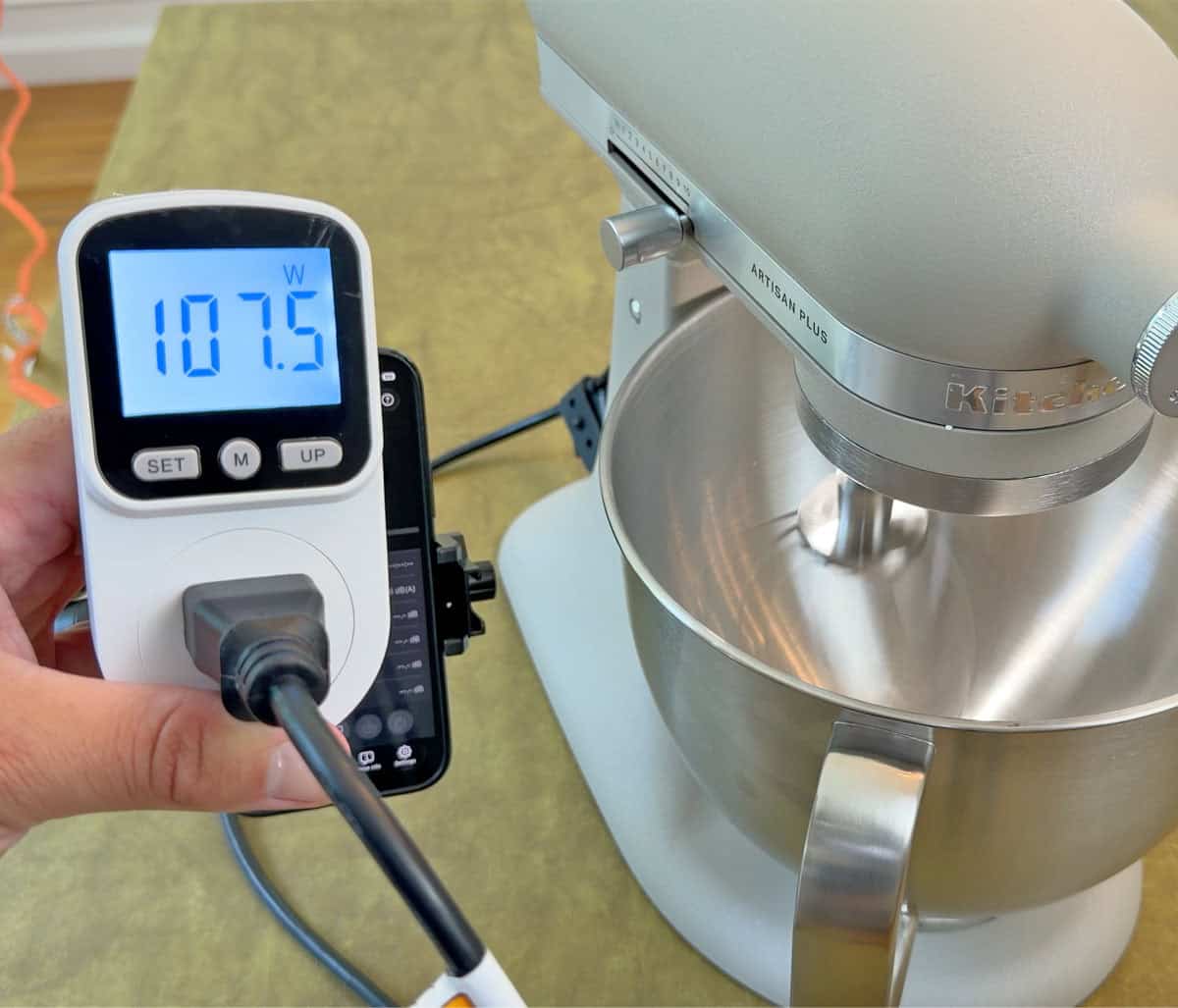
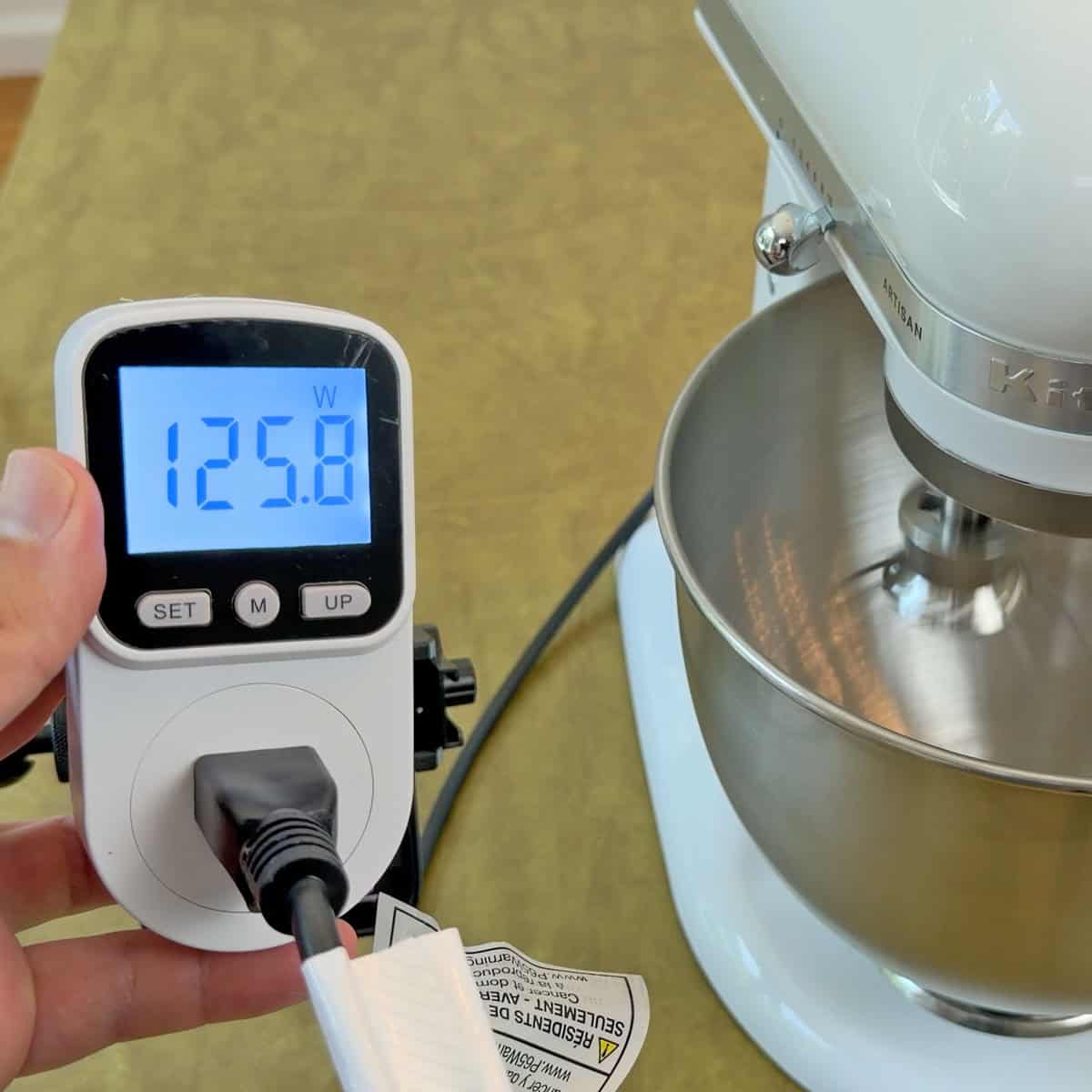
Rated wattage tells you how much electricity a motor can draw, not how much force actually reaches the bowl, and this is a good example of why that distinction matters.
During pizza dough kneading specifically, the Artisan stayed fairly steady between 90 and 110 watts. The Artisan Plus ranged more widely, from 75 to 120 watts.
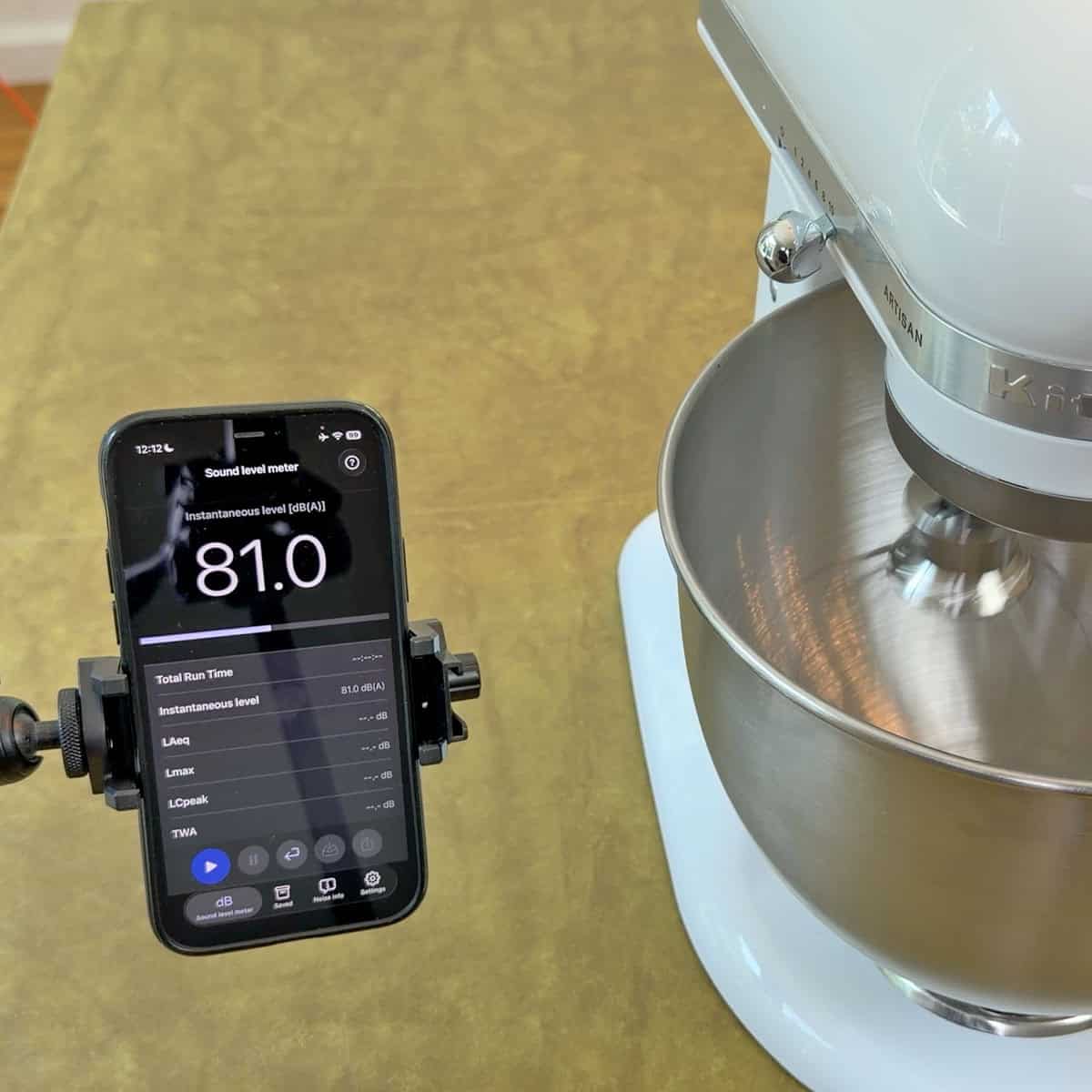
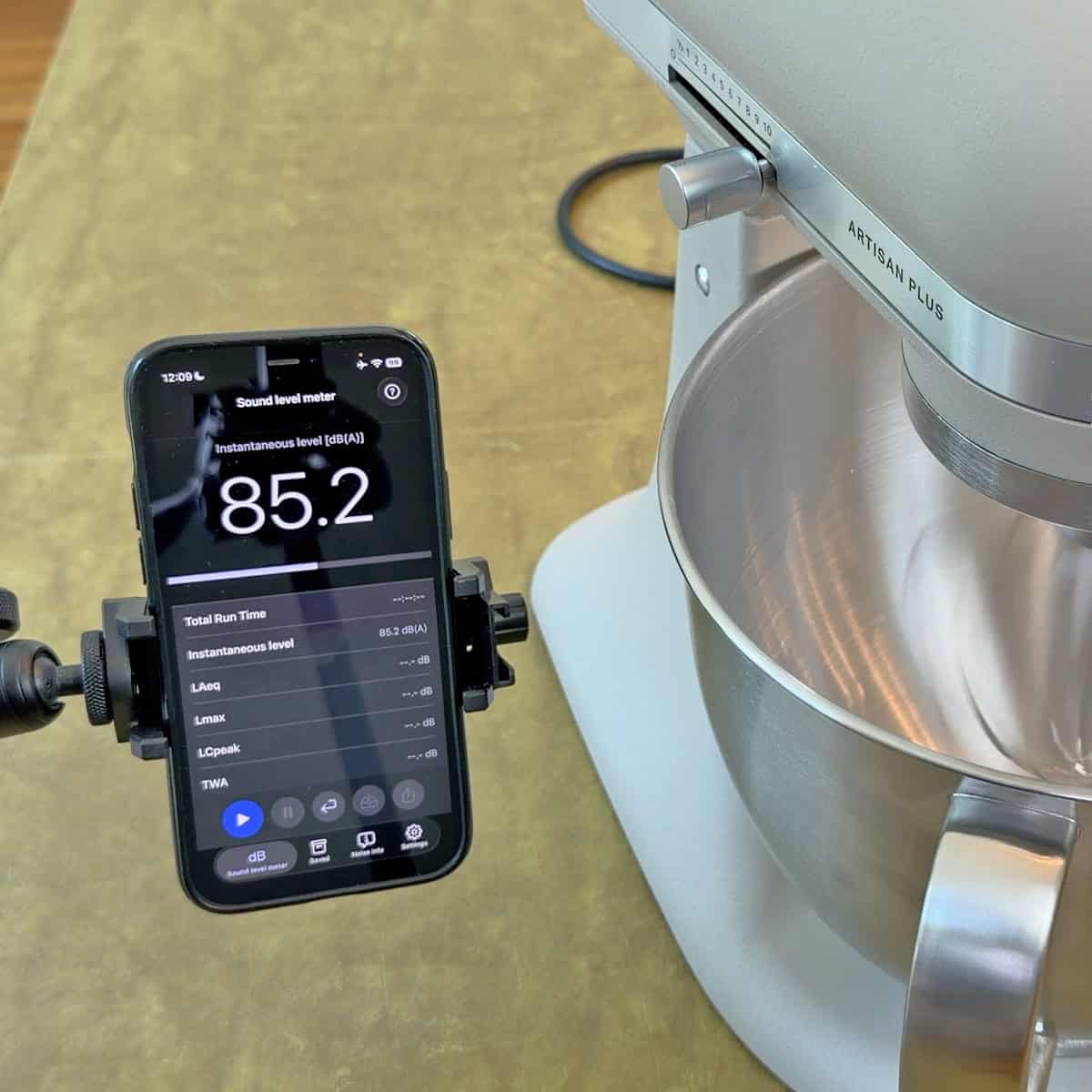
Noise came out close to even between the two. The Artisan measured 70, 74, and 81 dBA at low, medium, and high speeds. The Artisan Plus measured 66, 75, and 85 dBA at those same speeds, so it was a bit quieter at low, essentially tied at medium, and a little louder at high. I wouldn’t make my decision between these two based on noise alone.
Bottom Line: Should You Buy the KitchenAid Artisan or Artisan Plus?
Both of these mixers handle whipped cream, cookie dough, and pizza dough without any trouble. Neither one is going to let you down on the recipes most people actually make regularly.
Where they really differ is how much of the work falls on you. The Artisan Plus’s double flex-edge beater cut my cookie scraping down to a single pass, its attachments are heavier and sturdier and every one of them goes in the dishwasher, and it stayed stable kneading pizza dough while the Artisan’s lock lever kept working itself loose. The redesigned dial, bowl light, and the startup safety feature are smaller upgrades on their own, but they add up.
If you bake often, especially cookies or heavier doughs, the extra $100 for the Artisan Plus buys you real, noticeable convenience and stability, not just a nicer-looking mixer.
If you only mix occasionally and don’t mind scraping a bowl by hand every so often, the Artisan will do everything you need it to, and it comes in more colors.
You can check the latest prices for both mixers at the links below:
- KitchenAid Artisan on Amazon and KitchenAid.com
- KitchenAid Artisan Plus on KitchenAid.com
Related Topics
- Are KitchenAid Mixers Worth It? An In-Depth Review
- 6 High-Quality Alternatives to the KitchenAid Mixer
- KitchenAid Mixer Comparison: Which Is the Best?
- KitchenAid Tilt-Head vs. Bowl-Lift: Which Mixer Is Right for You?
- KitchenAid Classic vs. Artisan: What’s the Difference?
- KitchenAid Classic vs. Artisan Mini: Which Mixer Is Right for You?
- KitchenAid Deluxe vs. Classic Mixers: 9 Key Differences
- KitchenAid Artisan vs. Professional Stand Mixers: What’s the Difference?
- KitchenAid Deluxe vs. Artisan Mixers: What’s the Difference?
- KitchenAid Artisan vs. Artisan Mini: 10 Major Differences
- Cuisinart vs. KitchenAid: Which Stand Mixers Are Better?
- Are Cuisinart Stand Mixers Any Good? An In-Depth Review
- KitchenAid vs. Bosch Refrigerators: What’s the Difference?
