

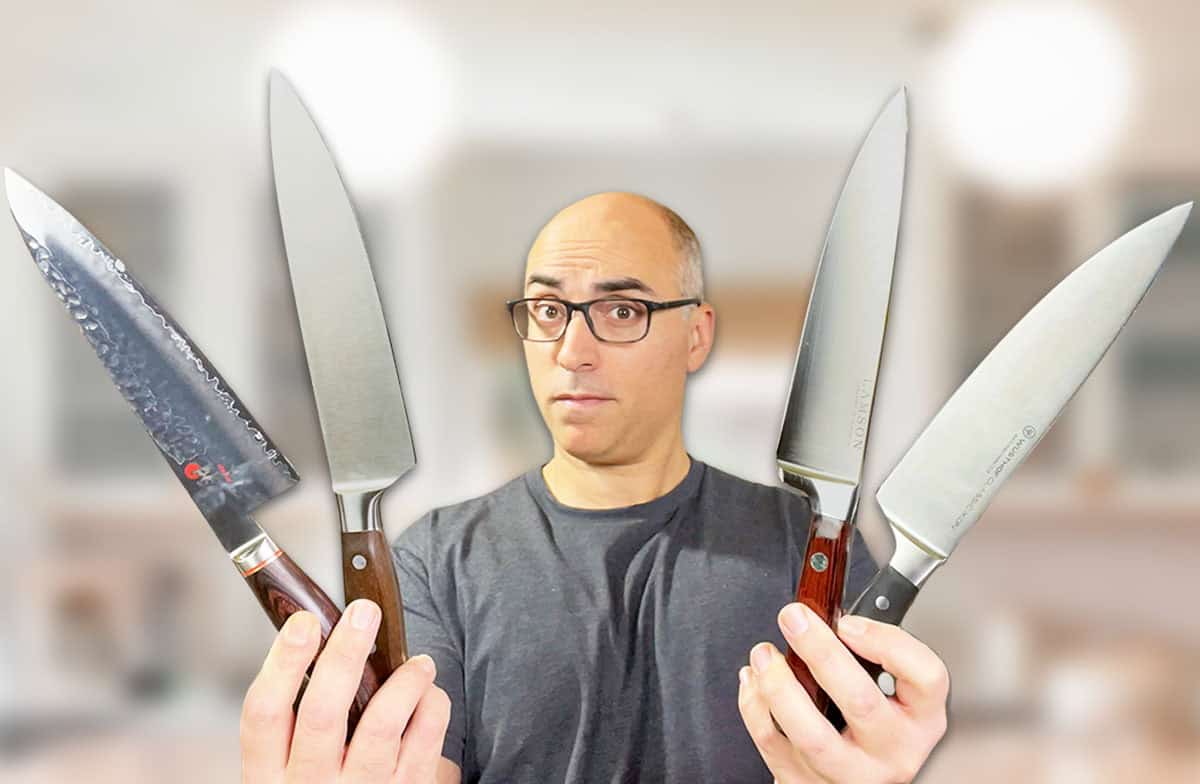
Kitchen knives are expensive, and you use them every day, so it’s not a purchase you want to get wrong.
To help you avoid a regretful purchase, I’m going to break down the seven biggest mistakes people make when buying kitchen knives.
After testing and reviewing over a hundred knives, I’ve learned which factors actually matter and which ones are just marketing hype.
By the end, you’ll know exactly what to look for when buying kitchen knives, how to avoid getting ripped off by marketing gimmicks, and why a knife that feels perfect in someone else’s hand might feel completely wrong in yours.
And to make shopping even easier, I’ll also give you a list of questions you can email to brands or bring to the store so you can confirm the important details before you buy. Click here to skip right to the questions.
Use the links below to navigate:
- Mistake 1: Handles
- Mistake 2: Weight and Balance
- Mistake 3: Blade Design
- Mistake 4: Blade Geometry
- Mistake 5: Blade Steel
- Mistake 6: Forged vs. Stamped
- Mistake 7: Knife Sets
- Knives I Recommend
- Questions to Ask Before Buying
Mistake 1: Handles
The handle is the number one reason people end up hating a knife. If it does not fit your hand, it does not matter how sharp the blade is or how long the edge lasts. You will avoid using it.
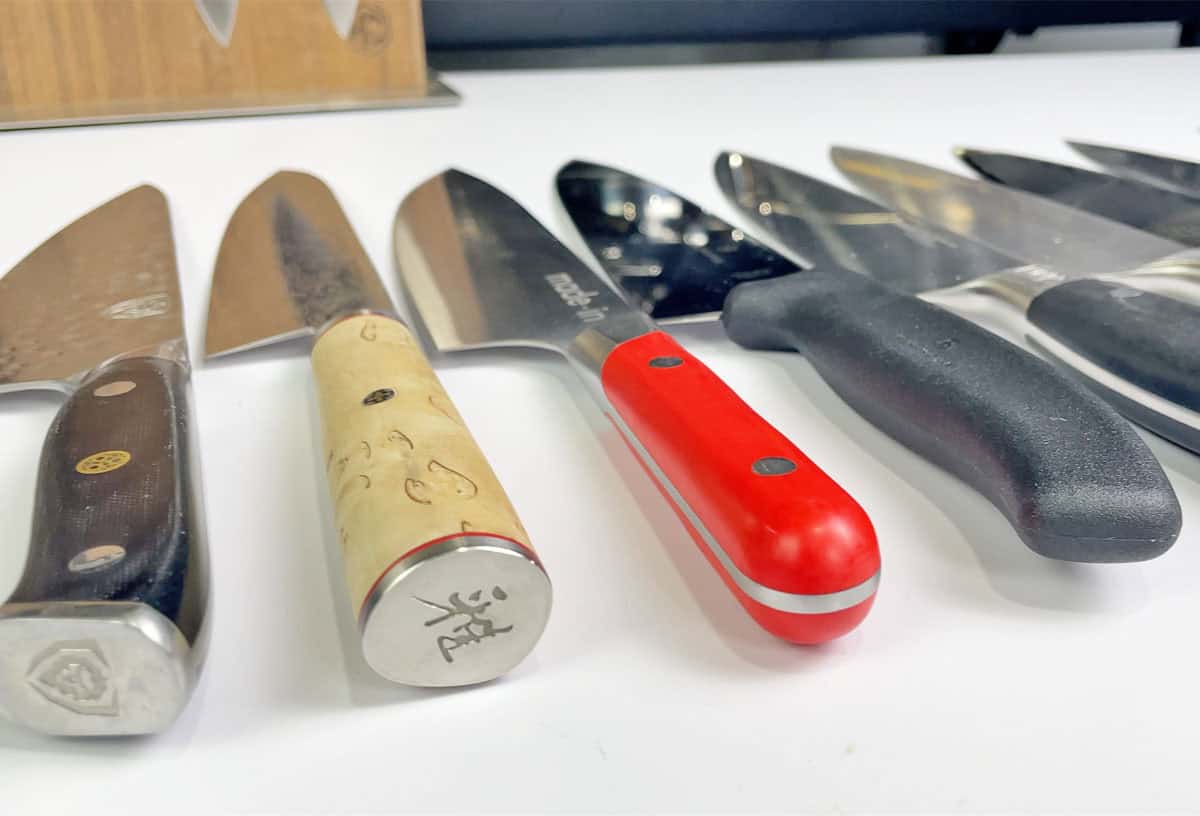
Handles come in several shapes. Traditional Western handles have a curved butt end and a thicker palm swell. Japanese wa handles are octagonal and much slimmer. Some knives take a middle-ground approach with smooth, rounded designs.

Across the dozens of knives I tested, handle circumferences ranged from 2.8 inches on the Caraway and Victorinox Swiss Classic to 3.5 inches on the Ninja Foodi Premium and Zwilling Four Star. Smaller handles feel nimble but can twist in your hand, while thicker handles fill your palm but can get tiring if you prefer a slimmer grip.

Round handles feel comfortable at first but can rotate when you chop, which makes you squeeze harder and causes fatigue. D-shaped handles can be even more particular. For example, the Shun Classic has a right-handed D-shape. If you are left-handed, the flat edge sits in the wrong spot and the knife never feels natural.

You also want to avoid handles that are overly thin or overly thick. Thin handles like the 2.8-inch Caraway can feel slippery and force you to grip harder for control. Thick handles like the 3.5-inch Zwilling Four Star offer stability but feel bulky if you have smaller hands. A handle should sit naturally in your palm without forcing your fingers into an uncomfortable position.
Comfort features matter more than most people realize. Textured plastics like the TPE on the Victorinox Swiss Classic stay grippy when wet. Polished woods or acrylics such as the handles on the Lamson Premier Forged can get slick when your hands are greasy. Slight tapers or curves help keep your hand locked in with less effort.

Two overlooked areas determine how a knife feels during long prep sessions:
• The spine, which is the top edge of the blade
• The choil, which is the curved cutout where the blade meets the handle
When you use a pinch grip, your thumb rests on the spine and your index finger wraps around the choil. If either area has sharp edges, they will dig into your fingers.
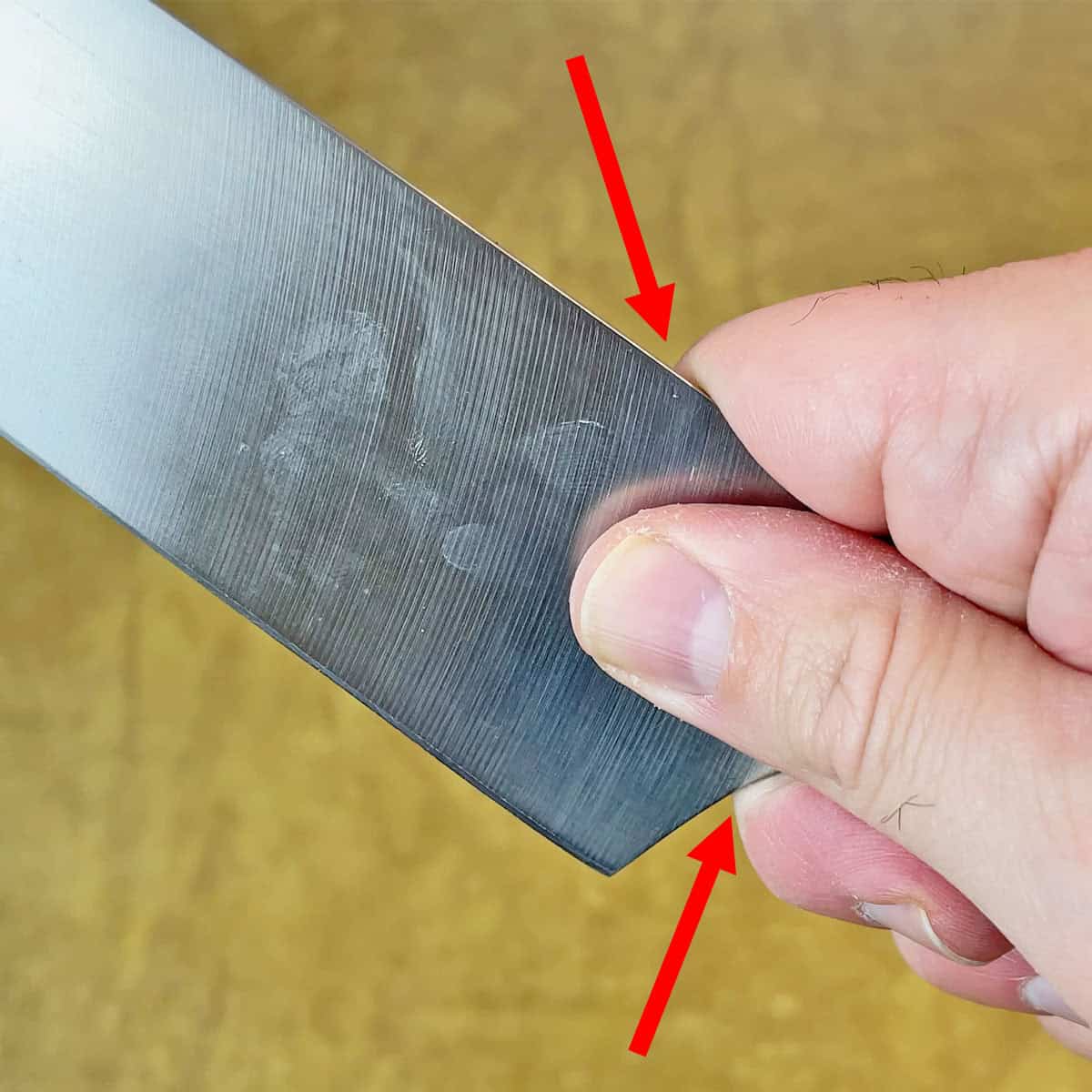
Some knives are worse than others. The Dalstrong Phantom has a pointed choil that can poke you if you grab it without paying attention.

Bolster design also affects comfort. A full bolster adds weight and prevents your hand from sliding forward, but it can block the heel of the blade when you sharpen. Knives like the Wusthof Classic have full bolsters that make maintenance more difficult.

A sloped or half bolster, like the one on the Dalstrong Shogun or Zwilling Pro, gives you a stable resting point for your grip without blocking the edge.

Some knives skip the bolster entirely, which keeps the knife lighter and easier to sharpen. I usually prefer either no bolster or a sloped one because they offer more control.
Unfortunately, you cannot judge handle comfort from photos. If possible, hold the knife in person. Some stores will let you try a few chopping motions. If you are shopping online, order two or three options, use them for a couple of days, and return the ones that do not feel natural. Always check the return policy before you buy.
Mistake 2: Weight and Balance
Another mistake is not paying attention to weight and balance. These two factors change how a knife feels and performs.

A heavier knife uses its own momentum to cut, so you do not need to push as hard. In my testing, Western-style knives often weighed between 8 and 10 ounces, and that extra mass made a noticeable difference when slicing dense ingredients. The downside is fatigue. If the knife is too heavy, your wrist and forearm will tire quickly.

A lighter knife gives you more control and agility for detailed work. Japanese-style knives often fall between 5 and 7 ounces. They feel fast and precise, but very light knives require more effort on thicker cuts because the blade does not carry as much of the workload.
Balance matters just as much as overall weight. If the blade is much heavier than the handle, the knife tips forward and feels unstable. If the handle outweighs the blade, the knife can feel disconnected and harder to control. A centered balance point, usually where the blade meets the handle, makes the knife feel steady and predictable.

Balance is affected by the tang, which is the portion of metal that extends from the blade into the handle. A full tang runs the entire length of the handle and adds weight toward the back. A partial tang keeps the handle lighter and shifts more weight toward the blade. Neither is better on its own. They simply create different balance points.
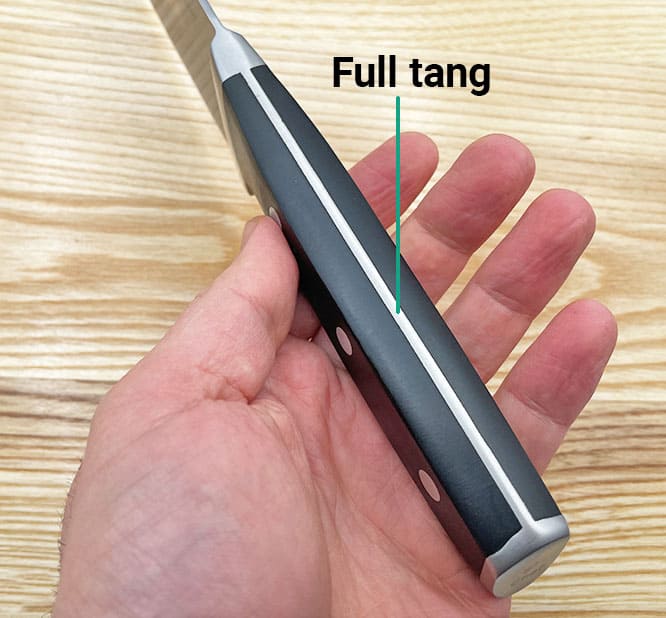
Most brands list a knife’s weight, so you can at least get a sense of how heavy or light it will feel. Balance, however, is something you need to feel for yourself. If possible, hold a few knives in person.
Mistake 3: Blade Design
The third mistake is choosing a blade shape that does not match your cutting style.
The curve of the edge is the biggest factor because it dictates how the knife moves. Western-style chef’s knives usually have a deeper belly, which means the edge has a more pronounced curve from heel to tip. This design works best for rocking cuts where the tip stays on the board and the blade moves in an arc.

The Japanese gyuto has a flatter edge with less curve. Instead of rocking, you use an up-and-down motion and lift the blade completely off the board between cuts. Neither style is better. They simply cater to different habits. If you naturally rock the blade, a rounded belly will feel smoother and more predictable. If you prefer clean, straight cuts, a flatter edge gives you better contact with the board.

Blade height is another detail people overlook. A narrow blade can look sleek, but if it is too short, your knuckles will hit the board every time you chop.

Taller blades are not as nimble, but they give you more knuckle clearance. In my testing, narrow profiles like the HexClad left less room between your hand and the board, while taller blades like the Made In or Zwilling Pro gave more space at the cost of some agility.
The height of the tip also changes how the knife handles detail work. Most chef’s knives have a gradual curve on both the spine and the belly, which keeps the tip low and easy to control. Others, such as the Zwilling Pro, have a straighter spine that raises the tip. With a higher tip, you need to lift your hand much higher to make small, precise cuts.
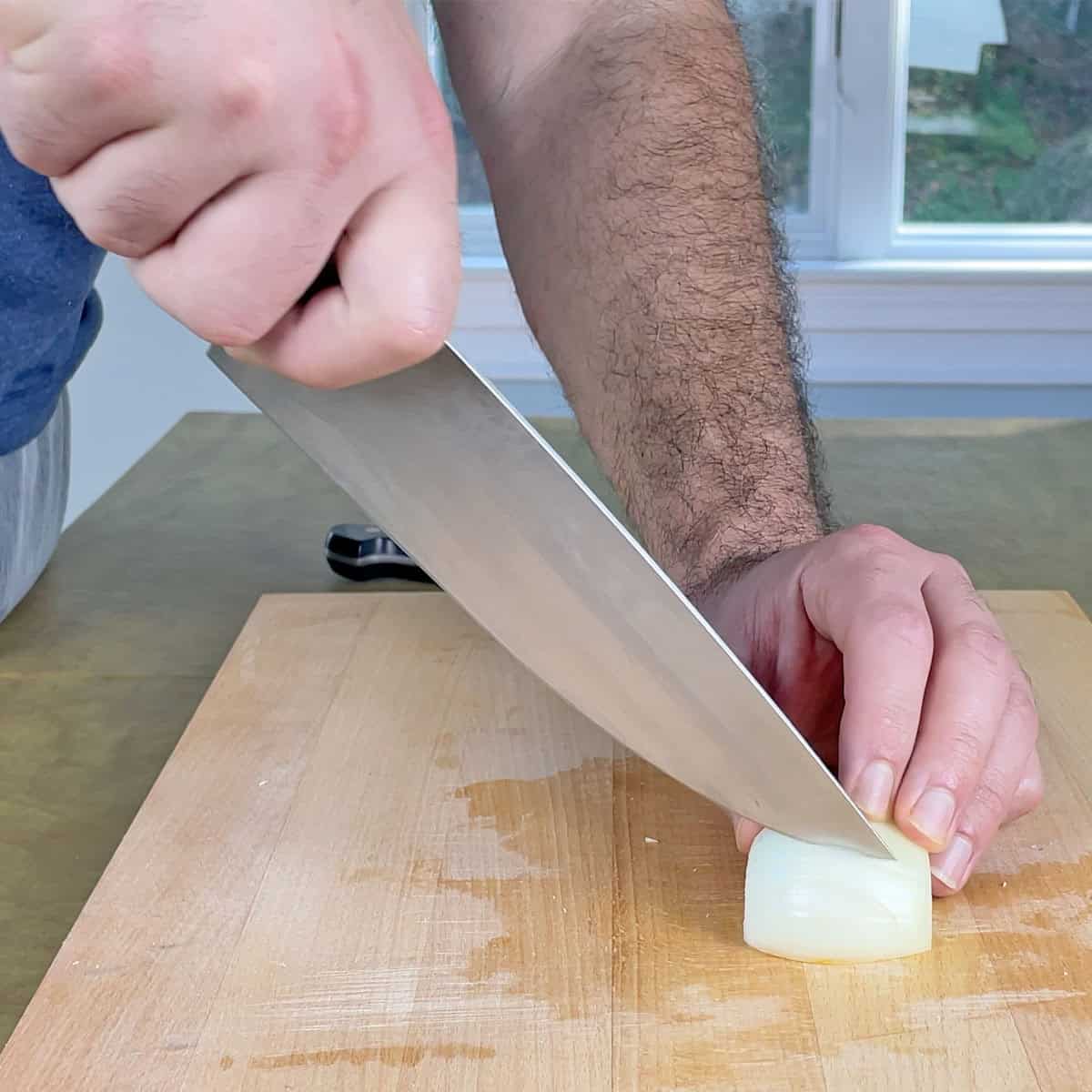
Choosing the right blade design comes down to how you naturally cut. If a knife does not match that motion, it will always feel slightly off.
Mistake 4: Blade Geometry
The fourth mistake is ignoring blade geometry. If there is too much metal behind the cutting edge, the knife will push food apart instead of slicing through it. This creates drag, slows you down, and makes dense ingredients feel harder to cut than they should. Most brands never mention geometry in their descriptions, and you cannot judge it accurately from photos.

The best way to check is to hold the knife in person. Gently pinch the blade about a quarter inch above the cutting edge. A good knife will feel thin in this area and taper smoothly up the side of the blade. That smooth taper reduces friction and gives you cleaner cuts. If it feels thick or blocky, the knife will wedge into ingredients rather than glide through them. You will notice this immediately on potatoes, carrots, and anything dense.
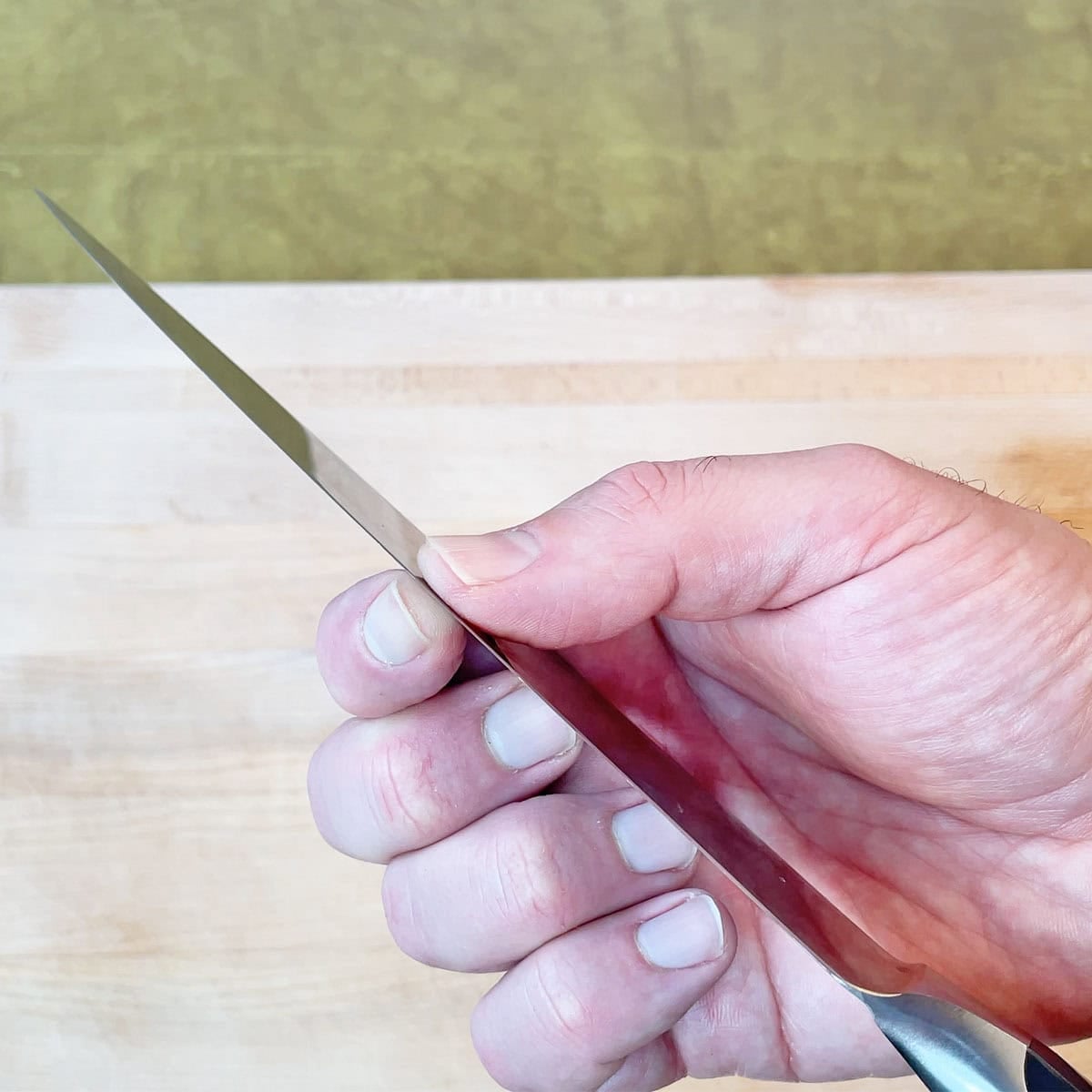
It also helps to look at the spine. A blade that gradually thins from heel to tip feels lighter and easier to control, especially when doing detail work. If the spine stays thick all the way through, the knife can feel clunky and front-heavy.
Geometry is one of the hardest things to evaluate when shopping online, which is why testing a knife at home or asking specific questions before buying is worth the effort.
Mistake 5: Blade Steel
The fifth mistake is either ignoring the type of steel a knife is made from or obsessing over it. Both can lead you in the wrong direction.
Some brands do not disclose their steel at all, which is a red flag. You should always know the exact steel so you can look it up and understand what you are paying for. On the other hand, many people overpay for knives simply because the steel name sounds exotic, even when the rest of the knife is nothing special.

Steel is just iron mixed with carbon and a few other elements. There are dozens of formulas, but they all try to balance three things: how long the edge stays sharp, how well the steel resists rust, and how durable it is when you hit something hard.
For home cooks, the simplest and most useful spec to look at is hardness. Most brands list hardness on the Rockwell scale, and this number gives you a reliable sense of how the knife will behave.
Harder steel, usually between 60 and 66 Rockwell, holds an edge longer but is more prone to chipping and takes more time to resharpen. Softer steel, around 54 to 57 Rockwell, dulls faster but is less fragile and much easier to bring back to sharp.
A simple way to picture it is to imagine two extremes. A blade made of playdough would lose its edge immediately but you could reshape it with no effort. A blade made of diamond would stay sharp for an incredibly long time but would be difficult to reshape once it dulled.
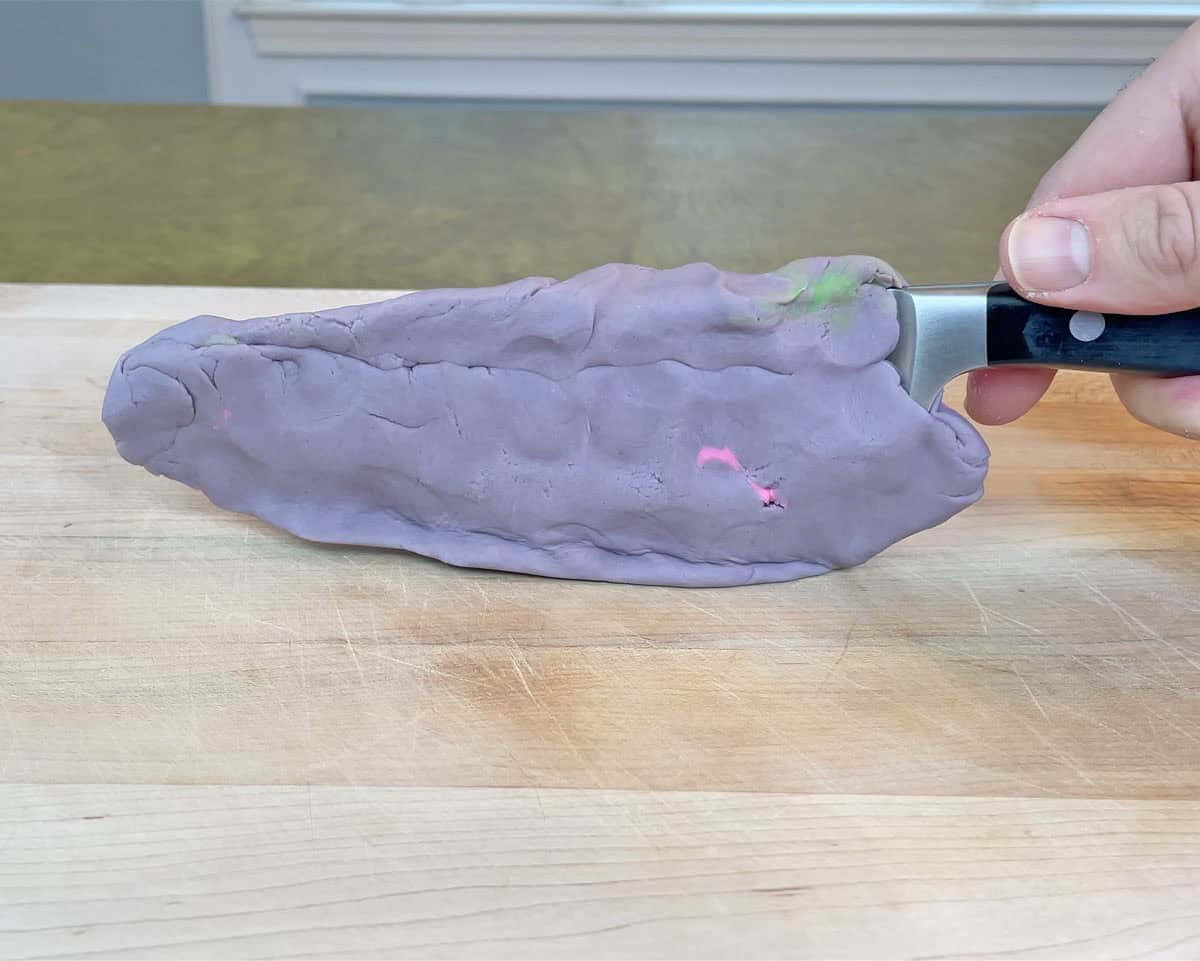
If you want a blade that is easy to resharpen and you do not want to worry about chips, choose a softer steel. If you want the longest-lasting edge and you are careful with your knives, a harder steel will make more sense.
If you are interested in how different steels show up in real knives, here are a few real world examples from the collections I tested:
- Wüsthof Classic, Zwilling Pro, and Made In all use X50CrMoV15 at around 58 HRC. This steel is tough, rust resistant, and very forgiving. It sharpens quickly and rarely chips, which makes it ideal for busy kitchens or anyone who does not want to think much about maintenance.
- Misen (Chef’s Knife 2.0) now uses AICHI ACUTO440, a high-carbon stainless steel with an unusually high chromium content. It offers better rust resistance than their previous AUS-10, holds an edge well, and stays easy to maintain even if you cut acidic foods or forget to dry the blade immediately.
- Dalstrong Phantom uses AUS-8 at 58 HRC. It sharpens easily and takes a fine edge, though it will not hold that edge as long as harder Japanese steels.
- MAC MTH-80 uses a proprietary high carbon steel at 59 HRC. It slices very cleanly, sharpens fast, and provides better edge retention than softer Western steels without being overly brittle.
- Shun Classic uses VG-MAX at about 60 to 61 HRC, and Oishya uses VG-10 at around 62 HRC. These steels take very sharp, thin edges and hold them longer, although they require slightly more care to avoid micro-chips.
- HexClad, Cangshan Haku, and Cangshan Yari use various Damascus-style constructions with harder steel cores in the low 60s. These cores extend edge retention while the outer layers add corrosion resistance.
- Cangshan Thomas Keller Series uses RWL34 powdered steel at 61 HRC, which offers excellent edge retention and a very fine grain structure. It sharpens to a high level but takes more effort than mid-range steels.
- Cutco uses 440A, which is highly rust resistant and easy to sharpen, although edge retention depends strongly on the heat treatment.
- Henckels Solution uses a softer generic stainless steel in the low 50s, which sharpens quickly but dulls much faster during daily prep.
Mistake 6: Forged vs. Stamped
The sixth mistake is assuming forged knives are always better than stamped knives.

Forged knives are made by heating steel and shaping it with force. Stamped knives are cut from a flat sheet of steel and then ground and finished. For years, brands promoted forged knives as the premium option, and many people still believe stamped knives are automatically lower quality. In reality, the construction method does not tell you how the knife will perform.
Other factors matter far more, especially hardness and blade geometry. A knife with good geometry and the right steel will cut better and stay sharp longer regardless of whether it was forged or stamped. A poorly designed forged knife can perform worse than a well-designed stamped one.
A clear example is the MAC MTH-80. It is a stamped knife, yet it is one of the best-performing knives I have tested. The blade is ground thin from spine to edge, which gives it smooth, low-resistance cuts. It is also light, well balanced, and easy to control. The fact that it is stamped does not hold it back in any way.

However, there are stamped knives at the very low end of the market that use steel so thin and soft that the blade flexes when you cut. A little flex is normal for specialty knives like fillet knives, but a chef’s knife should not bend easily. If it does, that is a sign the steel and geometry are not up to par.
When you evaluate knives, the focus should be on how they are engineered rather than whether they are forged or stamped.
Mistake 7: Knife Sets
Buying a large knife set is usually a waste of money. Those 14 or 16 piece blocks look like a deal, but most of the knives will sit untouched. The average home cook uses the same two or three knives every day and never pulls the others out of the block.
In most kitchens, the essentials are an 8 inch chef’s knife, a serrated bread knife, and a small paring knife. A nakiri or santoku can be useful if you do a lot of vegetable prep, but you do not need more than a few well chosen knives.
You get far more value by buying individual knives you will actually use or a simple three piece starter set. It saves money, reduces clutter, and lets you choose knives that fit your hand rather than whatever a set happens to include.
It is also best to avoid self sharpening blocks. The ceramic inserts inside those blocks grind your knife each time you pull it in and out, which removes metal unevenly and wears the blade down faster. A good honing rod and an occasional sharpening will take much better care of your knives than a block that sharpens for you.
Knives I Recommend
Before wrapping up, I want to share a handful of knife collections that I have been testing and using regularly. They cover a range of styles and preferences, and each one excels for a different reason.
MAC MTH-80
The MAC MTH-80 is thin behind the edge, lightweight, and well balanced, so it is one of the easiest knives to control. It consistently ranks as one of the top performers in my testing.

Misen Chef’s Knife
The Misen chef’s knife uses upgraded steel that offers better edge retention and rust resistance than most entry-level options. It also has a rounded spine that feels comfortable in a pinch grip, and it delivers excellent value for the price.

Miyabi Koh
The Miyabi Koh is lightweight with a thin, precise blade that handles detail work extremely well. Its octagonal handle provides a secure grip for most hand sizes.

Miyabi Birchwood
The Miyabi Birchwood features an ultra thin SG2 blade that holds its edge for a long time. The birchwood handle feels premium in the hand and adds almost no extra weight, which keeps the knife nimble.

Cangshan Thomas Keller Series
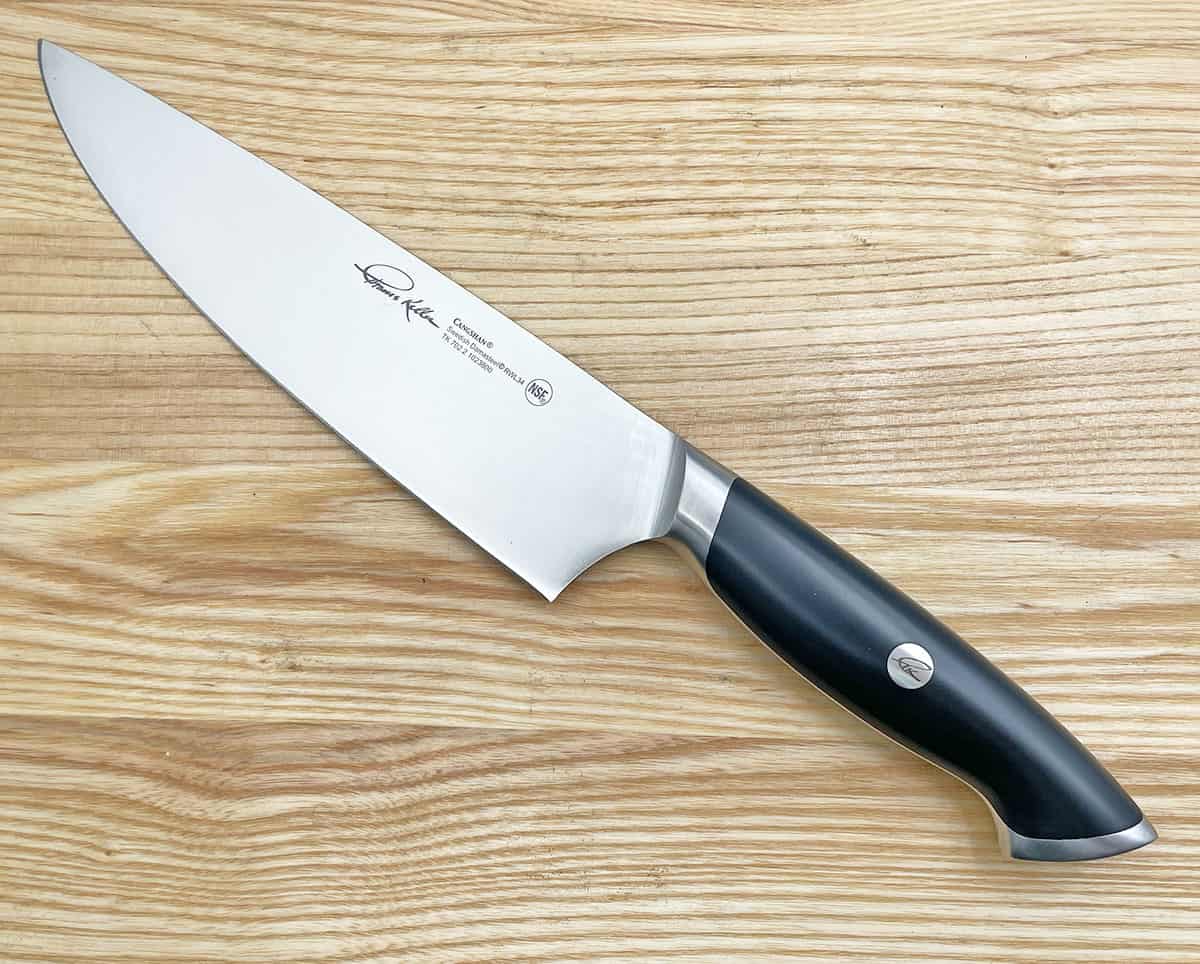
The Cangshan Thomas Keller Series is surprisingly thin behind the edge for a Western style knife, and the hard steel provides excellent edge retention. Its even weight distribution makes it feel more controllable than its size suggests.
Zwilling Pro
The Zwilling Pro has a sloped half bolster that is ideal for a pinch grip and works especially well if you prefer a rocking cut. It is a comfortable choice for anyone who likes a traditional Western feel.

Wusthof Classic
The Wusthof Classic is a hefty and durable workhorse with a full bolster and a substantial, traditional Western profile. It is a great option if you prefer a knife with more weight and a predictable, steady feel during heavy prep.

Questions to Ask Before Buying Kitchen Knives
Use this checklist when shopping for knives online, over the phone, or in-store. Copy and paste these questions into an email to the brand or bring them with you when shopping. Click here to download a Word doc with the questions.
What type of steel is the blade made from?
The steel determines sharpness, durability, corrosion resistance, and overall cutting feel. If a brand will not disclose the steel type, that is a red flag.
What is the Rockwell hardness rating?
The hardness determines how long the edge stays sharp, how durable the blade is, and how difficult it will be to sharpen. Lower hardness is easier to sharpen but dulls quickly, while higher hardness holds an edge longer but is more brittle. Anything under 58 is considered softer and anything over 60 is considered harder.
Is the blade stainless or carbon steel?
Stainless steel is low maintenance and resists rust, while carbon steel sharpens easily and cuts differently but can rust if you do not dry it immediately. Your choice should depend on how much upkeep you want to manage.
What is the factory edge angle?
The edge angle affects sharpness and durability. Lower angles cut more cleanly but are more delicate. All knives eventually need sharpening regardless of the factory angle. Most Western knives are sharpened to about 15 to 20 degrees per side, and most Japanese knives are about 12 to 15 degrees per side.
What is the weight of the 8 inch chef’s knife?
The weight affects fatigue, control, and how the knife feels during long prep sessions. A knife under 7 ounces feels light, 7 to 9 ounces is average, and anything over 9 ounces feels heavy.
What is the blade height?
The blade height determines how much knuckle clearance you have and how safe and comfortable the knife feels when chopping. Look for at least 1.75 to 2 inches at the heel.
What are the handle dimensions?
Handle length and thickness affect comfort and control, especially when using a pinch grip. Longer handles, usually between 4.5 and 5 inches, are better for larger hands.
Are the spine and choil rounded or smoothed?
Sharp edges on the spine or choil will dig into your fingers during a pinch grip. A rounded finish improves comfort and makes a noticeable difference if you cook frequently.
What type of bolster does the knife have?
The bolster influences balance, safety, and sharpening access. A full bolster provides finger protection and added heft, a half bolster makes the heel easier to sharpen and improves pinch grip comfort, and no bolster keeps the knife lightest.
Is the knife forged or stamped?
Both forged and stamped knives can perform well. Blade geometry and heat treatment have a much larger impact on performance than the manufacturing method, but it is still useful to know which one you are buying.
Does the knife have a full tang or partial tang?
Tang design affects durability, balance, and how the knife sits in your hand. A full tang provides stability and adds weight toward the back of the knife, while a partial tang keeps the handle lighter and shifts more weight toward the blade.
Warranty and returns
A good return policy and warranty reduce the risk of buying a knife you have not held. Comfort is impossible to judge online, and manufacturing defects should always be covered. Look for a 30 day return window, free return shipping, no restocking fees, and lifetime coverage for defects.
Related Topics
- I Tested 27 Chef’s Knives & These Are the Best for Every Budget
- The 8 Most Expensive Chef’s Knives (That Are Actually Worth It)
- Best Kitchen Knives NOT Made in China: The Definitive Guide
- Titanium and Stainless Steel Cutting Boards Review (Pros, Cons, Test Results)
- Wood vs. Plastic Cutting Boards: Which Material Is Better? (Test Results)
- Best Cutting Board? I Tested Epicurean, OXO, Boos, Teakhaus & More
- Best Kitchen Knives Made in the USA: Top Brands Reviewed
- 21 Different Types of Kitchen Knives Explained (With Comparison Chart)
- Best German Kitchen Knives: Top 5 Brands Reviewed
- The Definitive Guide to the Best Kitchen Knife Brands

