

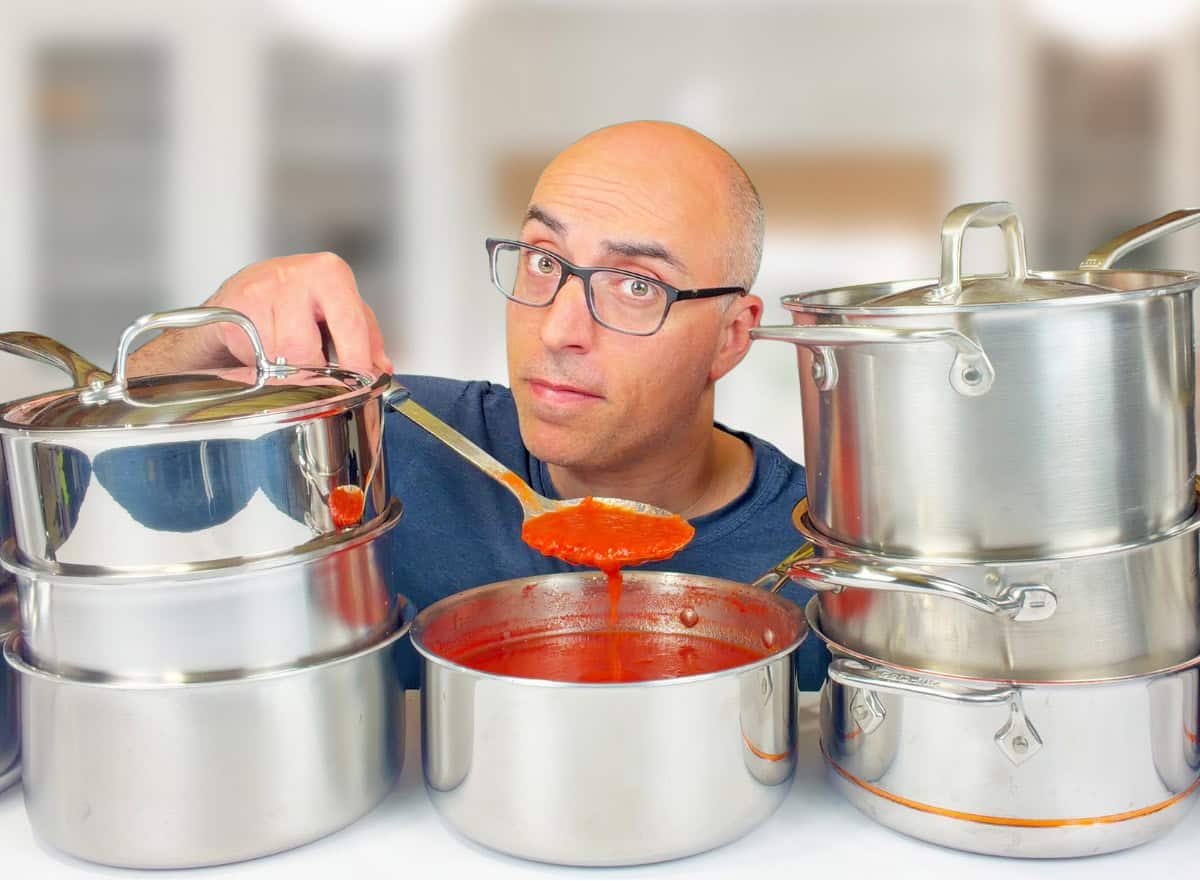
Is an expensive saucepan worth it? Or are the cheaper brands just as good? Which saucepan is truly the best?
To find out, I tested 13 of the highest-rated saucepans on the market.
I measured how evenly heat spreads across the cooking surface and up the walls, how fast each pan boils water on electric and induction, how hot the handles get after extended boiling, how secure they feel with dry and oily hands, how quickly they respond when pulled off the burner, and whether the rims drip when you pour.I also cooked with each pan for several weeks to see how they perform in a real kitchen.
In this guide, I share the results from all my tests and give you my honest review of each pan. I start with the least expensive and end with the most expensive. At the end, I explain which saucepans are truly the best and why.
Key Takeaways
After weeks of testing 13 saucepans across multiple controlled tests and real-world cooking, here are my recommendations.
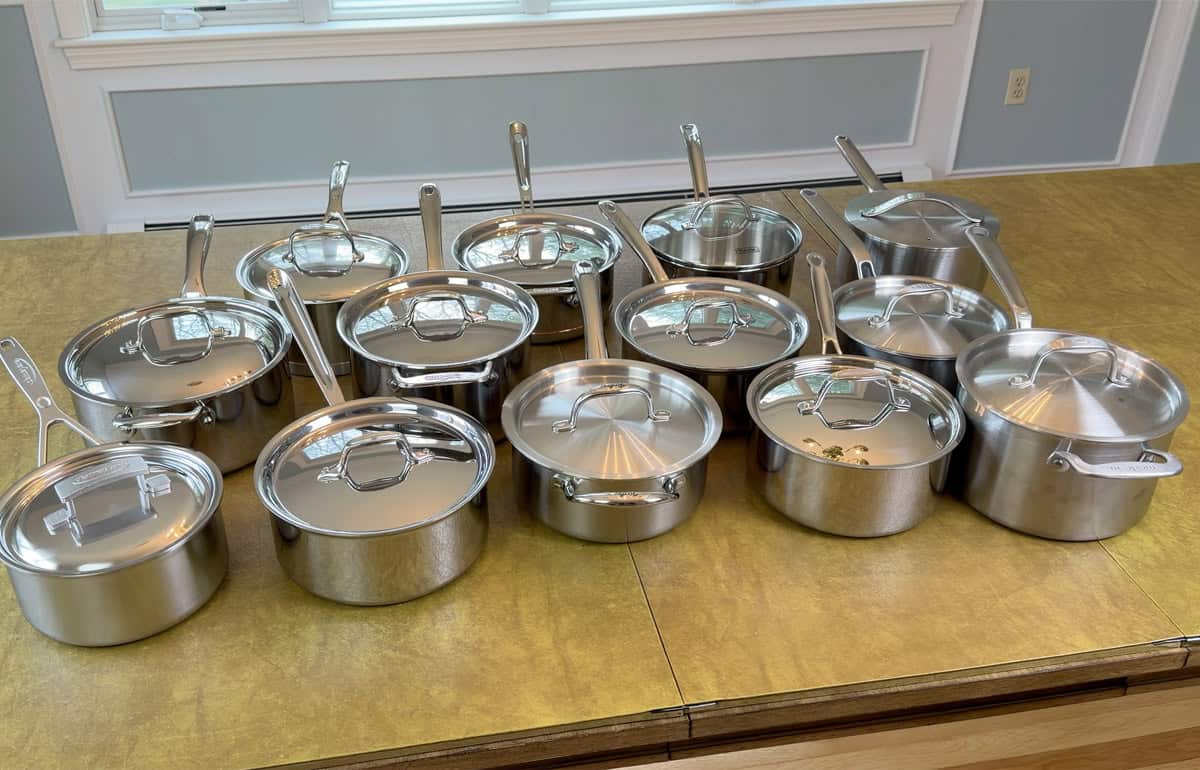
If I had to pick one saucepan, it would be the All-Clad D3. It has the most secure handle of any pan I tested, the coolest handle temperature after boiling (76°F), excellent heat distribution (48°F center-to-edge gap), and solid performance on both electric and induction. The deep groove on top locks your hand in place even with oily hands or an oven mitt, which matters on a saucepan more than any other pan.
If the D3 handle digs into your hand, the All-Clad D3 Everyday gives you the same pan with a more comfortable handle.
Made In is a strong alternative with 5-inch walls (the tallest I tested), a large helper handle, the fastest induction boil time (6:23), and the second most even heat distribution (38°F center-to-edge gap).
On a budget, Goldilocks is hard to beat. It was the second fastest to boil on induction (7:33), has a secure grooved handle, and costs a fraction of the premium options.
I don’t recommend Caraway, Fissler M5 Pro-Ply, or Legend because of their rounded, slippery handles. I like Viking 3-Ply Classic but you can only buy it as part of a set, and the glass lid is a downside. All-Clad Copper Core and All-Clad G5 are both well-made pans, but the performance advantages over the standard D3 are minimal and the prices are significantly higher.
Use the links below to navigate the review:
- How I Tested
- Comparison Chart
- Goldilocks
- Viking 3-Ply
- Legend
- Heritage Steel Eater Series
- Caraway
- Made In
- All-Clad D3
- All-Clad D3 Everyday
- Demeyere Industry
- Fissler M5 Pro-Ply
- All-Clad Copper Core
- Demeyere Atlantis
- All-Clad G5
- Bottom Line: Which Saucepan Is the Best?
How I Tested
Saucepans are used differently than frying pans. You’re boiling water, making sauces, cooking grains, and pouring hot liquids. That means handle security, boil speed, and heat distribution across the base all matter more here than in a skillet. I designed my tests around those priorities.
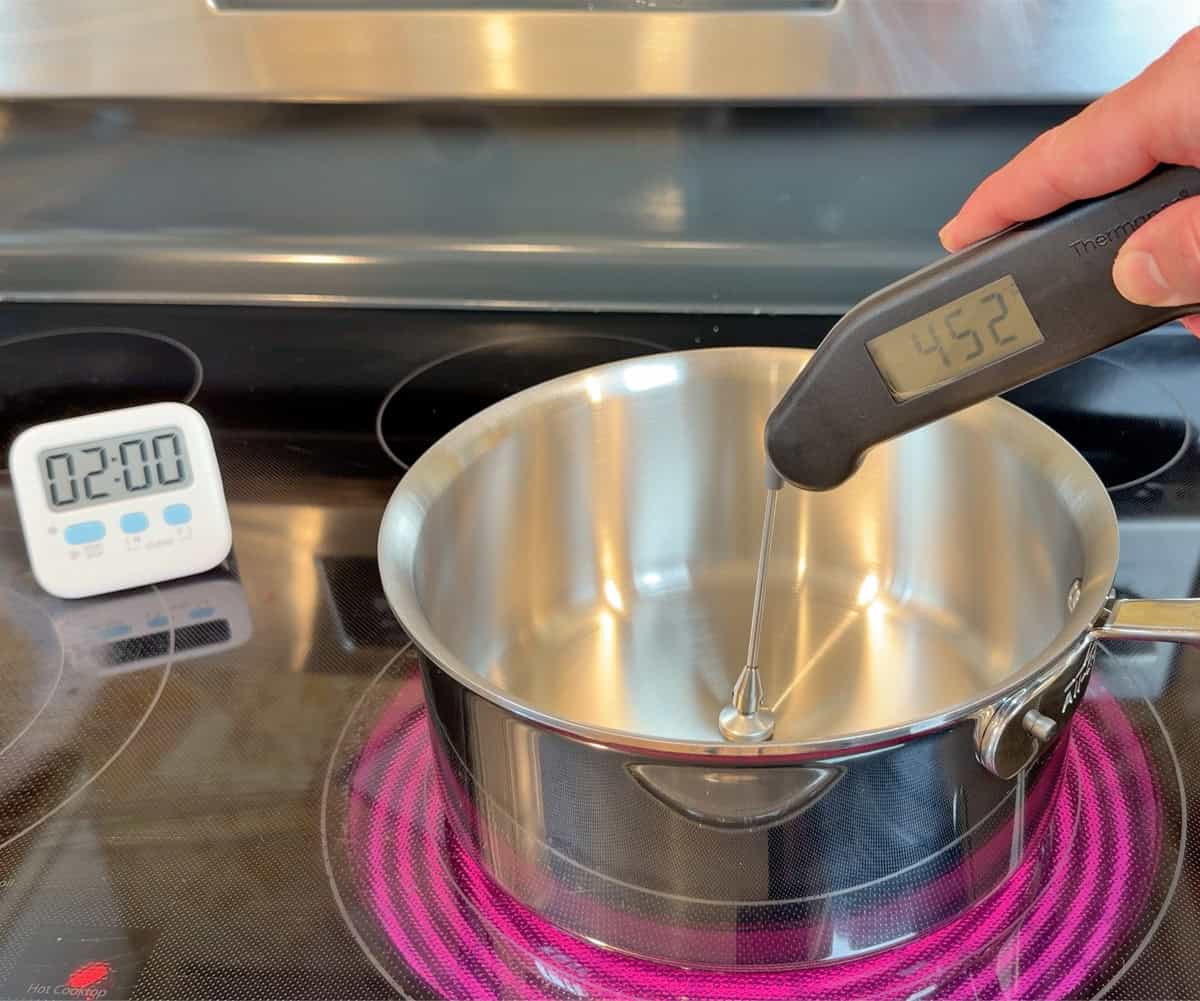
Heat distribution. I preheated each pan on medium for two minutes and measured the surface temperature in three spots: the center, the outer edge, and halfway up the sidewall. A smaller difference between the center and edge means the base heats more evenly, which reduces hot spots and helps sauces cook more consistently.
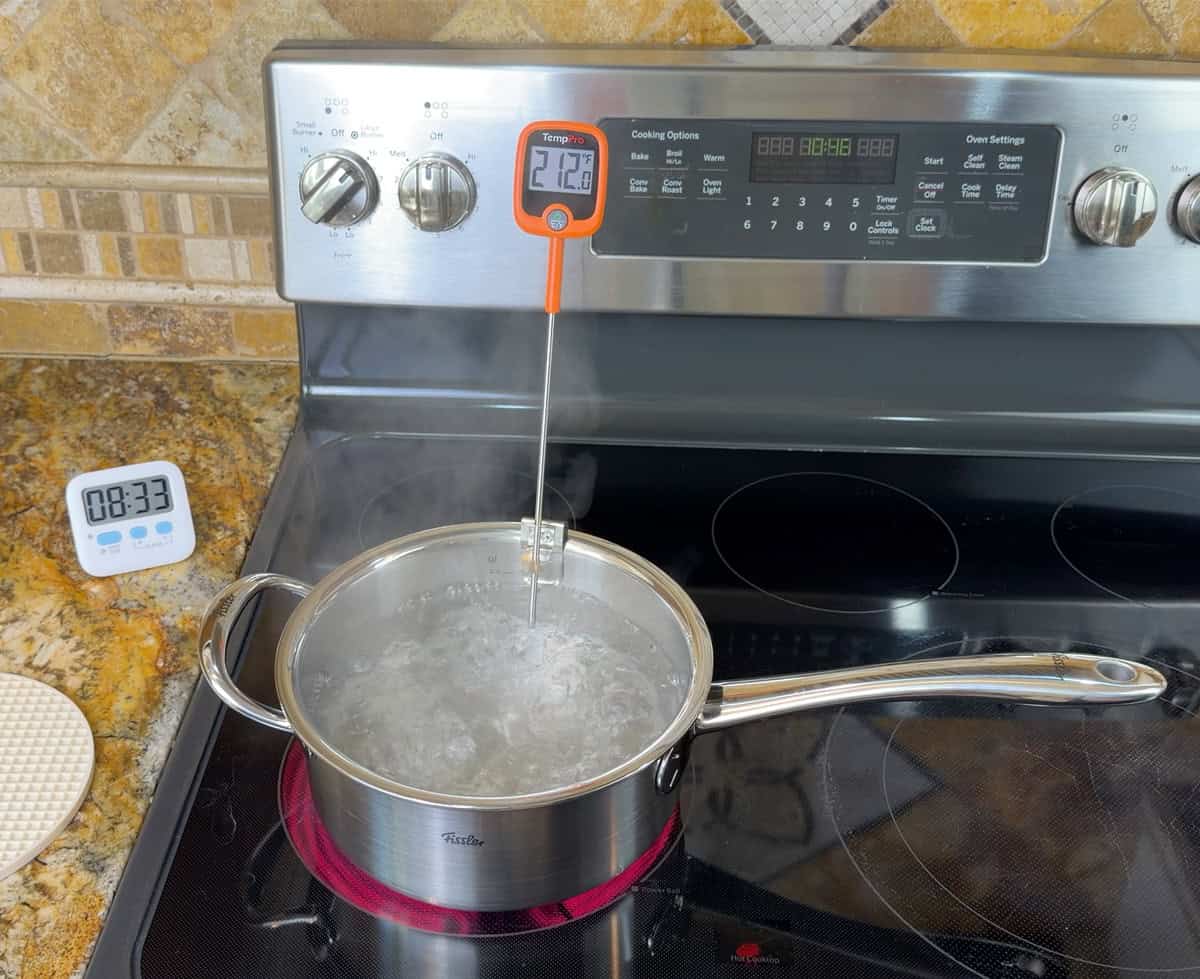
Boil time (electric and induction). I filled each pan with two quarts of water at the same starting temperature (54°F ) and timed how long it took to reach a boil. I ran this test on both an electric and induction cooktop because many saucepans perform very differently on each.
Responsiveness. I removed each pan from the burner and timed how long it took for the boiling to stop. A pan that calms down quickly gives you more control when you need to drop from a boil to a simmer fast.
Handle temperature. After 10 minutes of continuous boiling, I measured the temperature of each handle. Saucepans spend long stretches on the stove, and a handle that heats up over time is a safety concern.
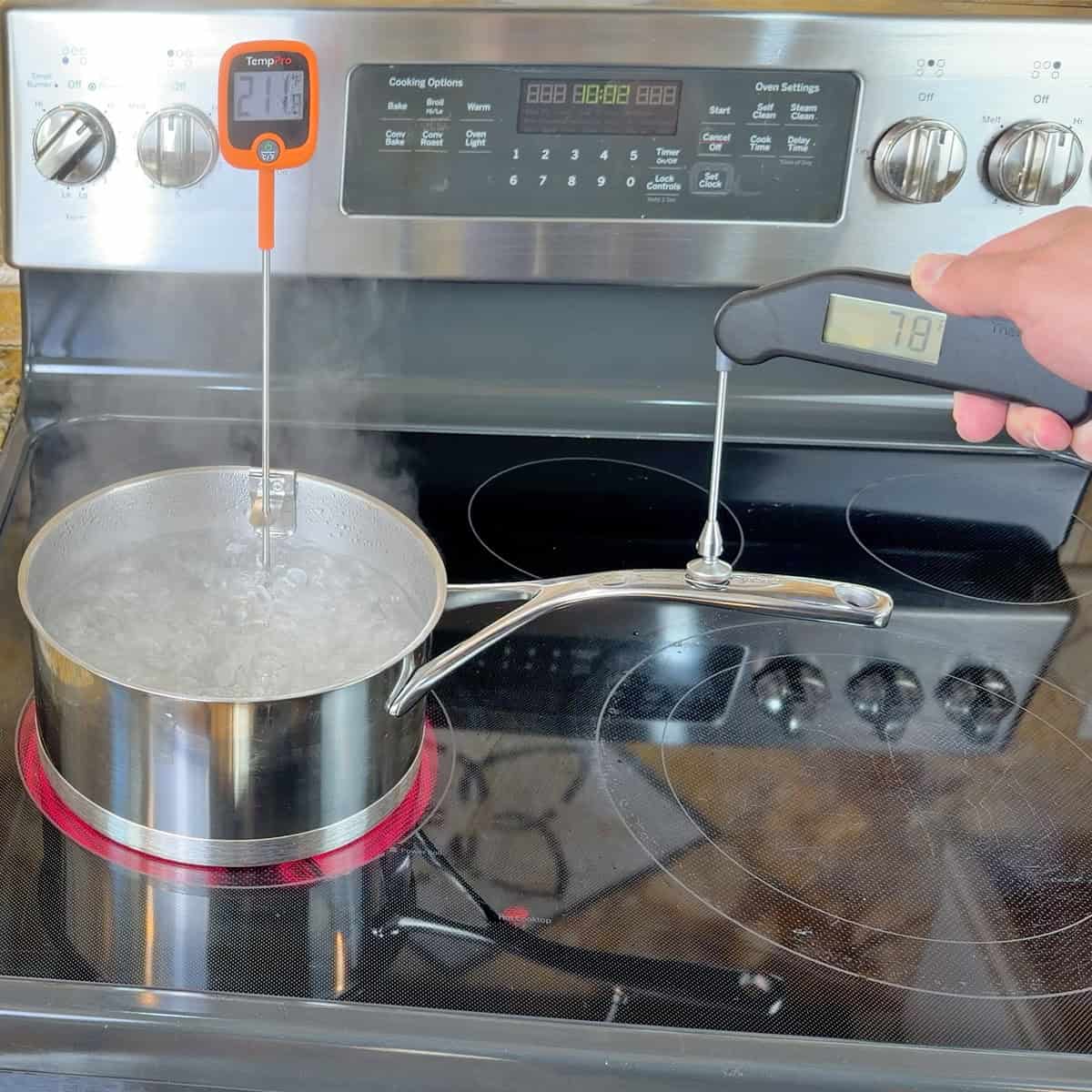
Handle security. I poured water from each pan into a glass with dry hands and again with oily hands. On a frying pan, a slippery handle is annoying. On a saucepan full of boiling water, it’s dangerous. I also poured oil to see which rims dripped down the sides.
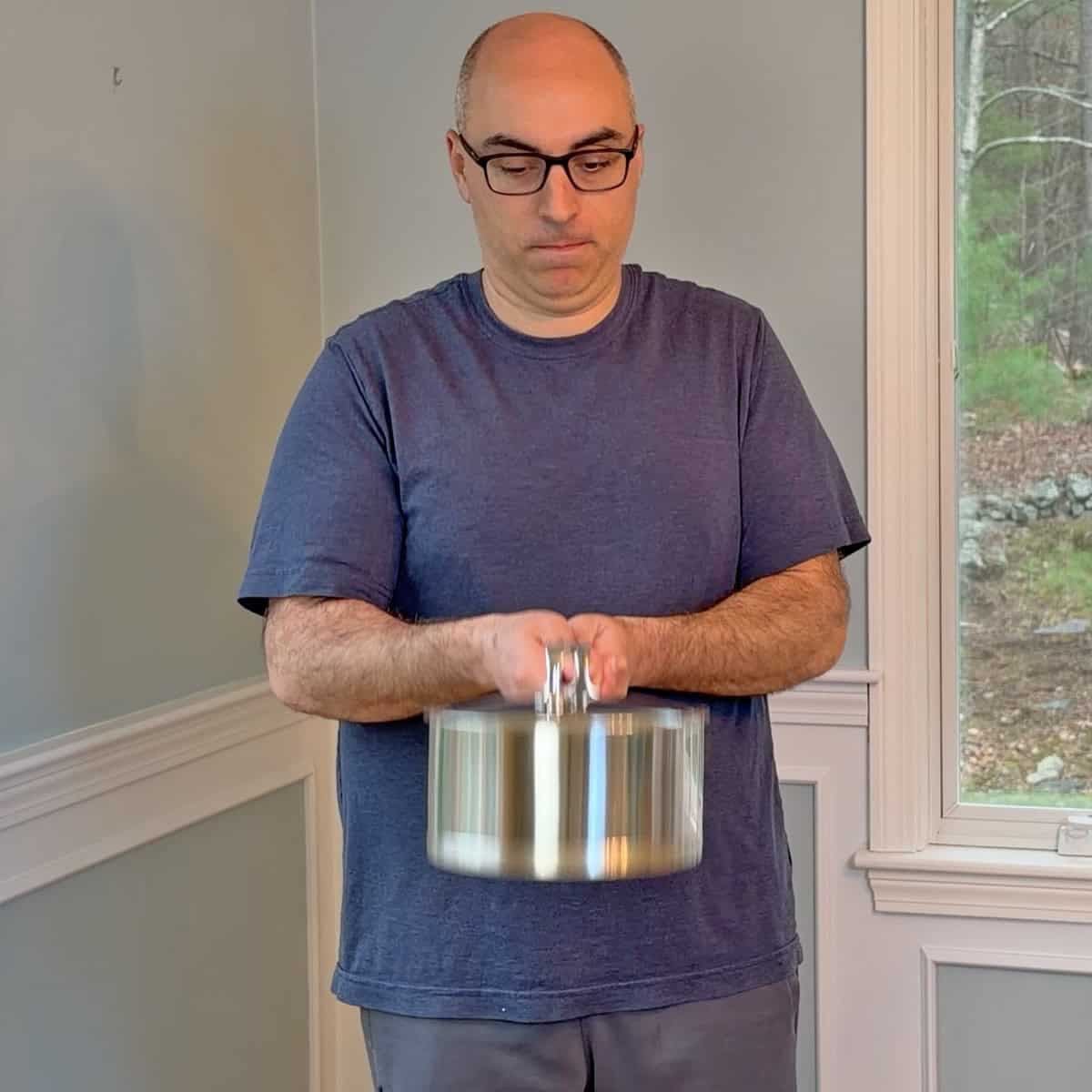
Handle strength. I filled each pan with water and shook it aggressively for two minutes. Most handles held up fine.
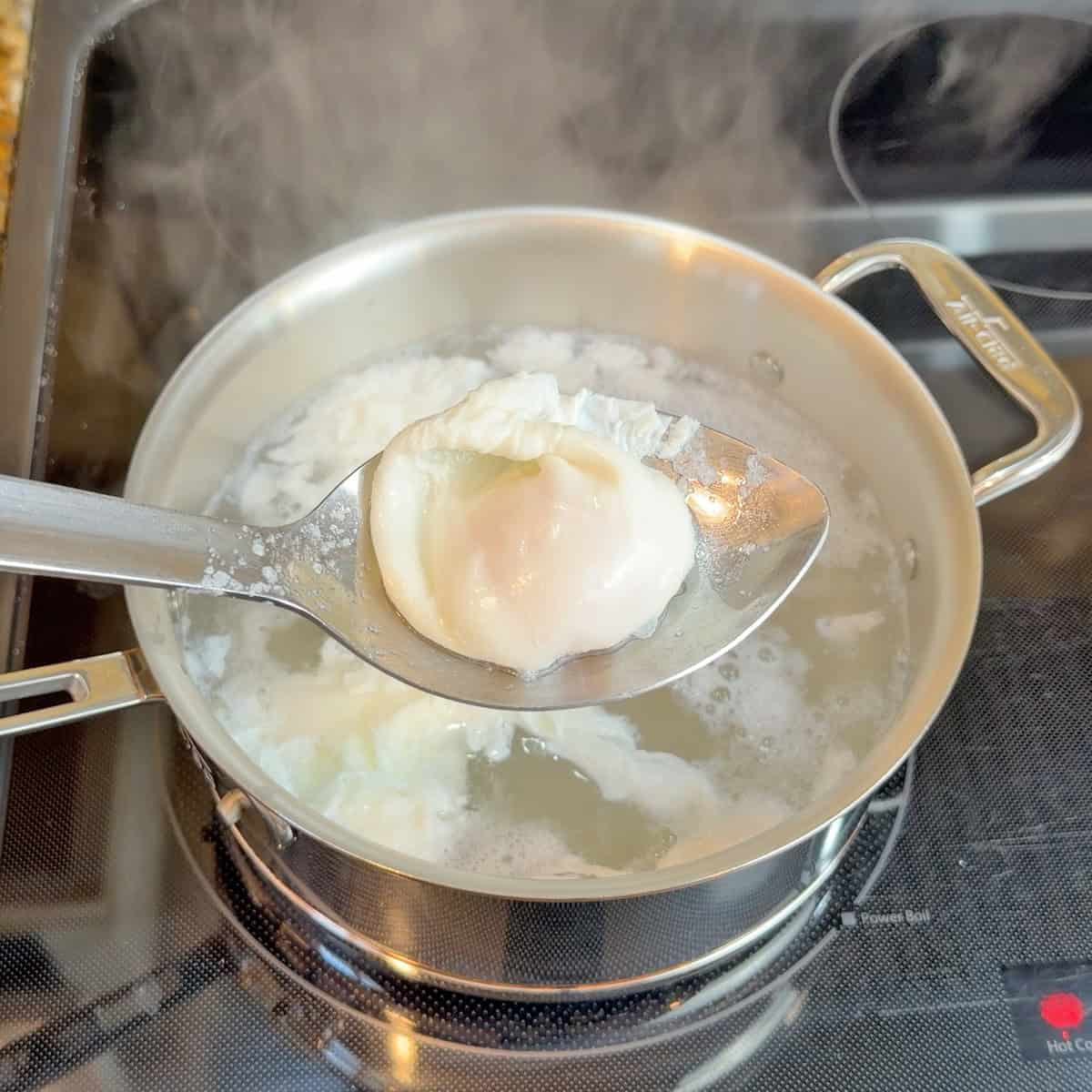
Real-world cooking and cleaning. Beyond the controlled tests, I cooked with each pan for several weeks and paid attention to how easy they are to clean, how balanced they feel, and how they perform day to day.
Saucepan Comparison Chart
Below is a comparison chart for all 13 saucepans I tested. They’re sorted from least to most expensive.
Swipe to view the entire chart.
| Saucepan | Made In | Construction | Capacity | Weight | Handle Length | Sealed Rims | Distribution (Center-Edge) | Boil Time Electric | Boil Time Induction | Handle Temp |
|---|---|---|---|---|---|---|---|---|---|---|
| Goldilocks | China | 3-ply aluminum core | 3 qt | 2.5 lb | 7.5 in | No | 117°F diff | 6:48 (9th) | 7:33 (2nd) | 85°F |
| Viking 3-Ply Classic | China | 3-ply aluminum core | 3 qt | 2.6 lb | 7.5 in | No | 114°F diff | 5:02 (2nd) | 7:55 (5th) | 82°F |
| Legend | China | 5-ply aluminum core | 4 qt | 3.4 lb | 7.5 in | Yes | 61°F diff | 5:26 (4th) | 10:00 (13th) | 77°F |
| Heritage Steel Eater | USA | 5-ply aluminum core | 3 qt | 2.2 lb | 8.0 in | No | 96°F diff | 6:53 (10th) | 8:10 (7th) | 91°F |
| Caraway | China | 5-ply aluminum core | 3 qt | 2.6 lb | 7.25 in | No | 91°F diff | 9:00 (12th) | 7:54 (4th) | 101°F |
| Made In | Italy | 5-ply aluminum core | 4 qt | 3.1 lb | 8.25 in | No | 38°F diff | 6:32 (8th) | 6:23 (1st) | 80°F |
| All-Clad D3 | USA | 3-ply aluminum core | 3 qt | 2.9 lb | 9.0 in | No | 48°F diff | 6:04 (6th) | 7:48 (3rd) | 76°F |
| All-Clad D3 Everyday | USA | 3-ply aluminum core | 3 qt | 2.6 lb | 7.5 in | No | 51°F diff | 6:31 (7th) | 8:15 (9th) | 82°F |
| Demeyere Industry | Belgium | 5-ply aluminum core | 2.25 qt | 2.6 lb | 8.0 in | Yes | 52°F diff | 9:39 (13th) | 7:58 (6th) | 84°F |
| Fissler M5 Pro-Ply | Germany | 5-ply aluminum core | 3 qt | 3.0 lb | 8.5 in | Yes | 73°F diff | 7:33 (11th) | 8:56 (12th) | 78°F |
| All-Clad Copper Core | USA | 5-ply copper core | 3 qt | 3.5 lb | 9.25 in | No | 61°F diff | 5:45 (5th) | 8:50 (11th) | 81°F |
| Demeyere Atlantis | Belgium | 7-ply aluminum core (base only) | 3 qt | 3.6 lb | 7.75 in | No | -11°F diff | 5:15 (3rd) | 8:27 (10th) | 78°F |
| All-Clad G5 | USA | 5-ply graphite core | 4 qt | 3.1 lb | 7.75 in | No | 60°F diff | 5:01 (1st) | 8:13 (8th) | 86°F |
Goldilocks
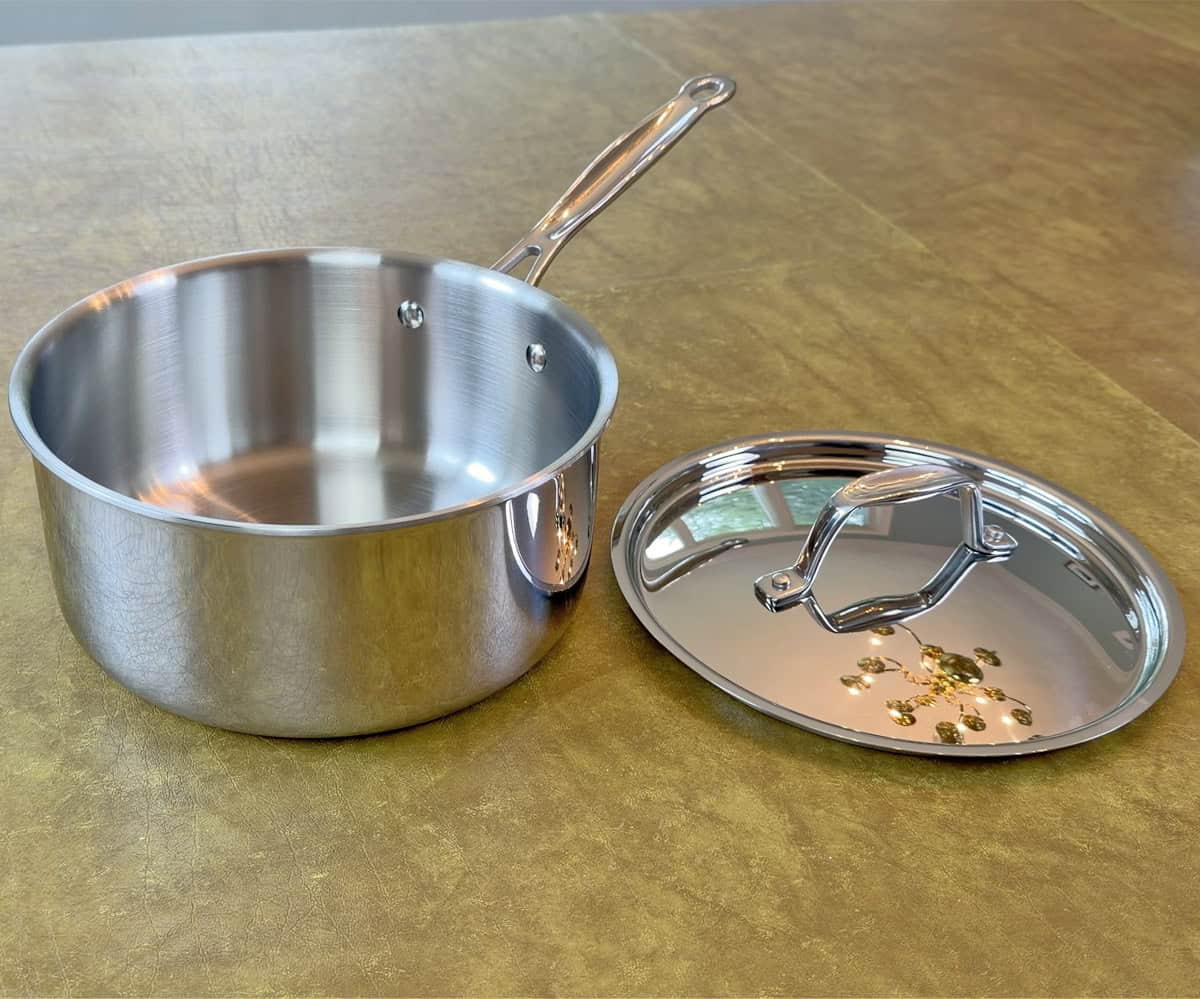
Goldilocks is a 3-ply aluminum core saucepan with a polished exterior and it’s made in China. It weighs 2.5 lbs without the lid, making it one of the lighter options I tested. The handle is thin but has a groove on top that keeps it from rotating when you tilt it. I wish the handle were a little thicker, but the grip is secure. At 7.5 inches, the handle is on the shorter side.
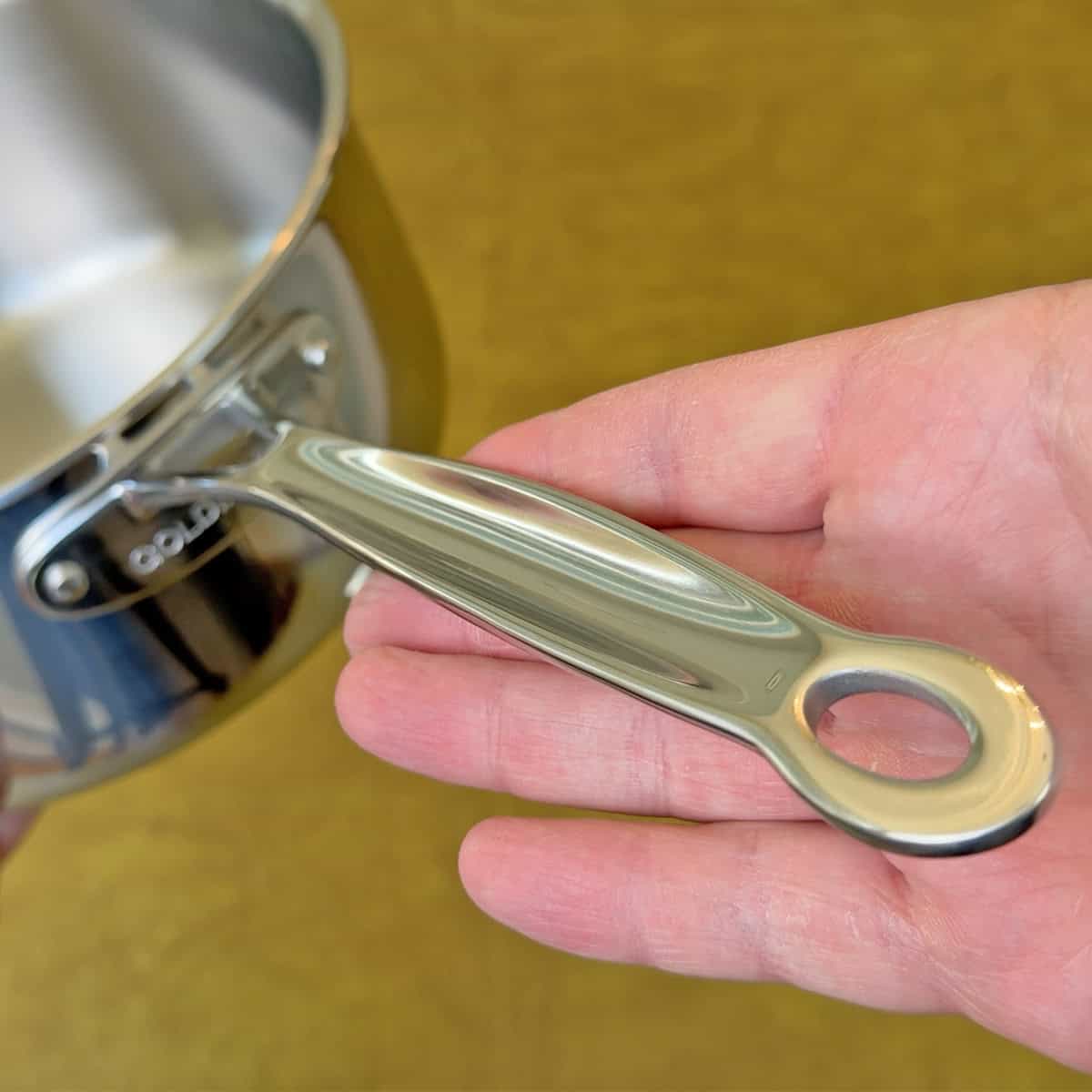
In my heat tests, it reached 486°F in the center after two minutes, the second highest surface temperature of any pan. But the difference between the center and edge was 117°F, the second largest gap I measured. That means the center gets hot fast, but the heat doesn’t spread as evenly across the base. The center-to-wall difference was 200°F, also on the high end.
It was the second fastest pan to boil on induction at 7:33, but finished 9th on electric at 6:48. The handle reached 85°F after 10 minutes of boiling, which is comfortable to grab. The lid is steel, and the 7-inch cooking surface is mid-range for the group.
For the price, this is a strong value pick with fast induction performance and a secure handle.
| Pan | Goldilocks |
| Where It’s Made | China |
| Construction | 3-ply, aluminum core |
| Capacity | 3 qt |
| Finish | Polished |
| Weight (without lid) | 2.5 lb |
| Cooking Surface | 7.0 in |
| Wall Height | 3.75 in |
| Handle Length | 7.5 in |
| Helper Handle | No |
| Sealed Rims | No |
| Rivets | Rivets |
| Lid Material | Steel |
| Conduction Test | 486°F — 2nd / 13 |
| Distribution Test | 117°F difference — 12th / 13 |
| Boil Time (Electric) | 6:48 — 9th / 13 |
| Boil Time (Induction) | 7:33 — 2nd / 13 |
| Handle Temp Test | 85°F — 10th / 13 |
| Where to Buy | CookGoldilocks.com |
Viking 3-Ply Classic
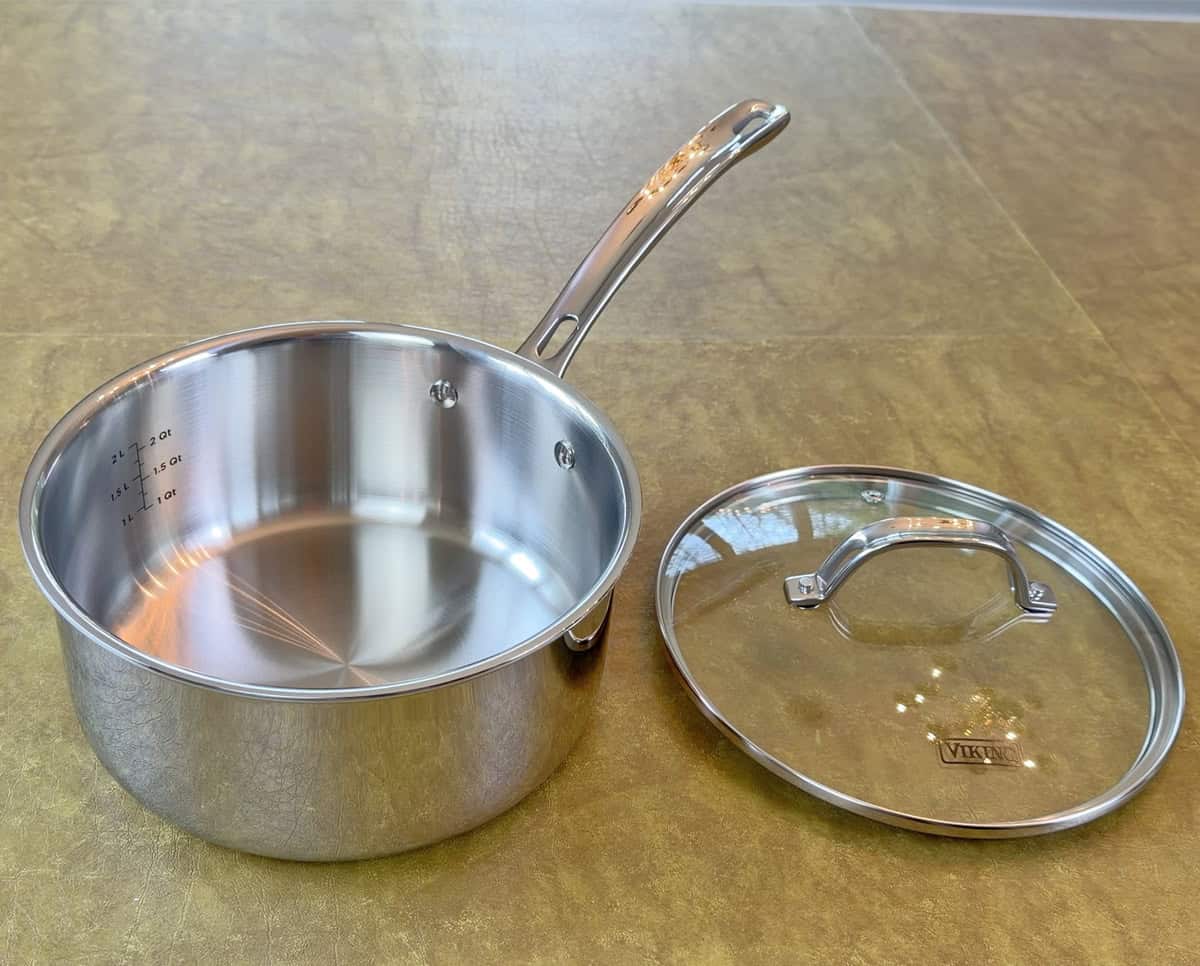
Viking 3-Ply Classic is a 3-ply aluminum core pan with a polished exterior and measurement markings on the inside. The handle reminds me of the All-Clad D3, but it’s curved instead of straight and the groove isn’t as deep, so it’s more comfortable. It still felt very secure during my pour tests, similar to the D3. At 2.6 lbs without the lid, it’s relatively light.
In my heat tests, it reached 541°F in the center after two minutes, the highest surface temperature of any pan. It was also the second fastest to boil on electric at 5:02, and finished 5th on induction at 7:55. The handle reached 82°F after boiling, and the pan was very responsive when removed from heat.
The center-to-edge difference was 114°F, which is large. And the center-to-wall difference of 245°F was the highest I measured. The base heats up fast, but the heat doesn’t spread as evenly across the surface or up the walls as some of the other pans.
My main complaint is the glass lid. The metal trim around the edge can trap water when you wash it, there’s a risk of it breaking, and when it fogs up you can’t see inside anyway.
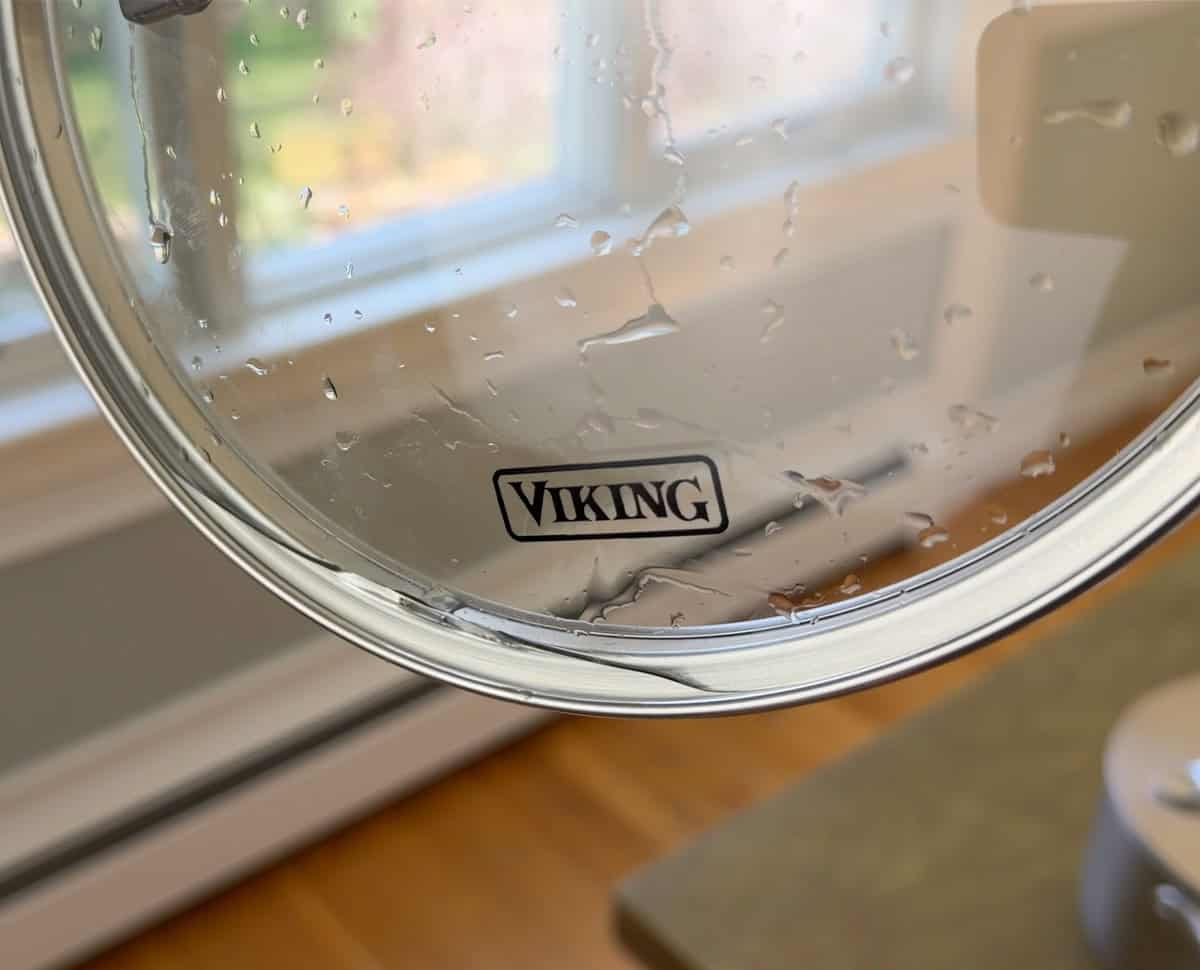
Steel lids are easier to clean, more durable, and lighter. You also can’t buy this pan on its own. It only comes as part of a set.
| Pan | Viking 3-Ply Classic |
| Where It’s Made | China |
| Construction | 3-ply, aluminum core |
| Capacity | 3 qt |
| Finish | Polished |
| Weight (without lid) | 2.6 lb |
| Cooking Surface | 7.0 in |
| Wall Height | 3.75 in |
| Handle Length | 7.5 in |
| Helper Handle | No |
| Sealed Rims | No |
| Rivets | Rivets |
| Lid Material | Glass |
| Conduction Test | 541°F — 1st / 13 |
| Distribution Test | 114°F difference — 11th / 13 |
| Boil Time (Electric) | 5:02 — 2nd / 13 |
| Boil Time (Induction) | 7:55 — 5th / 13 |
| Handle Temp Test | 82°F — 7th / 13 |
| Where to Buy | Viking’s website |
Legend
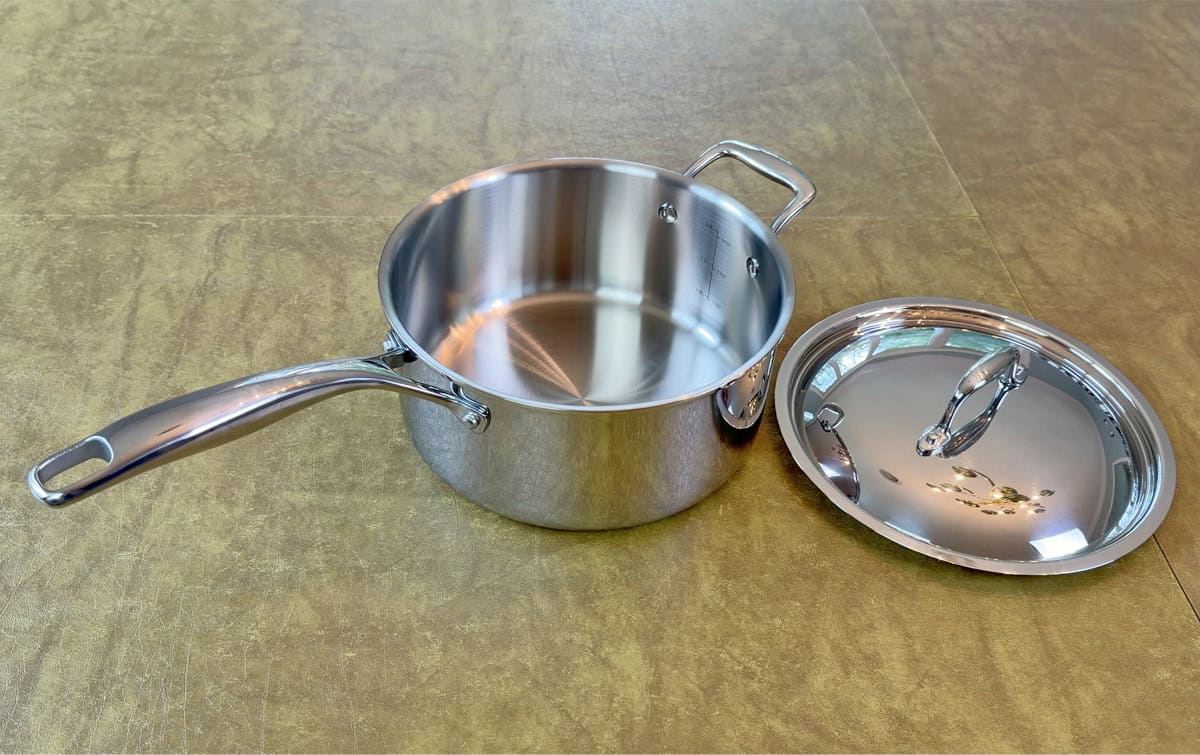
Legend is a 5-ply aluminum core saucepan with a polished exterior, measurement markings, a helper handle, and sealed rims, made in China. It weighs 3.4 lbs without the lid and is one of the larger pans in this group at 4 quarts.
Most stainless steel pans leave the aluminum core exposed around the edge. Over time, especially if you use the dishwasher, that aluminum can recede, causing the steel layers to become sharp or even separate. Sealed rims eliminate that risk entirely. It’s a nice feature at this price point.
In my heat tests, the center reached just 366°F after two minutes, the lowest of any pan. The center-to-edge difference was 61°F and the center-to-wall difference was 150°F, both middle of the pack. It boiled in 5:26 on electric (4th fastest) but was the slowest on induction at 10:00 flat. The handle stayed cool at 77°F after boiling.
The problem is the handle. It’s round, which is fine most of the time. With dry hands I could tilt and pour without any issues.
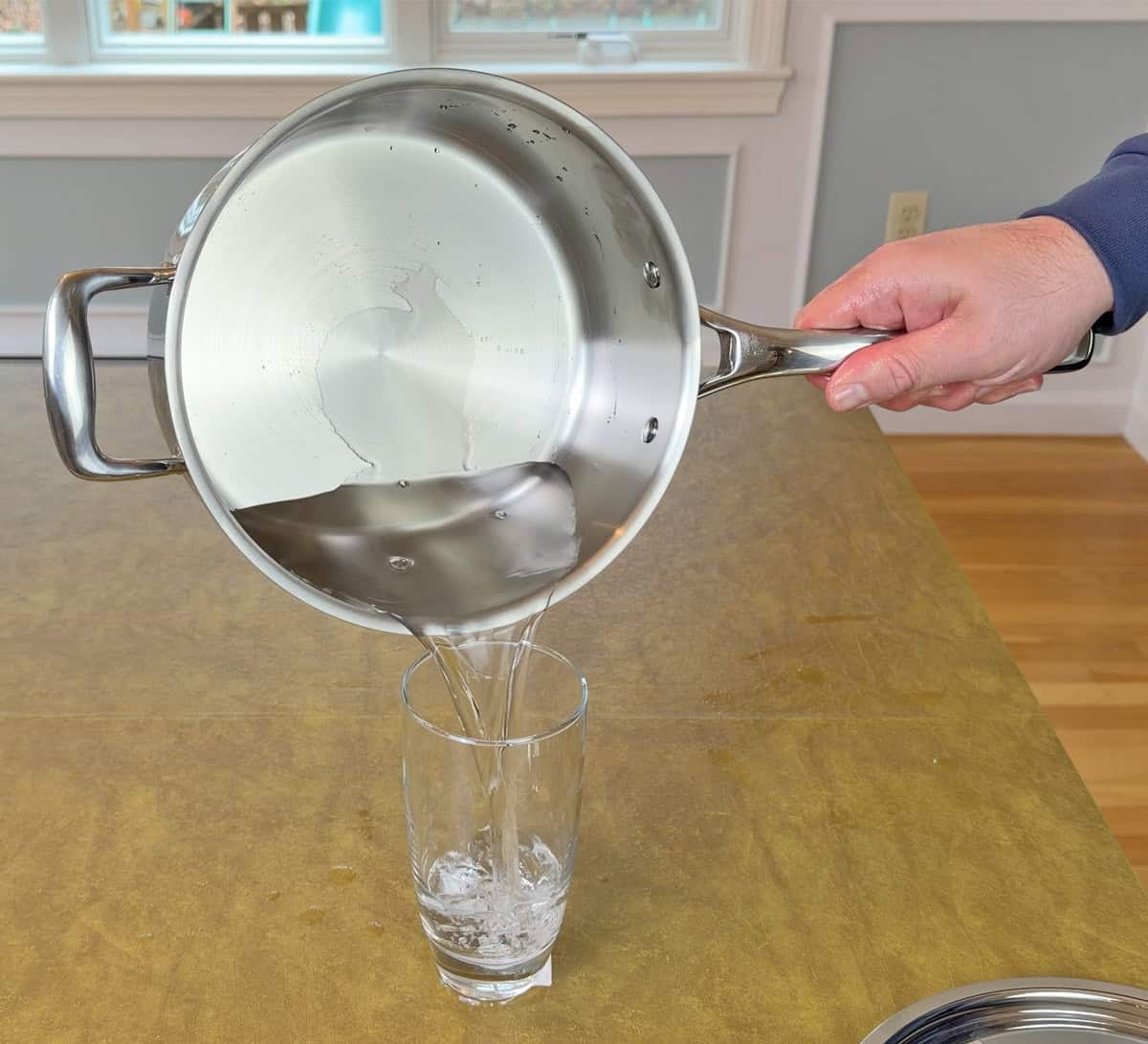
But when I put oil on my hands, the difference between a rounded handle like this and a grooved handle like the Viking was very noticeable. For a saucepan you’re tilting to pour boiling water or heavy sauces, that matters.
| Pan | Legend |
| Where It’s Made | China |
| Construction | 5-ply, aluminum core |
| Capacity | 4 qt |
| Finish | Polished |
| Weight (without lid) | 3.4 lb |
| Cooking Surface | 8.0 in |
| Wall Height | 4.0 in |
| Handle Length | 7.5 in |
| Helper Handle | Yes |
| Sealed Rims | Yes |
| Rivets | Rivets |
| Lid Material | Steel |
| Conduction Test | 366°F — 13th / 13 |
| Distribution Test | 61°F difference — 7th / 13 |
| Boil Time (Electric) | 5:26 — 4th / 13 |
| Boil Time (Induction) | 10:00 — 13th / 13 |
| Handle Temp Test | 77°F — 2nd / 13 |
| Where to Buy | Amazon |
Heritage Steel Eater Series
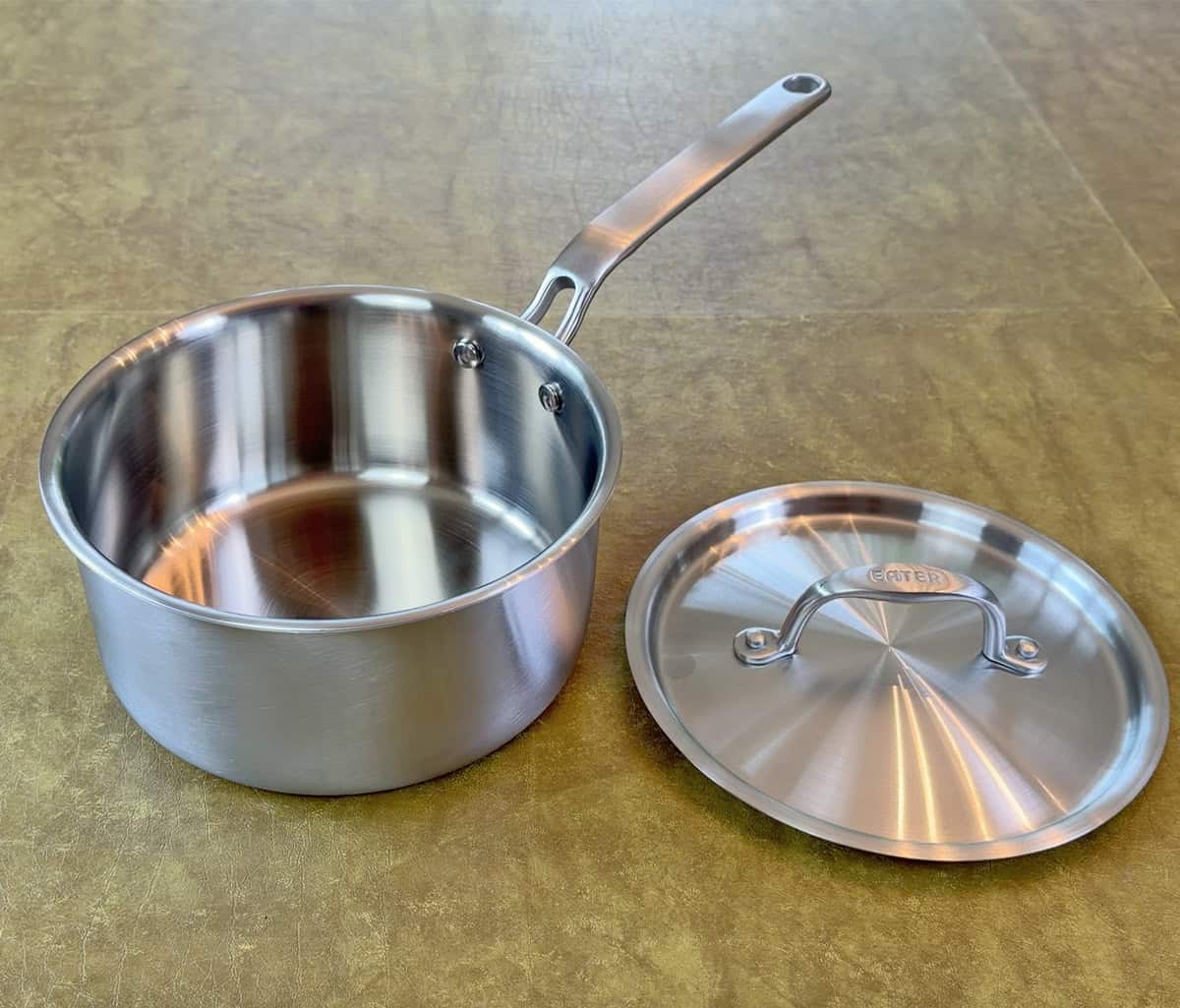
Heritage Steel Eater Series is a 5-ply aluminum core saucepan with a brushed exterior, made in Clarksville, Tennessee. I actually prefer a brushed finish over polished. Polished finishes look great at first, but over time they scratch and end up looking brushed anyway.
At just 2.2 lbs without the lid, it’s the lightest pan I tested, which makes it noticeably easier to clean and maneuver in the sink. The handle is 8 inches long and felt slightly slippery with oily hands. Not nearly as bad as the Legend, but I wish it was a little thicker with a slight groove on top.
It reached 469°F in the center after two minutes (4th highest), with a center-to-edge gap of 96°F and a center-to-wall gap of 189°F. It finished 10th on electric at 6:53 and 7th on induction at 8:10.
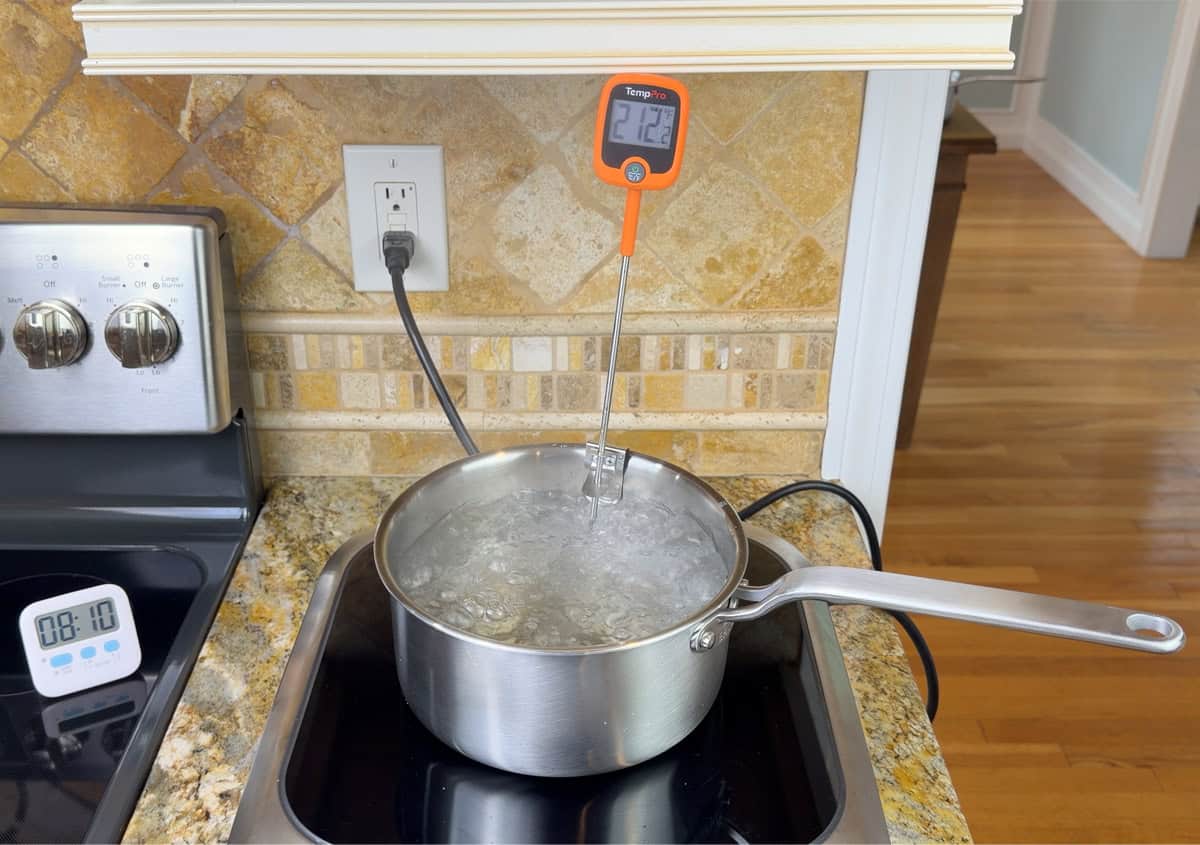
The handle reached 91°F after 10 minutes of boiling, the second warmest after Caraway. That’s still cool enough to grab comfortably, but it runs warmer than most of the other pans (the group ranges from 76°F to 101°F).
One thing to know: the rivets stick out on the inside more than any other pan I tested. It’s not a big deal, but over time they can collect more buildup and grease, and they’re a little harder to clean around.
| Pan | Heritage Steel Eater Series |
| Where It’s Made | Clarksville, TN, USA |
| Construction | 5-ply, aluminum core |
| Capacity | 3 qt |
| Finish | Brushed |
| Weight (without lid) | 2.2 lb |
| Cooking Surface | 6.75 in |
| Wall Height | 3.6 in |
| Handle Length | 8.0 in |
| Helper Handle | No |
| Sealed Rims | No |
| Rivets | Rivets |
| Lid Material | Steel |
| Conduction Test | 469°F — 4th / 13 |
| Distribution Test | 96°F difference — 11th / 13 |
| Boil Time (Electric) | 6:53 — 10th / 13 |
| Boil Time (Induction) | 8:10 — 7th / 13 |
| Handle Temp Test | 91°F — 12th / 13 |
| Where to Buy | HeritageSteel.us |
Caraway
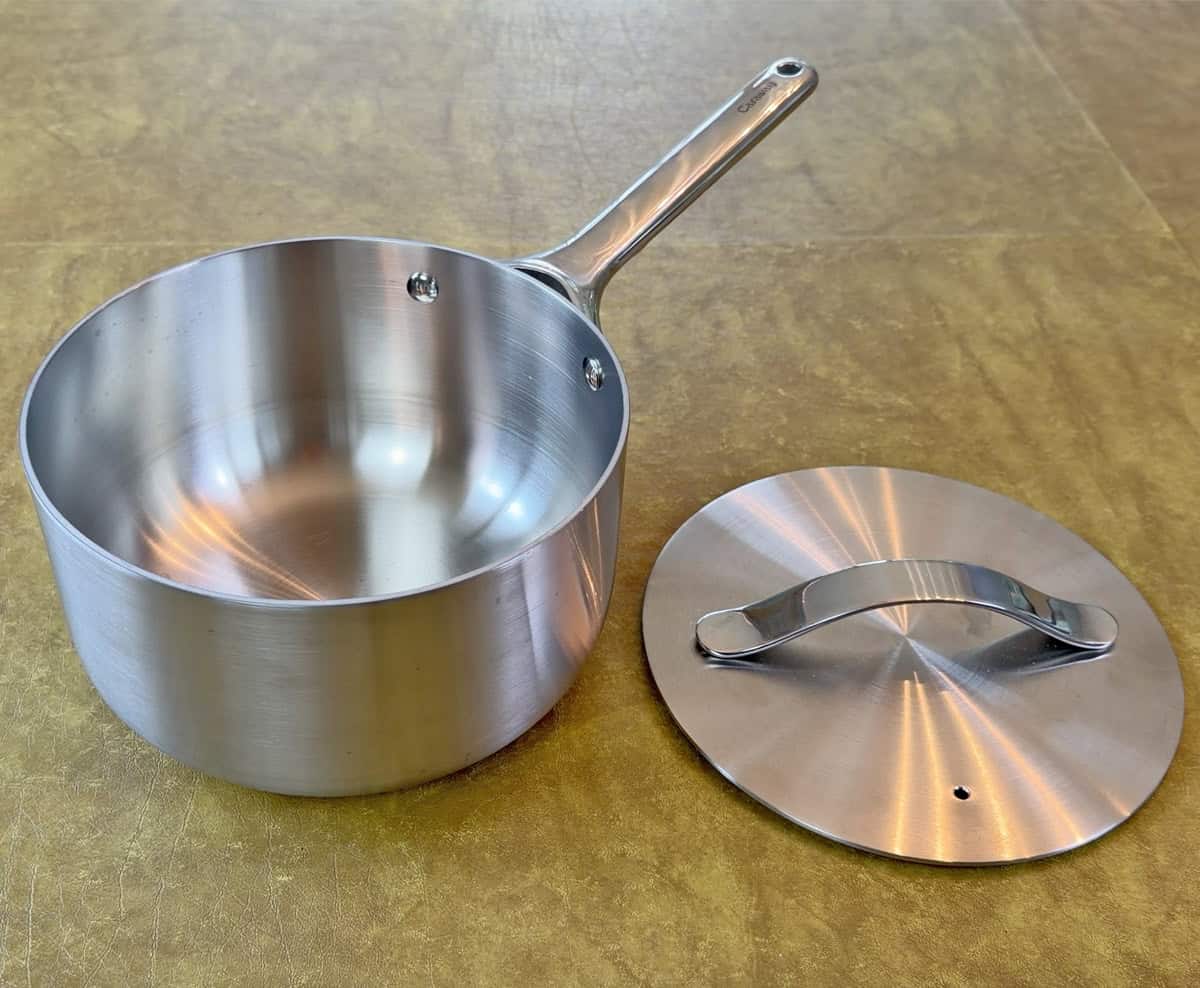
Caraway is a 5-ply aluminum core saucepan with a brushed exterior and a modern design. The bottom is more rounded than the others, which makes it the easiest pan to reach the corners with a whisk. The lid is flat with a handle that spans all the way across, which looks cool but is hard to clean under. It’s also by far the heaviest lid I tested (the pan weighs 2.6 lbs without it and 4.1 lbs with it).
This is the only pan without flared rims, so when I poured oil it dripped down the sides.
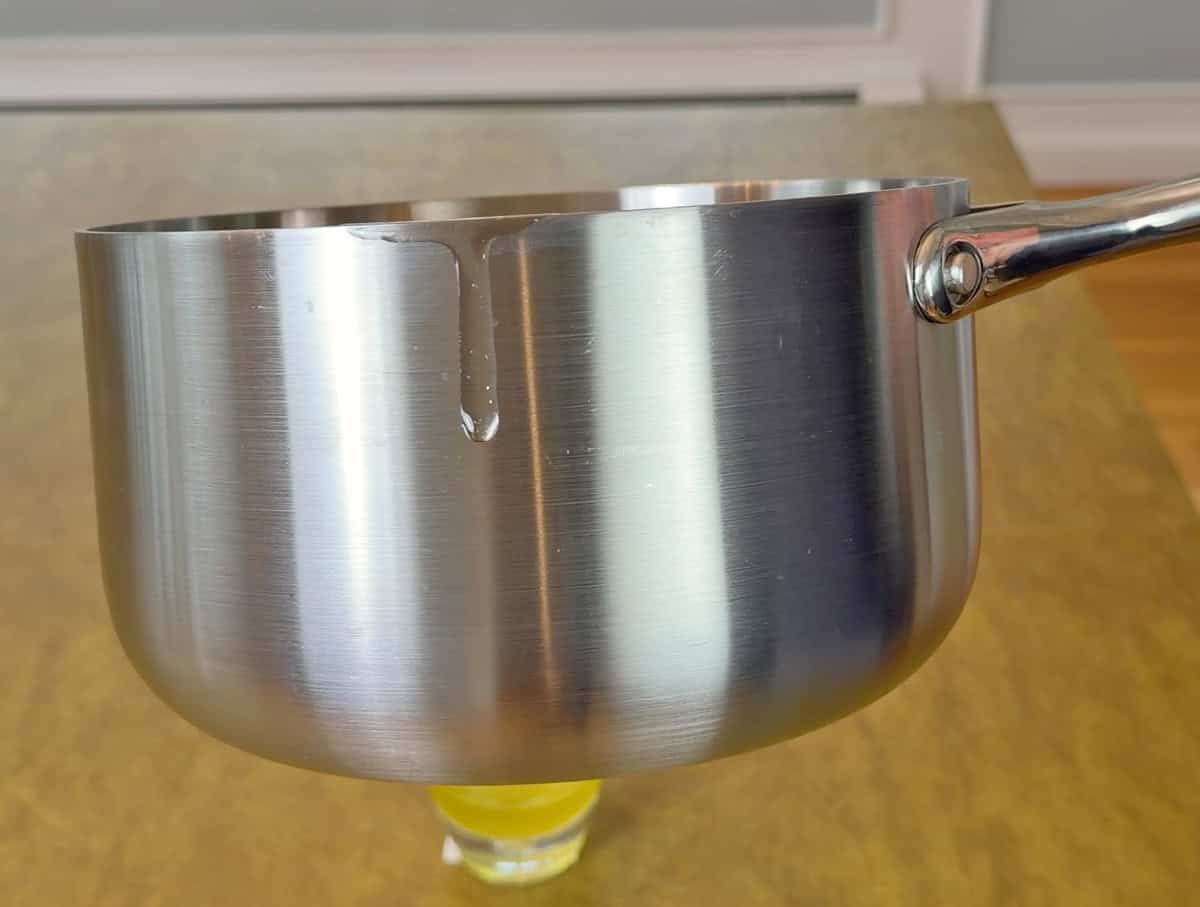
The handle is round and slippery with oily hands, and after 10 minutes of boiling it reached 101°F, the hottest handle of any pan by a wide margin. The next warmest was Heritage Steel at 91°F. 101°F is still not too hot to touch, just noticeably warmer.
In my heat tests, it reached 434°F in the center (10th out of 13) with a center-to-edge difference of 91°F. It was the slowest to boil on electric at 9:00, but jumped to 4th on induction at 7:54. The 6.25-inch cooking surface diameter is on the smaller side, and the walls are 4.25 inches tall.
It also annoys me that they don’t print the capacity on the bottom of the pan.
| Pan | Caraway |
| Where It’s Made | China |
| Construction | 5-ply, aluminum core |
| Capacity | 3 qt |
| Finish | Brushed |
| Weight (without lid) | 2.6 lb |
| Cooking Surface | 6.25 in |
| Wall Height | 4.25 in |
| Handle Length | 7.25 in |
| Helper Handle | No |
| Sealed Rims | No |
| Rivets | Rivets |
| Lid Material | Steel |
| Conduction Test | 434°F — 10th / 13 |
| Distribution Test | 91°F difference — 10th / 13 |
| Boil Time (Electric) | 9:00 — 12th / 13 |
| Boil Time (Induction) | 7:54 — 4th / 13 |
| Handle Temp Test | 101°F — 13th / 13 |
| Where to Buy | Amazon |
Made In
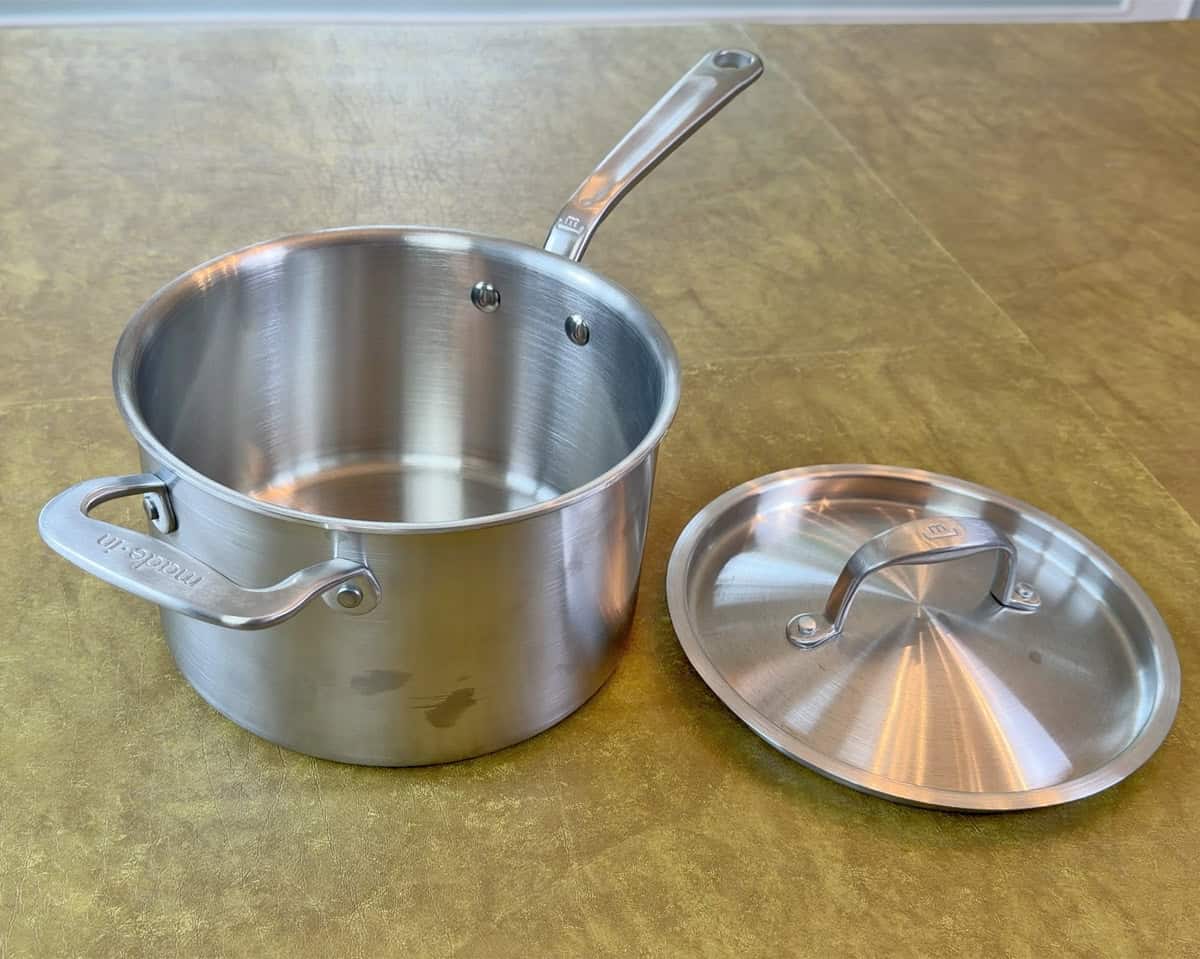
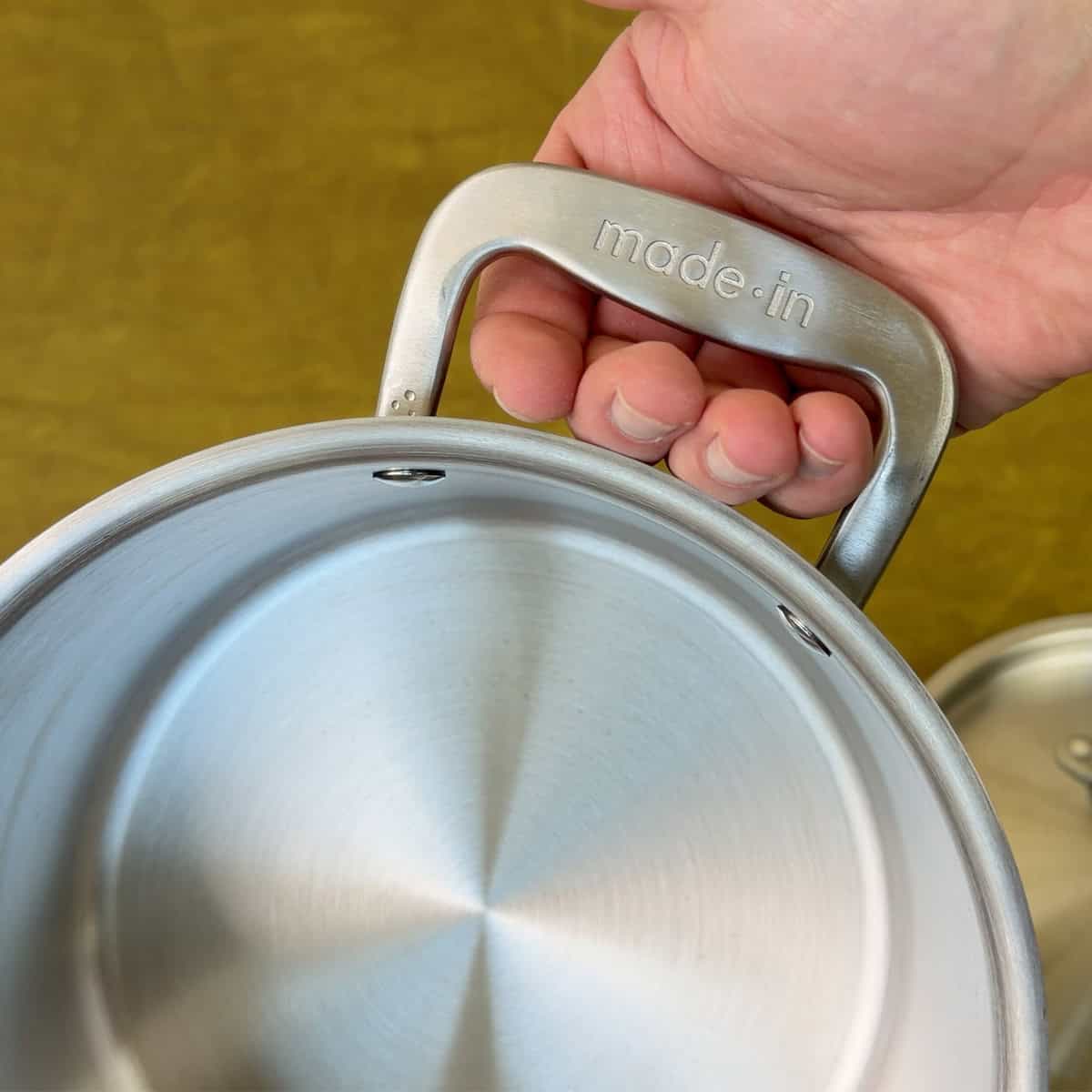
Made In is a 5-ply aluminum core pan with a brushed exterior. It’s made in Italy. At 4 quarts with 5-inch walls, it has the tallest walls of any pan I tested. The handle is 8.25 inches long, comfortable, and secure during my pour tests. The helper handle is huge, with a wide enough gap to easily fit four fingers even with an oven mitt. The lid handle is also large and easy to grab.
In my heat tests, the center-to-edge difference was just 38°F, the second smallest gap of any pan. Heat spreads across the base very evenly. The center reached 391°F, which is lower than most, but for a 4-quart pan with a larger 7.5-inch cooking surface, that’s expected. What matters more is how evenly that heat distributes, and Made In was excellent there.
It was the fastest pan to boil on induction at 6:23, beating the next closest (Goldilocks at 7:33) by over a minute. On electric it finished 8th at 6:32. The handle reached 80°F after boiling, and the pan weighs 3.1 lbs without the lid.
| Pan | Made In |
| Where It’s Made | Italy |
| Construction | 5-ply, aluminum core |
| Capacity | 4 qt |
| Finish | Brushed |
| Weight (without lid) | 3.1 lb |
| Cooking Surface | 7.5 in |
| Wall Height | 5.0 in |
| Handle Length | 8.25 in |
| Helper Handle | Yes |
| Sealed Rims | No |
| Rivets | Rivets |
| Lid Material | Steel |
| Conduction Test | 391°F — 11th / 13 |
| Distribution Test | 38°F difference — 2nd / 13 |
| Boil Time (Electric) | 6:32 — 8th / 13 |
| Boil Time (Induction) | 6:23 — 1st / 13 |
| Handle Temp Test | 80°F — 5th / 13 |
| Where to Buy | MadeInCookware.com |
All-Clad D3
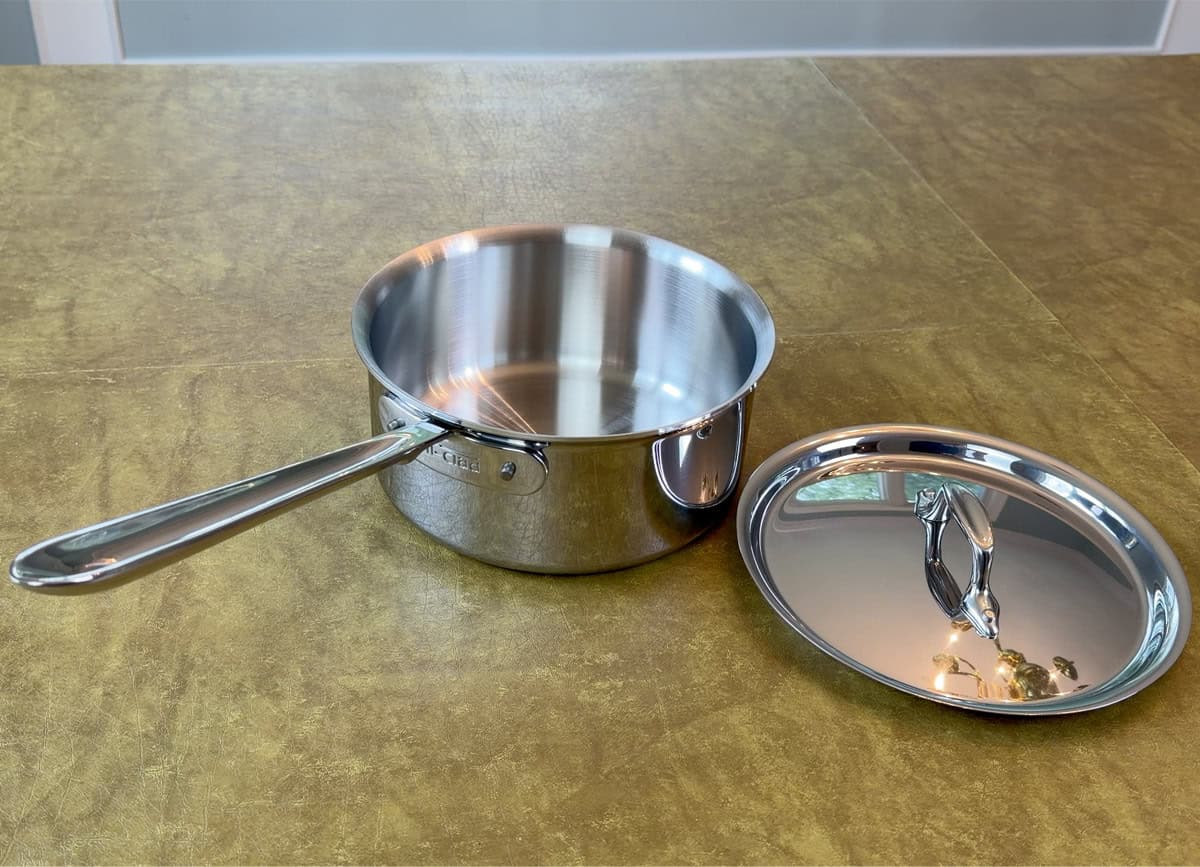
All-Clad D3 is a 3-ply aluminum core saucepan with a polished exterior and flared rims. The center-to-edge temperature difference was just 48°F, the third smallest of any pan. It reached 452°F in the center after two minutes and boiled in 6:04 on electric (6th) and 7:48 on induction (3rd).
The standout feature is the handle. At 9 inches, it’s the second longest I tested (behind the Copper Core at 9.25 inches). It stayed the coolest of any pan at just 76°F after 10 minutes of boiling. And the deep groove on top really locks your hand in place. Even with oily hands or an oven mitt, this handle is not slipping.
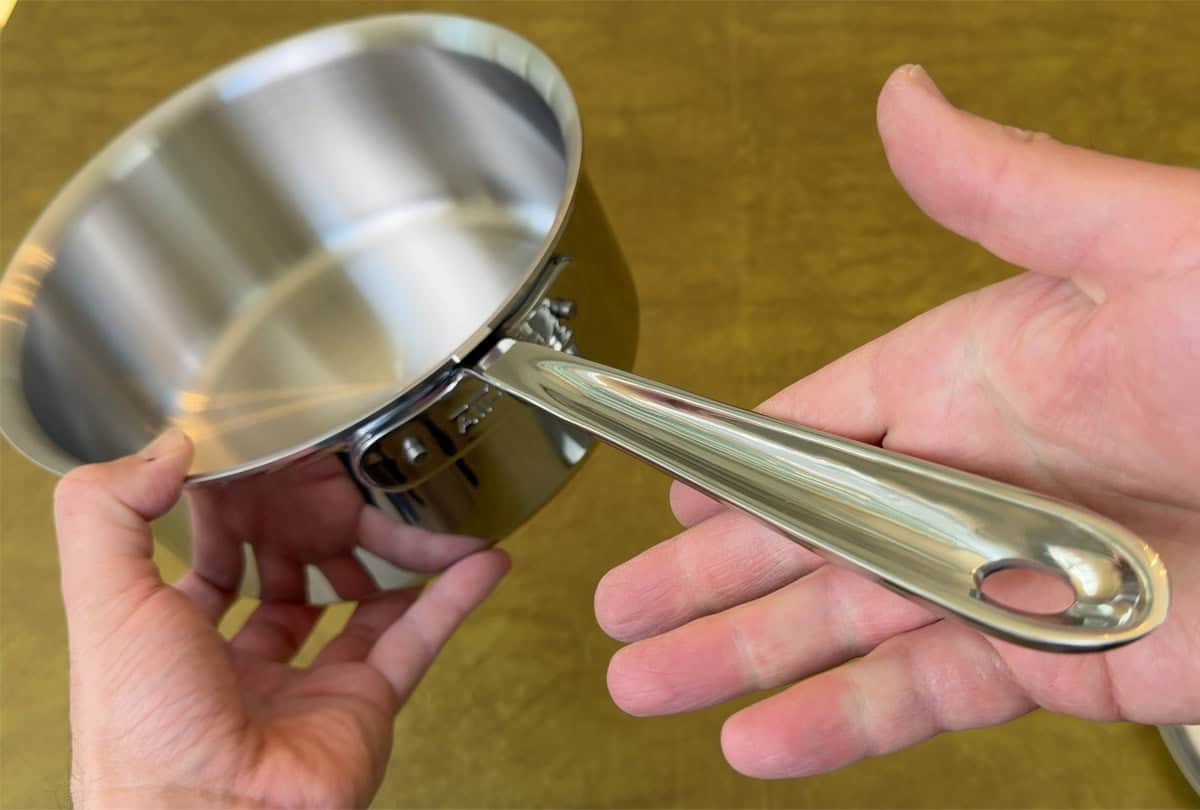
This level of grip may not be necessary on a frying pan, but I really appreciate it on a saucepan. When you’re pouring boiling water or tilting a pot full of sauce, a secure handle isn’t just a preference. It’s a safety feature.
The downside is comfort. The edges of that deep groove can dig into your hand, which is the most common complaint about the D3 collection. But for a saucepan, the safety is worth the tradeoff.
It weighs 2.9 lbs without the lid. One note on responsiveness: it took 2 to 3 seconds longer than most other pans for the boiling to fully stop after removing from heat. Not a major issue, but worth noting if responsiveness is a priority.
| Pan | All-Clad D3 |
| Where It’s Made | Canonsburg, PA, USA |
| Construction | 3-ply, aluminum core |
| Capacity | 3 qt |
| Finish | Polished |
| Weight (without lid) | 2.9 lb |
| Cooking Surface | 7.25 in |
| Wall Height | 3.75 in |
| Handle Length | 9.0 in |
| Helper Handle | No |
| Sealed Rims | No |
| Rivets | Rivets |
| Lid Material | Steel |
| Conduction Test | 452°F — 7th / 13 |
| Distribution Test | 48°F difference — 3rd / 13 |
| Boil Time (Electric) | 6:04 — 6th / 13 |
| Boil Time (Induction) | 7:48 — 3rd / 13 |
| Handle Temp Test | 76°F — 1st / 13 |
| Where to Buy | Amazon |
All-Clad D3 Everyday
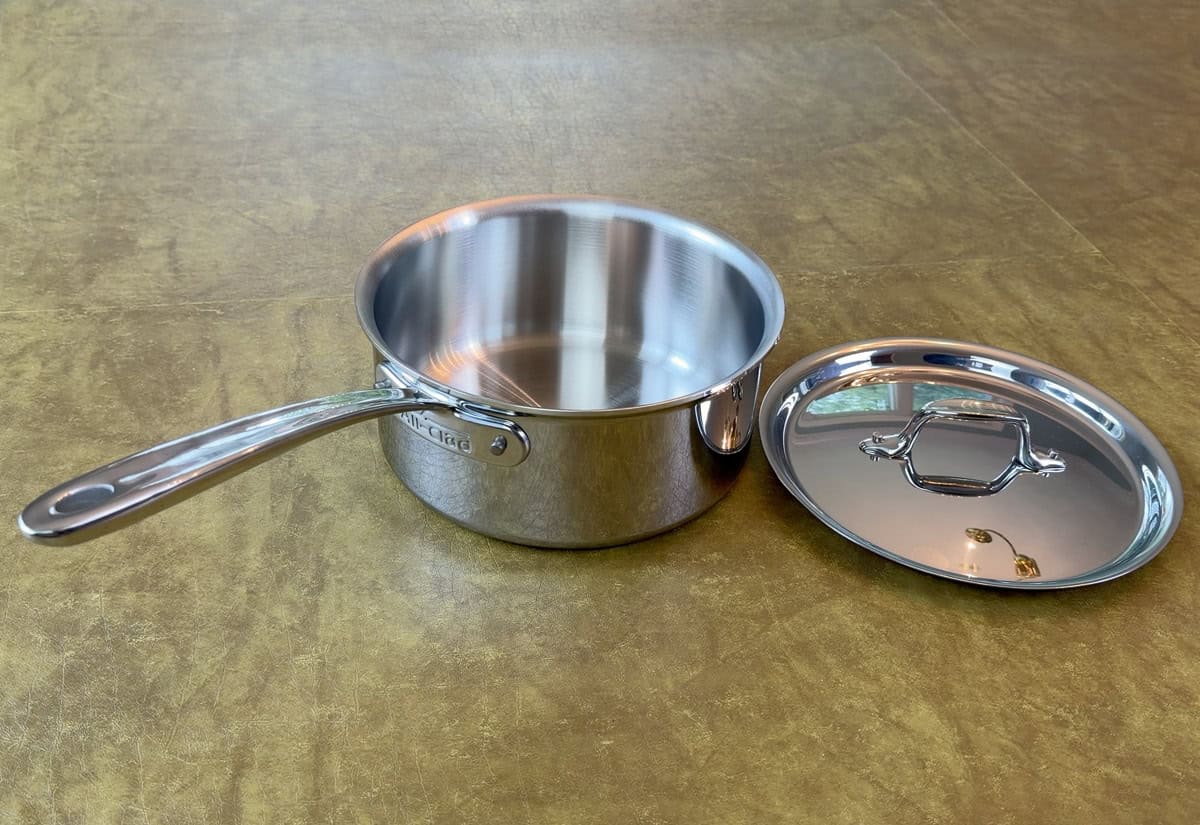
All-Clad D3 Everyday is the same saucepan, same lid, and same price as the All-Clad D3. The only difference is the handle. The groove is more subtle and the edges are smoother, so it’s more comfortable to hold. It’s still more secure than the fully rounded handles on pans like Legend and Caraway, but your hand is not as locked in place as the standard D3.
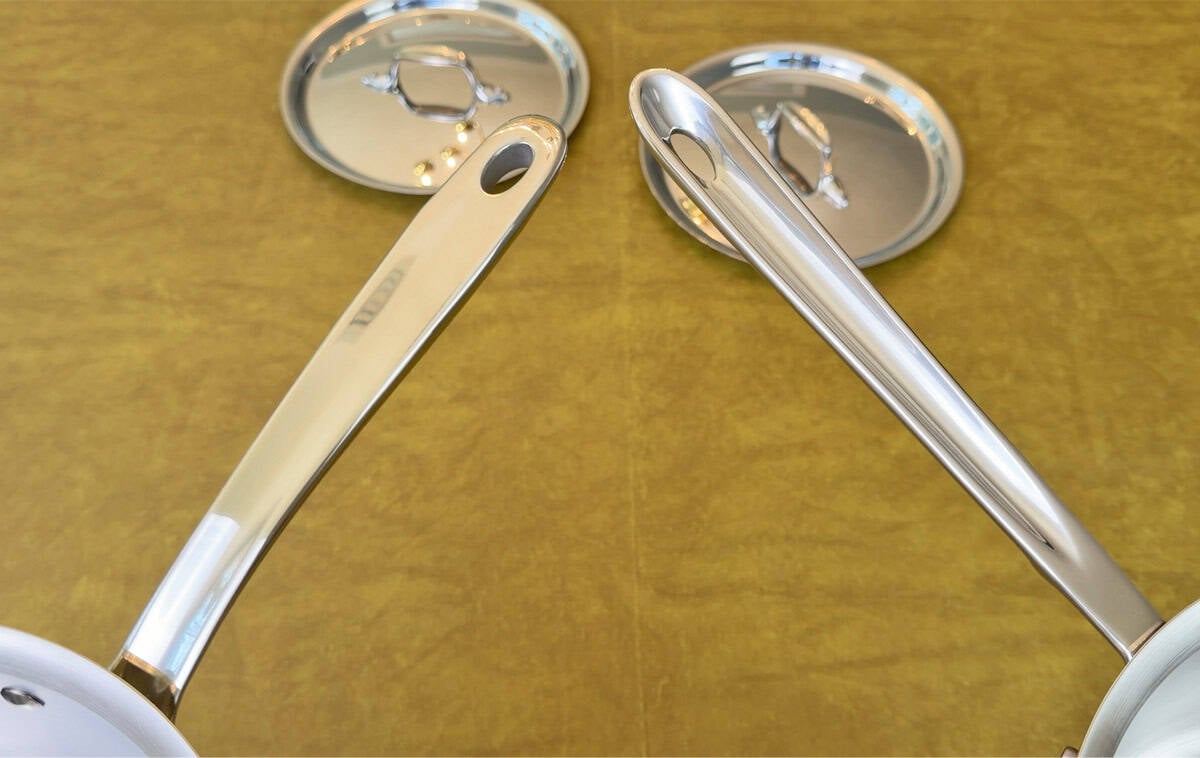
The heat numbers were close to the D3: 439°F center temp, 51°F center-to-edge gap, and boil times of 6:31 on electric and 8:15 on induction. The handle reached 82°F after boiling. It weighs 2.6 lbs without the lid, slightly lighter than the D3. Like the standard D3, responsiveness was a couple of seconds slower than most pans.
If you like the idea of All-Clad D3 but the handle comfort is a dealbreaker, this is the answer.
| Pan | All-Clad D3 Everyday |
| Where It’s Made | Canonsburg, PA, USA |
| Construction | 3-ply, aluminum core |
| Capacity | 3 qt |
| Finish | Polished |
| Weight (without lid) | 2.6 lb |
| Cooking Surface | 7.25 in |
| Wall Height | 3.75 in |
| Handle Length | 7.5 in |
| Helper Handle | No |
| Sealed Rims | No |
| Rivets | Rivets |
| Lid Material | Steel |
| Conduction Test | 439°F — 9th / 13 |
| Distribution Test | 51°F difference — 4th / 13 |
| Boil Time (Electric) | 6:31 — 7th / 13 |
| Boil Time (Induction) | 8:15 — 9th / 13 |
| Handle Temp Test | 82°F — 7th / 13 |
| Where to Buy | All-Clad.com |
Demeyere Industry
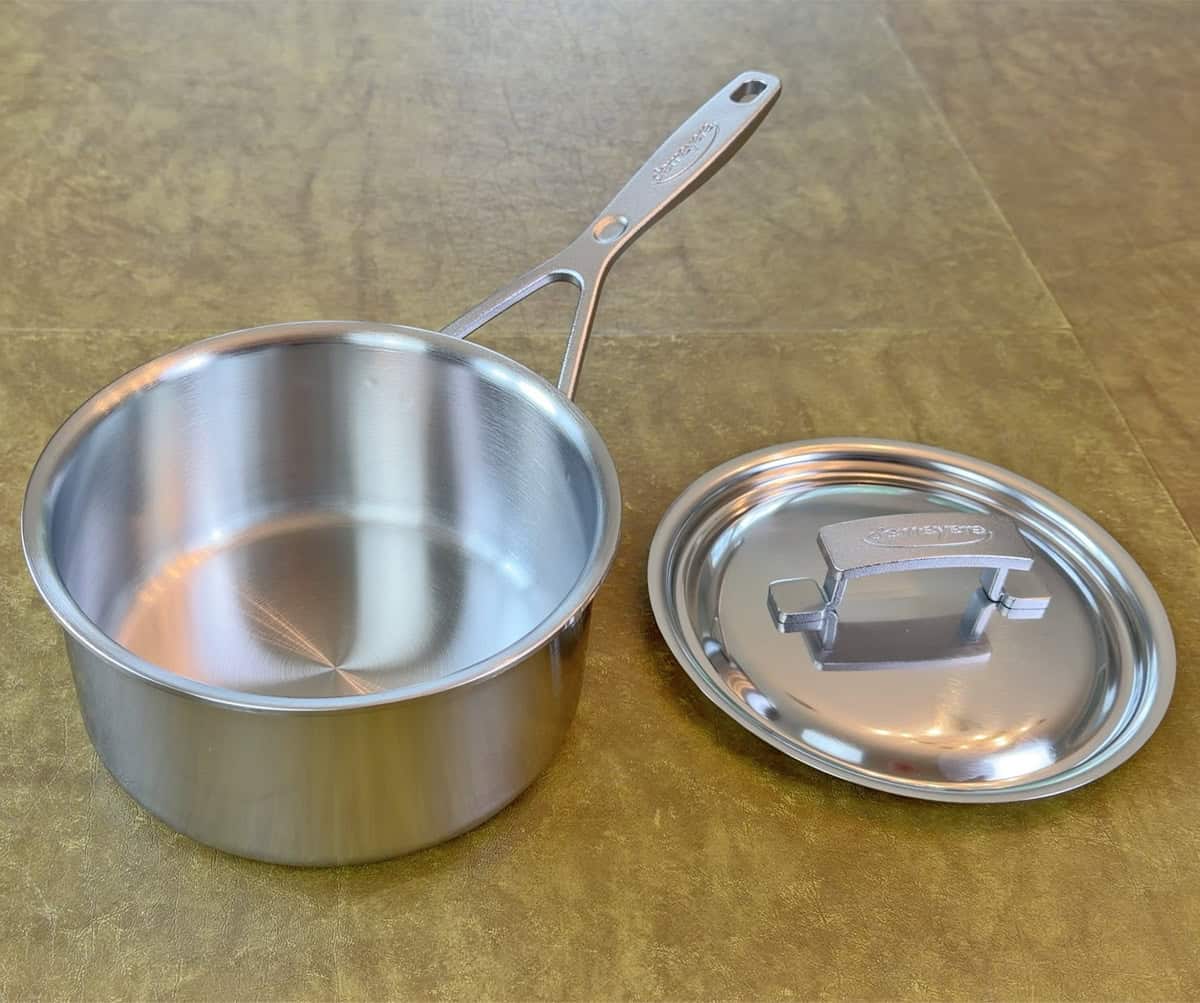
Demeyere Industry is the smallest pan I tested at just 2.25 quarts. It’s a 5-ply aluminum core pan made in Belgium with a brushed exterior, sealed rims, and a completely rivetless interior. The pans without rivets (Demeyere Industry, Demeyere Atlantis, and Fissler) are slightly easier to clean on the inside, but the difference isn’t huge.
The handle is flat with a slightly rough texture that keeps it secure, even with oily hands. It also has a wide fork at the base that disperses heat and keeps it cool (84°F after boiling). The lid handle has a boxy design, and you can only really fit three fingers comfortably.
In my heat tests, the center-to-wall temperature difference was 125°F, the lowest of any pan. The center-to-edge gap was 52°F. But those numbers are likely influenced by the smaller size. It was the slowest to boil on electric at 9:39 and finished 6th on induction at 7:58. At 2.6 lbs without the lid, it’s light for a 5-ply pan. The 6.5-inch cooking surface is the smallest I tested.
| Pan | Demeyere Industry |
| Where It’s Made | Belgium |
| Construction | 5-ply, aluminum core |
| Capacity | 2.25 qt |
| Finish | Brushed |
| Weight (without lid) | 2.6 lb |
| Cooking Surface | 6.5 in |
| Wall Height | 3.5 in |
| Handle Length | 8.0 in |
| Helper Handle | No |
| Sealed Rims | Yes |
| Rivets | Rivetless |
| Lid Material | Steel |
| Conduction Test | 378°F — 12th / 13 |
| Distribution Test | 52°F difference — 5th / 13 |
| Boil Time (Electric) | 9:39 — 13th / 13 |
| Boil Time (Induction) | 7:58 — 6th / 13 |
| Handle Temp Test | 84°F — 9th / 13 |
| Where to Buy | Amazon |
Fissler M5 Pro-Ply
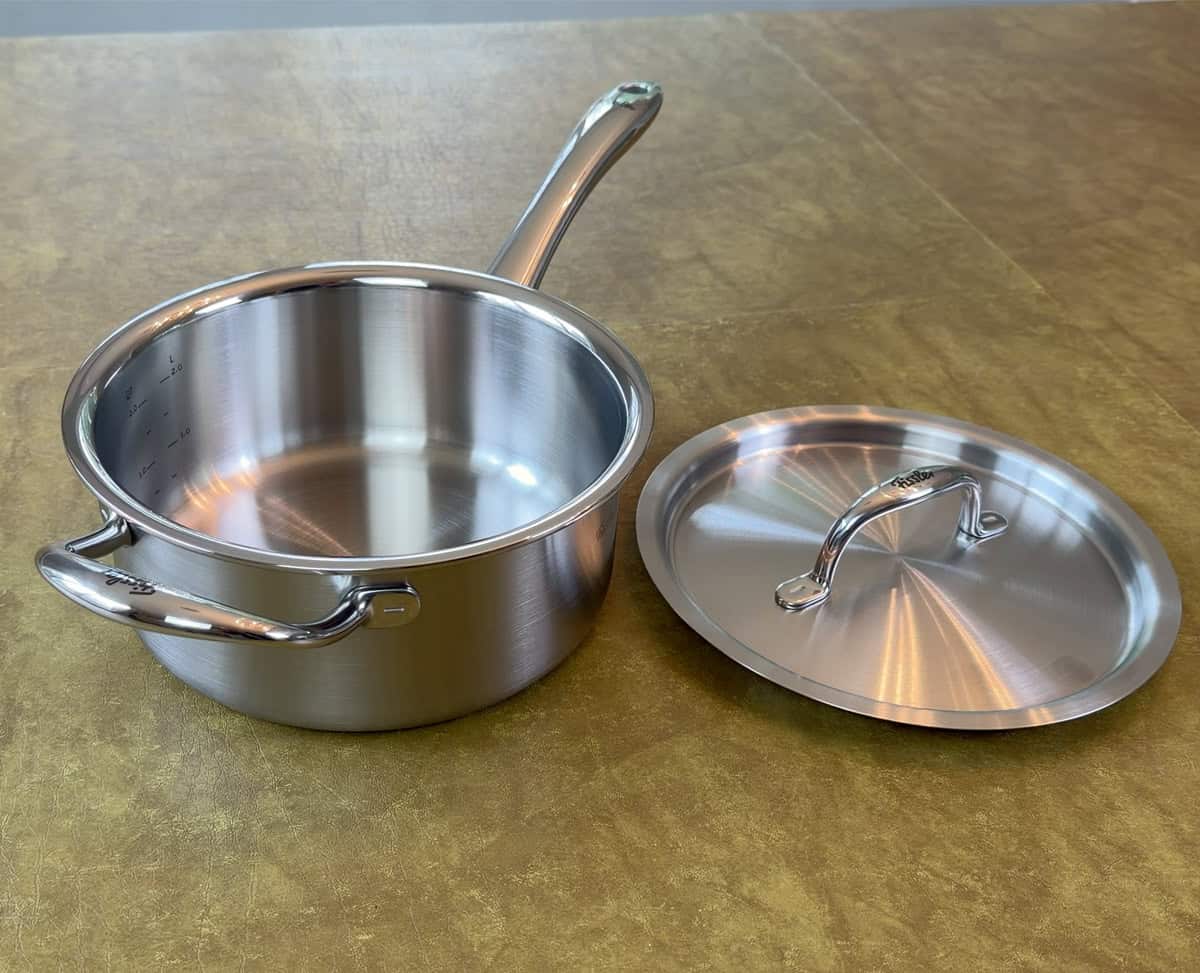
Fissler M5 Pro-Ply is a 5-ply aluminum core saucepan made in Germany with a brushed exterior, sealed rims, no rivets anywhere, and measurement markings on the inside. It has a large helper handle and very flared rims that kept oil from dripping down the sides. This and All-Clad Copper Core are the only 3-quart saucepans I tested with a helper handle.
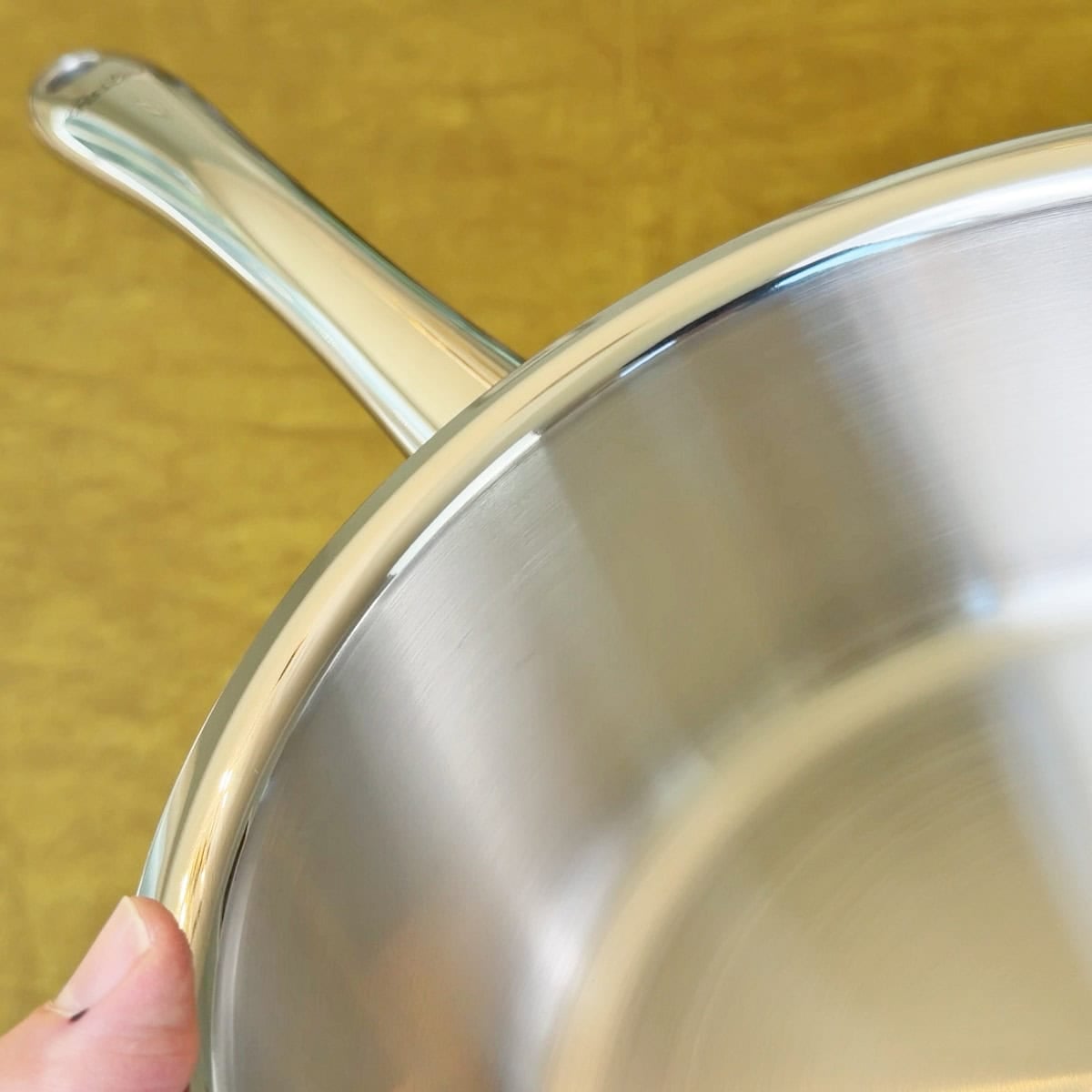
The problem is the main handle. It’s very round and slippery when you tilt the pan with oily hands.
In my heat tests, it reached 445°F in the center with a center-to-edge gap of 73°F. It was one of the slowest to boil on both electric (7:33, 11th) and induction (8:56, 12th). The handle stayed cool at 78°F and the pan weighs 3.0 lbs without the lid. The handle length is 8.5 inches.
This is a well-built pan that feels solid in hand, but the handle undermines it. At this price, there are better options.
| Pan | Fissler M5 Pro-Ply |
| Where It’s Made | Germany |
| Construction | 5-ply, aluminum core |
| Capacity | 3 qt |
| Finish | Brushed |
| Weight (without lid) | 3.0 lb |
| Cooking Surface | 7.0 in |
| Wall Height | 3.5 in |
| Handle Length | 8.5 in |
| Helper Handle | Yes |
| Sealed Rims | Yes |
| Rivets | Rivetless |
| Lid Material | Steel |
| Conduction Test | 445°F — 8th / 13 |
| Distribution Test | 73°F difference — 9th / 13 |
| Boil Time (Electric) | 7:33 — 11th / 13 |
| Boil Time (Induction) | 8:56 — 12th / 13 |
| Handle Temp Test | 78°F — 3rd / 13 |
| Where to Buy | Amazon |
All-Clad Copper Core
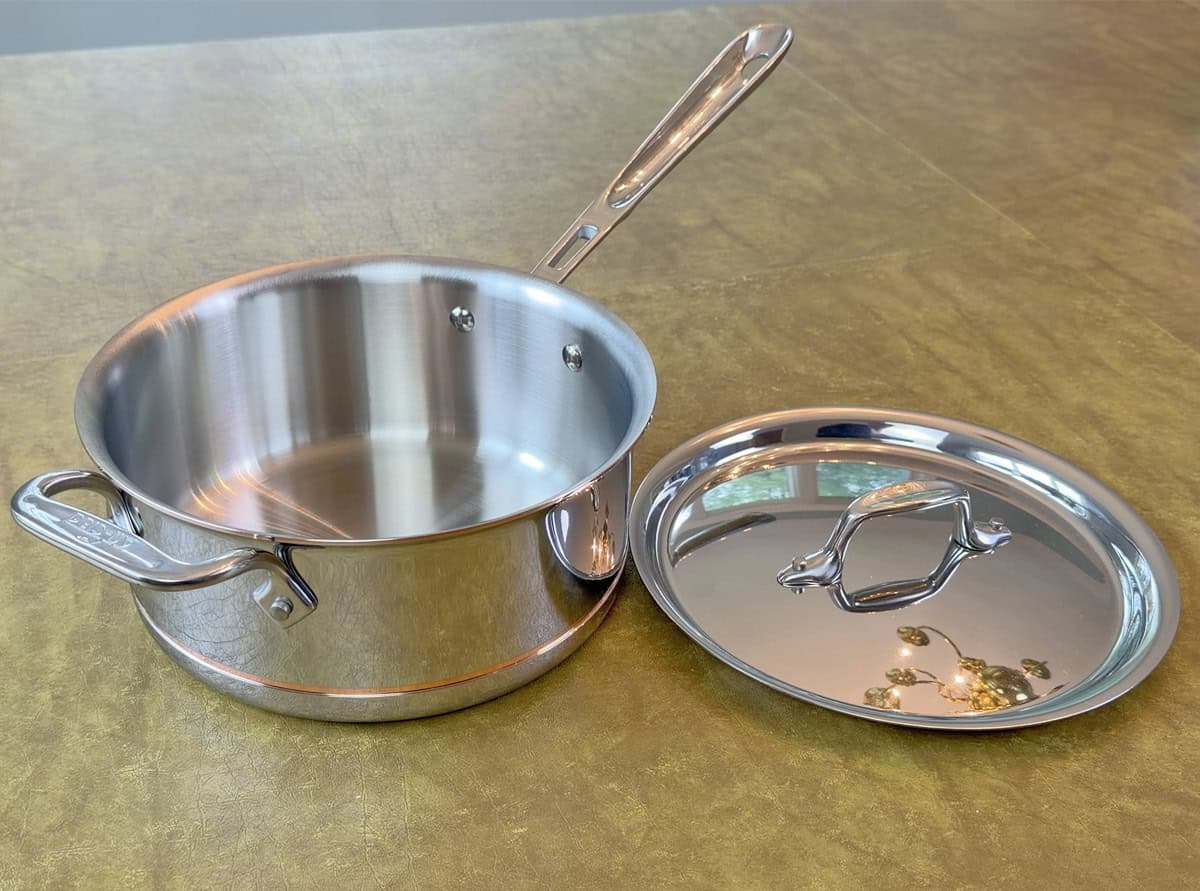
All-Clad Copper Core has a polished exterior, flared rims, and an elegant copper ring around the bottom. It has the same cup-shaped handle as the All-Clad D3, with a cutout to disperse heat. At 9.25 inches, it’s the longest handle of any pan I tested. Same deep groove and secure grip as the D3. This pan and Fissler are the only 3-quart saucepans I tested with a helper handle.
The main feature is the copper core. Copper conducts heat faster than aluminum, so in theory this pan should heat faster and be more responsive. Copper is also heavier, which is why this pan is tied for the heaviest I tested at 4.3 lbs with the lid (same as Legend and Demeyere Atlantis), and 3.5 lbs without.
In my heat tests, it reached 460°F in the center with a 61°F center-to-edge gap. It boiled in 5:45 on electric (5th) and 8:50 on induction (11th). The handle reached 81°F after boiling.
I didn’t see the performance advantage across my tests or in real-world cooking. It’s a high-end looking pan, and it performs well, but the difference between this and the aluminum core pans isn’t noticeable enough to justify the significant premium over the D3.
| Pan | All-Clad Copper Core |
| Where It’s Made | Canonsburg, PA, USA |
| Construction | 5-ply, copper core |
| Capacity | 3 qt |
| Finish | Polished |
| Weight (without lid) | 3.5 lb |
| Cooking Surface | 7.5 in |
| Wall Height | 3.75 in |
| Handle Length | 9.25 in |
| Helper Handle | Yes |
| Sealed Rims | No |
| Rivets | Rivets |
| Lid Material | Steel |
| Conduction Test | 460°F — 6th / 13 |
| Distribution Test | 61°F difference — 7th / 13 |
| Boil Time (Electric) | 5:45 — 5th / 13 |
| Boil Time (Induction) | 8:50 — 11th / 13 |
| Handle Temp Test | 81°F — 6th / 13 |
| Where to Buy | Amazon |
Demeyere Atlantis
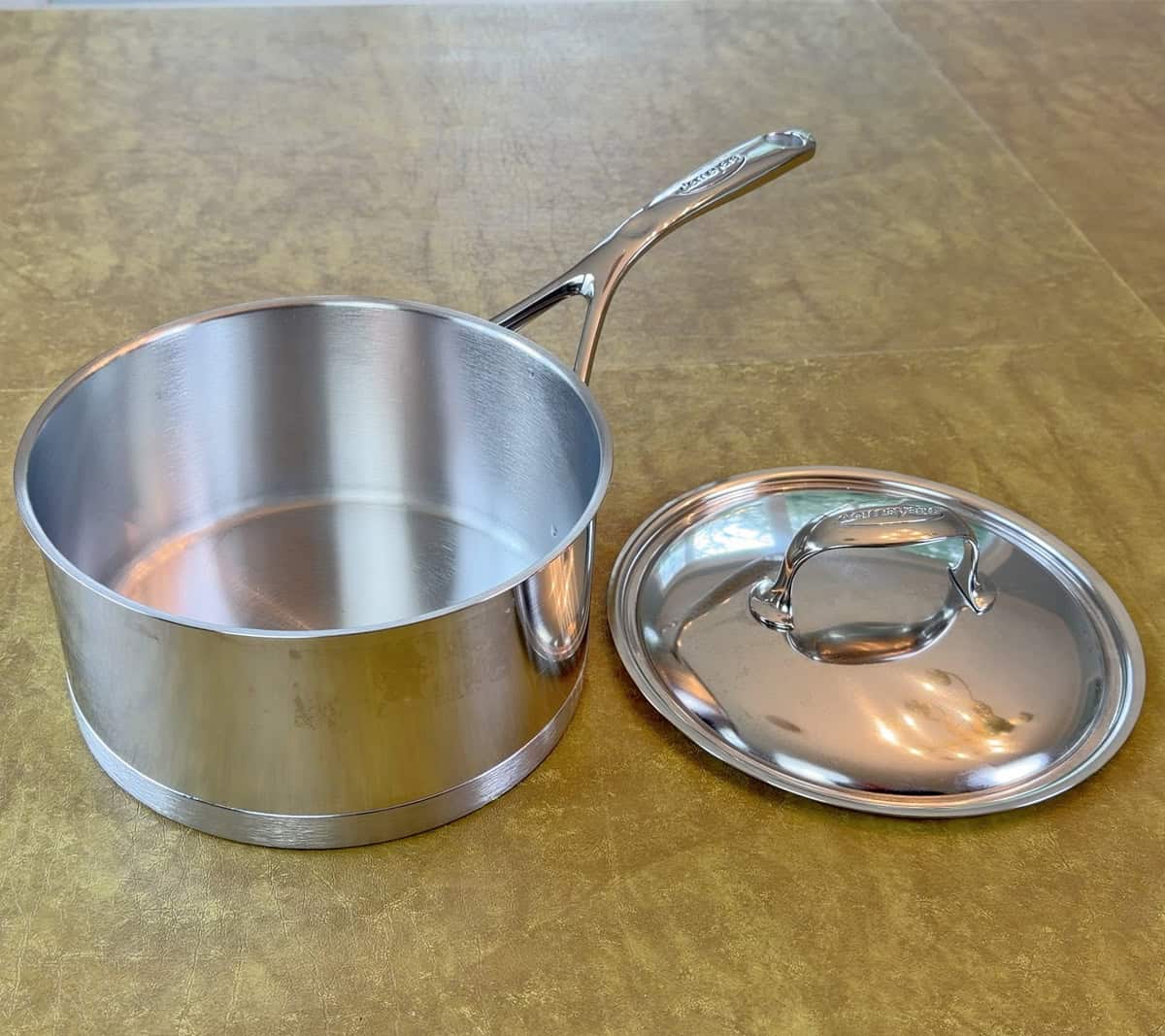
Demeyere Atlantis saucepan has a unique two-toned brushed exterior and rivetless welded handles. It has a thick 7-ply base that sits perfectly flat on the cooktop and thin single-ply steel walls. This is the only disc-base design in the group. The conductive layers are in the base only, not the walls.
Because of the thick base, the temperature was the most even between the center and edge. The edge actually measured 490°F compared to 479°F in the center, making it the only pan where the edge was hotter than the center (-11°F difference). But because the conductive layers stop at the base, the sidewalls heat much slower, resulting in the second highest center-to-wall difference at 241°F.
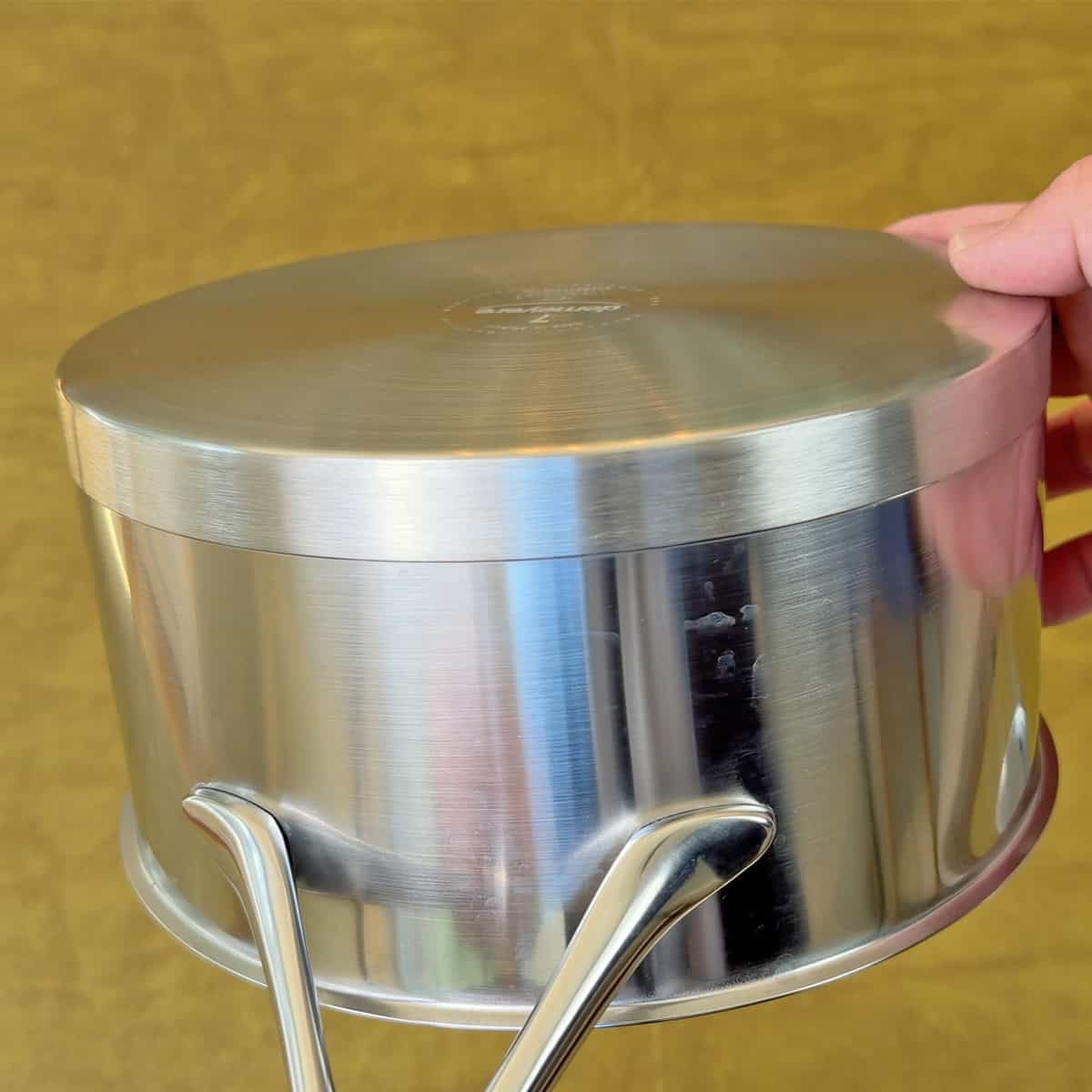
It boiled in 5:15 on electric (3rd fastest) but was slower on induction at 8:27 (10th). The handle reached 78°F after boiling.
It’s tied for the heaviest pan I tested at 4.3 lbs with the lid, and that thick disc makes it extremely bottom-heavy and awkward to tilt. The walls are so vertical that they meet the bottom at almost a 90-degree angle, which makes it the hardest pan to whisk in the corners. The round handle gets slippery with oily hands, and pouring and washing puts a decent amount of strain on your wrist. At 7.75 inches, the handle is also relatively short for such a heavy pan.
The handles are welded on, not riveted. Years ago when I tested the Demeyere Atlantis frying pan, a welded handle broke off during my testing.

Since saucepans are heavy, especially when filled with liquid, I was concerned it would happen again during my shake test. It didn’t, and all of the other welded handles held up fine as well. But welded handles are not indestructible, and if you ever notice one starting to wiggle or loosen, stop using it.
| Pan | Demeyere Atlantis |
| Where It’s Made | Belgium |
| Construction | 7-ply, aluminum core (base only) |
| Capacity | 3 qt |
| Finish | Brushed (two-toned) |
| Weight (without lid) | 3.6 lb |
| Cooking Surface | 7.5 in |
| Wall Height | 4.0 in |
| Handle Length | 7.75 in |
| Helper Handle | No |
| Sealed Rims | No |
| Rivets | Rivetless (welded) |
| Lid Material | Steel |
| Conduction Test | 479°F — 3rd / 13 |
| Distribution Test | -11°F difference — 1st / 13 |
| Boil Time (Electric) | 5:15 — 3rd / 13 |
| Boil Time (Induction) | 8:27 — 10th / 13 |
| Handle Temp Test | 78°F — 3rd / 13 |
| Where to Buy | Zwilling.com |
All-Clad G5
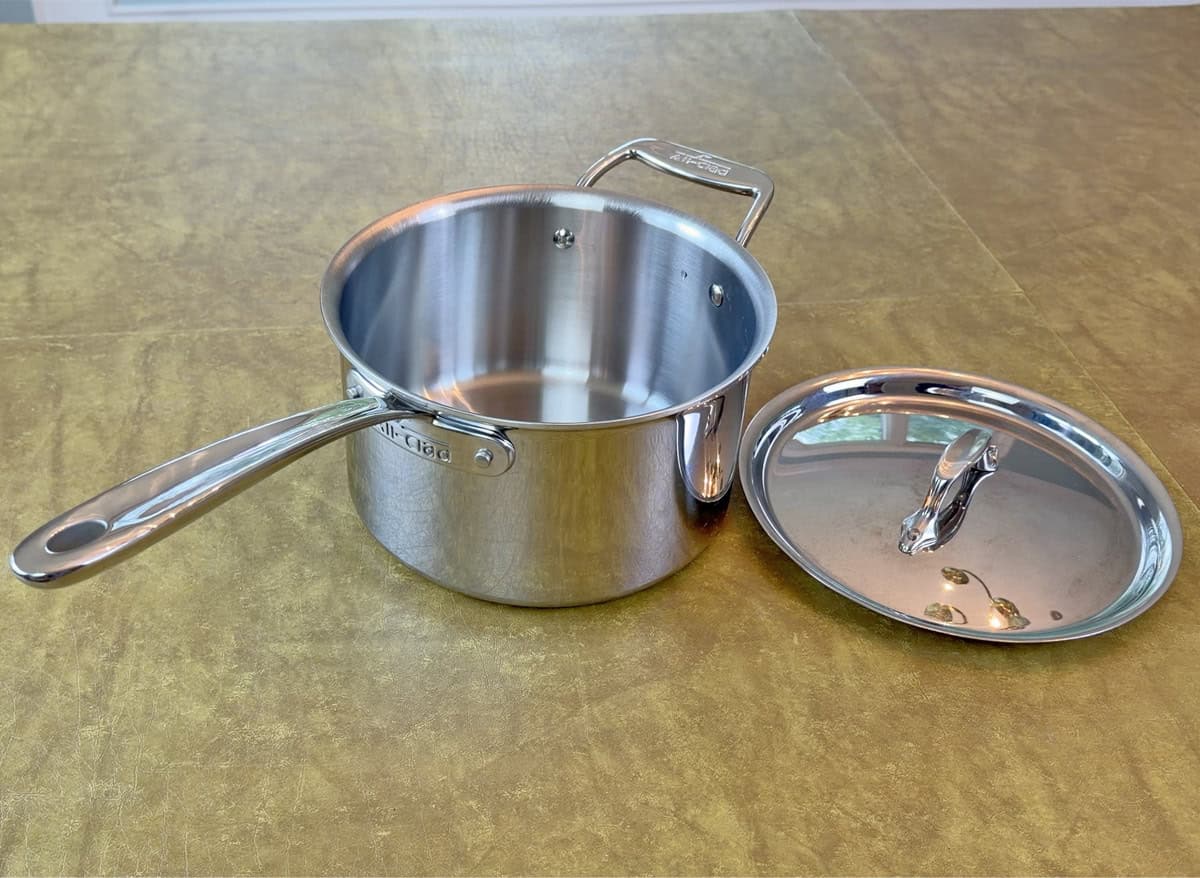
All-Clad G5 is the most expensive saucepan I tested. It’s a 5-ply pan made in the USA with a polished exterior and a perforated graphite disc in the core instead of standard aluminum or copper. Graphite conducts heat faster than copper but weighs significantly less, so the idea is that you get faster heating without as much weight. You can actually see the perforated disc through the cooking surface in certain light, which gives it a unique look.
It has the same handle as the D3 Everyday (subtle groove, comfortable edges) and a large helper handle. It’s a 4-quart pan with 4.8-inch walls, a 7.5-inch cooking surface, and it weighs 3.1 lbs without the lid.
In my heat tests, it reached 461°F in the center with a 60°F center-to-edge gap. It was the fastest pan to boil on electric at 5:01, beating Viking by just one second. But it came in 8th on induction at 8:13, which surprised me. The handle reached 86°F after boiling.
The graphite core did deliver the fastest electric boil time, but the performance gap over pans costing significantly less is small.
| Pan | All-Clad G5 |
| Where It’s Made | Canonsburg, PA, USA |
| Construction | 5-ply, graphite core |
| Capacity | 4 qt |
| Finish | Polished |
| Weight (without lid) | 3.1 lb |
| Cooking Surface | 7.5 in |
| Wall Height | 4.8 in |
| Handle Length | 7.75 in |
| Helper Handle | Yes |
| Sealed Rims | No |
| Rivets | Rivets |
| Lid Material | Steel |
| Conduction Test | 461°F — 5th / 13 |
| Distribution Test | 60°F difference — 6th / 13 |
| Boil Time (Electric) | 5:01 — 1st / 13 |
| Boil Time (Induction) | 8:13 — 8th / 13 |
| Handle Temp Test | 86°F — 11th / 13 |
| Where to Buy | All-Clad.com |
Bottom Line: Which Saucepan Is the Best?
After all that testing, which saucepans are actually worth buying and which ones should you avoid?
If I had to pick one saucepan, it would be the All-Clad D3. It wasn’t the absolute best in every single test. But the handle is the most secure I tested, it stayed the coolest on the stove at 76°F, heat distribution is solid with a 48°F center-to-edge gap, and it performed well on both electric (6:04) and induction (7:48). For a pan you’re going to fill with boiling water and tilt to pour, handle security is the most important feature, and nothing else comes close.
If the D3 handle comfort is a dealbreaker, the All-Clad D3 Everyday gives you the same pan with a more comfortable handle. The groove is subtler and the edges are smoother, but you give up some of that locked-in grip.
Made In is another strong option. It has the tallest walls (5 inches), a large helper handle, the fastest induction boil time (6:23), and the second most even heat distribution (38°F center-to-edge gap). If you cook primarily on induction, Made In deserves serious consideration.
Goldilocks is a great value. It was the second fastest to boil on induction (7:33), has a secure grooved handle, and costs a fraction of the premium options.
The Demeyere Atlantis isn’t for everyone, but if you want the most even heating base (the edge was actually hotter than the center), an extremely thick warp-resistant bottom, and you don’t mind the extra weight (4.3 lbs with the lid), it’s worth considering. Just know the round handle, bottom-heavy balance, and near-90-degree wall angle come with tradeoffs.
On the other end, I wouldn’t buy Caraway, Fissler M5 Pro-Ply, or Legend, mainly because of the rounded, slippery handles. When you’re lifting and tilting a heavy pot of boiling liquid, a secure grip isn’t optional. I like the Viking 3-Ply Classic but the glass lid is a downside and you can only buy it as part of a set. And the All-Clad Copper Core and G5 are both well-made pans, but the performance advantages over the standard D3 are minimal and the prices are significantly higher.
Related Topics
- I Tested 53 Frying Pans: These Are the Best and Worst
- I Tested 31 Stainless Steel Frying Pans: These Are the Best & Worst
- The 9 Best Cookware Brands (After Testing Over 30)
- Best Cookware NOT Made in China: The Definitive Guide
- Nordic Ware vs. USA Pan: Which Sheet Pan Is Better?
- Best Non-Toxic Cookware? I Tested 45+ Healthy Brands
- Best Cast Iron Skillet: I Tested 6 Top Brands to Find the Winner
- Best Sheet Pan? I Tested Nordic Ware, Caraway, Hestan, and USA Pan
- Best Cookware Made in the USA: Top Brands Reviewed

